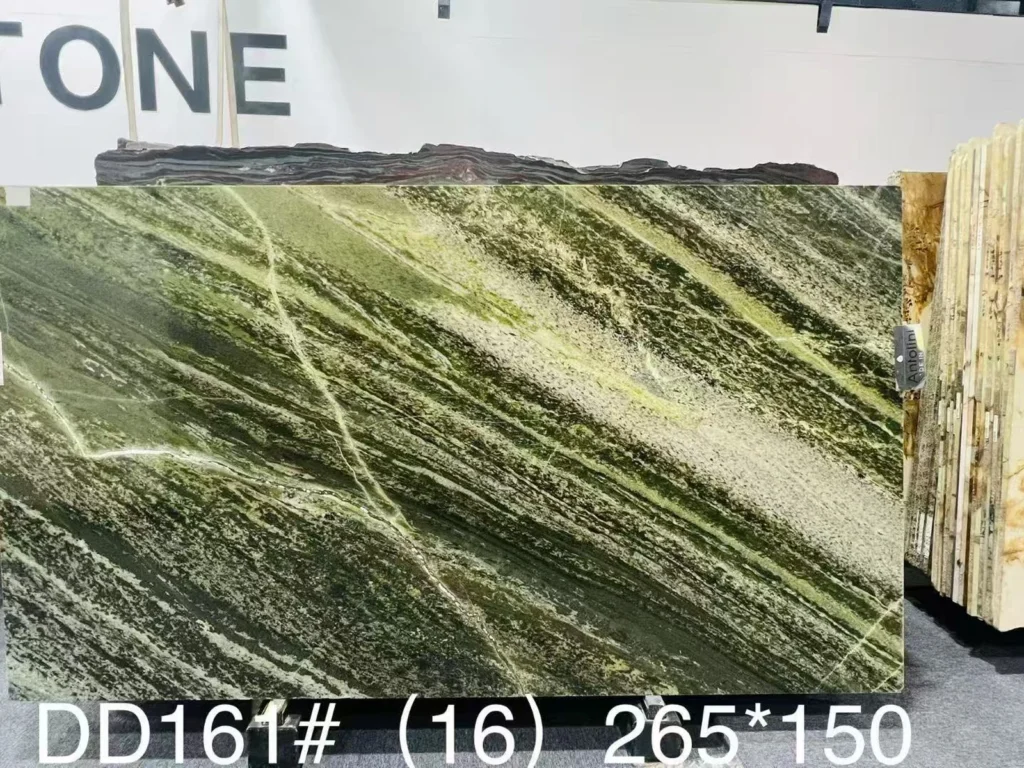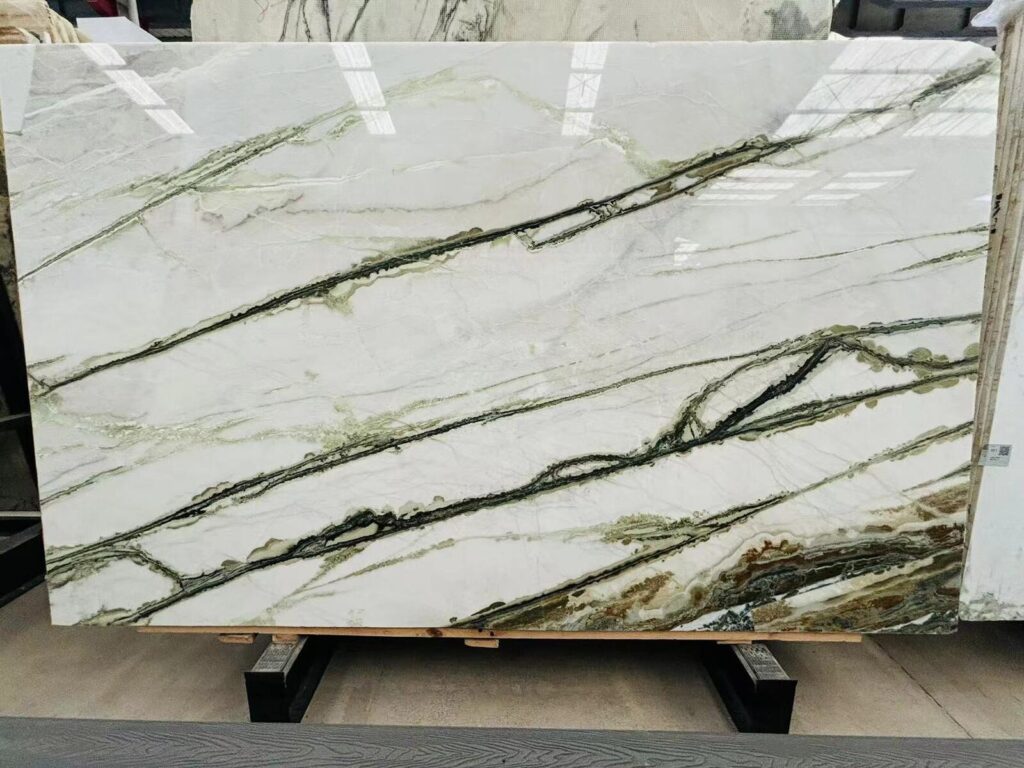


Kurze ZusammenfassungQuartzite Edge Colour should be reviewed separately from the broad slab face. A cut edge exposes the same natural stone from a different direction, and its appearance can change because different mineral structures are being viewed in cross-section. A raw sawn edge may also look lighter or duller than the finished surface because it has not yet received the same polishing sequence. In some Natural Quartzite and other natural-stone slabs, factory resin treatment can deepen the appearance of the polished face, making a newly fabricated edge appear lighter by comparison. Edge profile, polish, light direction, moisture condition, local stone variation, and the exact slab area can also affect the result. If a finished edge is visually important, approve a representative worked edge from the actual material rather than assuming the slab face will predict it exactly.
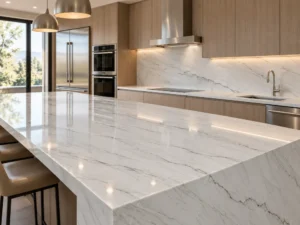
A Natural Quartzite slab looks warm, deep, and polished across its main face.
The fabricator cuts the countertop.
Suddenly the fresh edge appears lighter.
Or slightly greyer.
Or more crystalline.
After edge polishing, the difference becomes smaller—but the edge still does not look exactly like the broad horizontal surface.
Is something wrong with the stone?
Nicht unbedingt.
Farbe der Quarzitkante: Warum eine geschnittene Kante anders aussehen kann als die Oberfläche is fundamentally a question about how a three-dimensional natural material is viewed and processed.
The face and the edge belong to the same stone, but they expose the material in different directions and under different surface conditions.
Understanding that distinction before fabrication can prevent a normal material or finishing difference from becoming an unexpected project dispute.
A stone slab is three-dimensional.
The broad polished face shows one plane through the natural material.
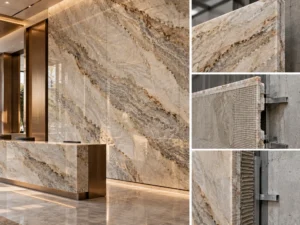
A cut edge shows a cross-section through that same structure.
Those two planes do not necessarily display the minerals in the same way.
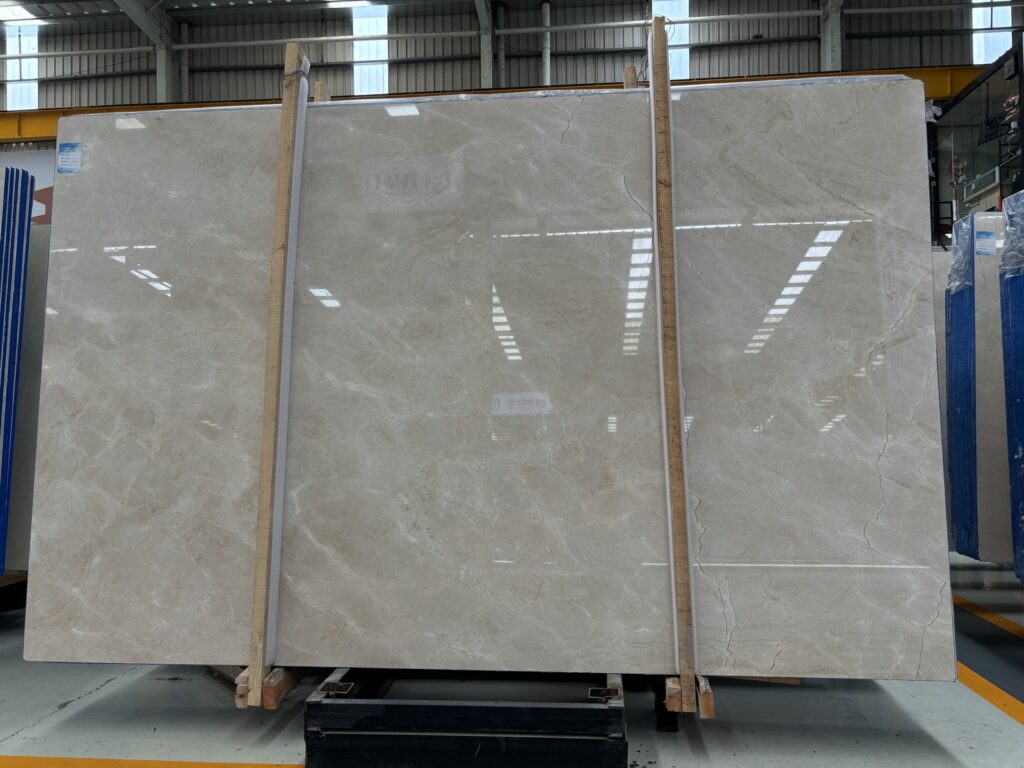
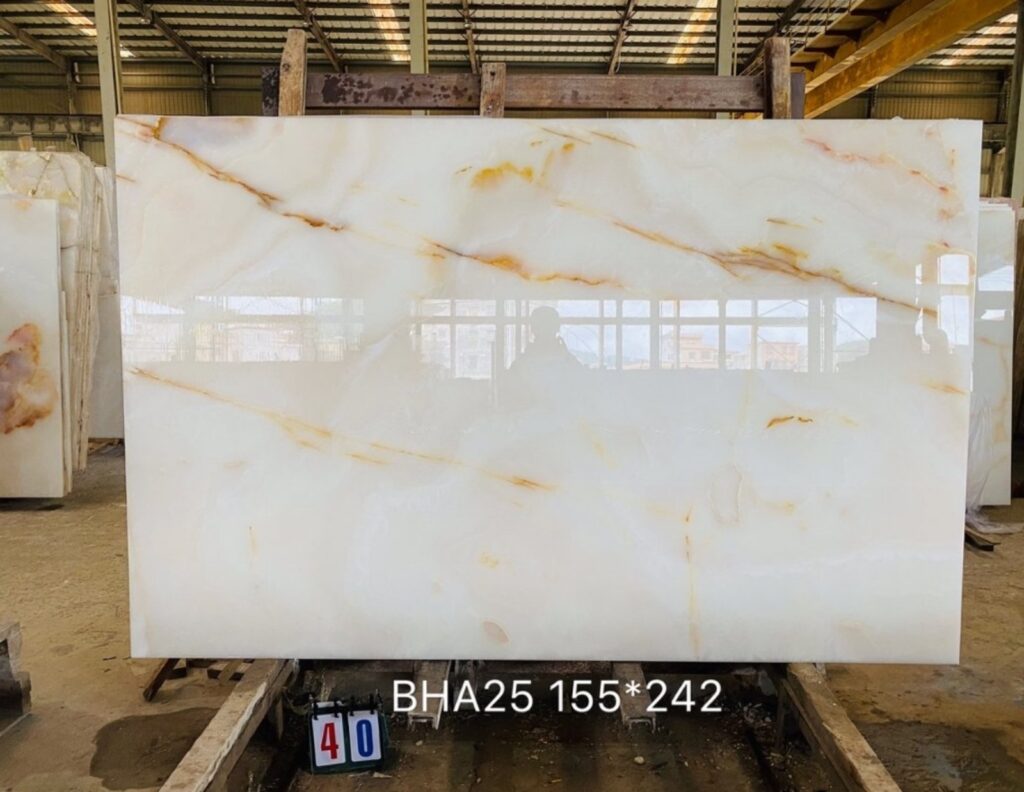
When buyers select Natural Quartzite, they normally look at the large polished slab face.
That view reveals:
The large face is therefore the main reference for slab selection and layout.
Once the slab is cut, the edge intersects the material through its thickness.
A vein that appears as a narrow line on the face may appear as a wider mineral band in cross-section.
A pale crystalline zone may become more visible.
A darker mineral feature may disappear from the edge entirely if it exists only in another part of the slab thickness.
The result can be a legitimate visual difference even though the face and edge come from exactly the same piece of stone.
It is easy to think of natural stone pattern only as a two-dimensional image printed across the top.
Natural Quartzite does not work that way.
Its visual structure exists throughout the material.
That is one reason a worked edge can reveal mineral relationships that were not obvious from the top face alone.
Face-to-Edge Principle
Same Stone ≠ Same Viewing Plane. Broad Face → Mineral Structure → Cross-Section → Finished Edge. A visual difference at the edge does not automatically mean that a different material has been used.
A newly cut stone edge is not necessarily the final visual condition.
Before edge processing, it may be rougher, duller, lighter-looking, or less saturated than the polished slab face.

The polished face reflects light differently from a freshly sawn surface.
A rougher edge scatters more light and may therefore appear visually paler or more matte.
This difference can be especially noticeable on darker or strongly saturated areas of Natural Quartzite.
Do not make the final colour judgment immediately after the saw cut if the finished design requires a polished or otherwise refined edge.
During fabrication, the edge may pass through several abrasive stages before reaching the specified finish.
As the edge becomes smoother, its reflection, clarity, and colour depth can change.
A finished polished edge may move visually closer to the polished face.
However, it may still not become identical because it remains a different viewing plane through the natural stone.
If the main surface is honed, brushed, leathered, or another project-specific finish, the edge should be reviewed according to the intended finished condition.
Do not compare a polished face with an unfinished edge and describe the difference as the final expected colour relationship.
The project’s approved finish should control the comparison.
| Edge Condition | Typical Visual Question | Approval Use |
| Raw sawn edge | Why does it look pale, dull or rough? | Fabrication reference only; not automatically the final visual standard |
| Partially polished edge | Is the colour still developing with the finish? | Process review |
| Finished polished edge | How does the completed edge relate to the face? | Final visual review |
| Honed / other specified edge | Does sheen and texture match the approved finish intent? | Finish-specific approval |
Another important explanation can come from factory slab processing.
Some natural-stone slabs receive resin treatment before final polishing.
The treatment may be used to fill small pits, fissures, or intercrystalline voids and improve the visual finish of the polished surface.
The Natural Stone Institute notes that resin application can make the colour of a treated stone face somewhat darker.
When a countertop is later cut from that slab, the newly exposed edge may not have the same face treatment and can therefore appear lighter than the polished surface.

Do not assume that every Natural Quartzite slab has received the same resin process.
Different stones, suppliers, factories, slab conditions, and production methods can involve different treatments.
The actual slab and available production information should control the project discussion.
A lighter edge can have several possible visual causes:
Do not look at one photograph and automatically conclude that the slab has been heavily resined or that the edge has been fabricated incorrectly.
Industry products exist that are intended to deepen or adjust the appearance of stone edges.
However, Natural Stone Institute guidance specifically notes that such products have not been found to be universally successful for every stone condition.
Therefore, a fabricator should not promise that any colour difference can always be made invisible with a topical product.
If a visual adjustment is being considered, it should be tested on the actual material and approved for the defined project condition before widespread application.
Do Not Jump Straight to “Colour Enhancer”
First identify the cause of the visual difference: raw finish, cross-section, resin-treated face, local stone variation, polishing sequence, or lighting. Only then should any proposed visual adjustment be evaluated on the actual material.
Even when the material and polish are unchanged, edge geometry affects the way light reaches the stone.
A straight edge presents a relatively broad vertical stone surface.
It may therefore show the cross-section clearly, particularly on thicker tops.
A small easing at the upper corner also changes the highlight line where the face turns into the edge.

A bevel introduces another viewing plane.
The bevel catches light differently from both the horizontal face and vertical edge.
On some materials, this creates a narrow bright highlight. On others, a mineral feature passing through the bevel may become more obvious.
A curved profile continuously changes its angle to the light.
The colour may therefore appear to shift across the curve even though the stone itself is unchanged.
This is largely a visual and reflection effect rather than evidence that the profile contains different stone.
A mitred build-up creates another condition.
The visible front is typically formed by another stone face rather than exposing the complete slab thickness as one broad straight edge.
This can create a different visual result from a conventional exposed edge.
However, the mitre introduces a physical joint, pattern relationship, adhesive line, and fabrication detail that require their own approval.
A mitred edge should not be selected only as a way to “hide” an unwanted edge-colour difference without reviewing the complete fabricated detail.
Edges and faces rarely receive light from exactly the same direction.
A countertop face is horizontal.
Its front edge is vertical.
A waterfall return, sink edge, backsplash end, or furniture top may introduce still more orientations.
Each plane reflects the room differently.
A horizontal polished countertop may reflect windows, ceiling lights, or bright ceilings.
The vertical edge may instead reflect cabinetry, flooring, shadows, or the lower part of the room.
This alone can change perceived colour depth.
Side lighting or grazing light can emphasize:
A difference seen only under one extreme reflection angle should therefore be reviewed from normal project viewing positions before it is classified as unacceptable.
Automatic exposure may brighten the horizontal face while leaving the vertical edge darker.
Another photograph may do the opposite.
White balance and reflected surroundings can also change the apparent colour.
Use photographs for traceability and remote coordination, but where an edge appearance is critical, connect them to an identified physical sample or finished piece.
Der Quarzitplatten im aufrechten und im flachen Blickwinkel: Warum sich die Darstellung ändert guide explains the broader principle: the material can remain unchanged while orientation, reflection, lighting, and viewing distance change the way it reads.
One countertop component can contain more than one edge colour.
This can happen when different parts of the perimeter cross different geological zones.

If a dark or warm mineral band reaches the front of the finished piece, the edge may show the cross-section of that band.
A few hundred millimetres away, the same edge may pass through a much paler stone zone.
The result is natural edge variation along one component.
Quartz-rich or crystalline fields can appear more translucent, granular, white, grey, or otherwise different when viewed through the edge.
Do not assume that the complete edge will reproduce one uniform colour sampled from a single point.
If the project contains a highly visible island edge, table top, reception counter, vanity end, or waterfall transition, review where that edge sits on the actual slab.
The cutting position determines which natural zones will reach the exposed edge.
This is particularly useful when:
Edge appearance is therefore partly a slab-layout issue, not only a polishing issue.
A visible condition on the slab face may intersect an edge after cutting.
Its appearance can change once the stone is viewed in cross-section.
Die Baustelle’s Wie man akzeptable Reparaturen in einer Bestellung für natürlichen Quarzit definiert guide explains why conditions along a visible polished edge deserve edge-specific review rather than being accepted or rejected only from the broad slab face.
If a line, fill, or repaired-looking area becomes visible at the edge, record what is actually observed.
Zum Beispiel:
“A visible filled linear area intersects the finished front edge of Piece K-03.”
This is more useful than immediately declaring:
“The edge is cracked.”
or:
“This is harmless.”
Where the technical significance matters, the responsible fabricator or stone professional should review the actual condition.
A filled area may be visually acceptable across a broad horizontal face but become more noticeable at a polished front edge.
Another condition may be visible on the slab but disappear completely during edge trimming.
That is why important visible-edge conditions should be connected to the final cutting layout.
A flat face sample can answer many material questions.
It cannot fully answer edge-colour questions.
Where practical, prepare the worked edge from the actual material selection or a representative piece with comparable natural character and treatment.
If the sample comes from a visibly different stone zone, record that limitation.
A polished straight edge does not prove the appearance of a bullnose, bevel, mitred edge, or other profile.
If the profile is visually important, fabricate the relevant geometry in the sample.
Compare the face and edge under consistent clean, dry conditions.
Do not compare a wet edge with a dry face and interpret the darker wet colour as proof of the final finished appearance.
Position the sample so the viewer can examine both:
Then move the sample under representative project light if lighting is critical.
A useful approval might state:
“Polished straight edge appearance accepted on identified Quartzite sample under reviewed lighting. Approval applies to the defined edge-detail scope and does not automatically approve unrelated slab zones, alternative profiles, refinished areas, or changed material selections.”
This is more precise than:
“Edge approved.”
Edge Approval Sequence
Actual Material → Face Reference → Raw Edge → Intended Edge Profile → Final Edge Finish → Same Lighting → Normal Viewing Distance → Approval Record.
After fabrication, return to the approved project condition.
Do not invent a new edge-colour standard at the end of production.
| QC Check | Was zu prüfen ist |
| Piece identity | Correct piece ID and drawing revision |
| Face | Approved finish and actual natural appearance |
| Kante | Correct profile, finish, polish and visible colour relationship |
| Transition | Face-to-edge consistency under representative viewing conditions |
| Natural / treated conditions | Any identified filled, repaired or visually sensitive areas intersecting the edge |
| Beweise | Complete-piece view plus relevant edge close-up where required |
For remote approval, photographs should show the complete component as well as the edge detail.
An extreme close-up can make a small tonal difference look much more dominant than it will from normal room distance.
Conversely, a distant photograph may hide an edge mismatch that is obvious beside the finished countertop.
Use both scales where the edge is visually important.
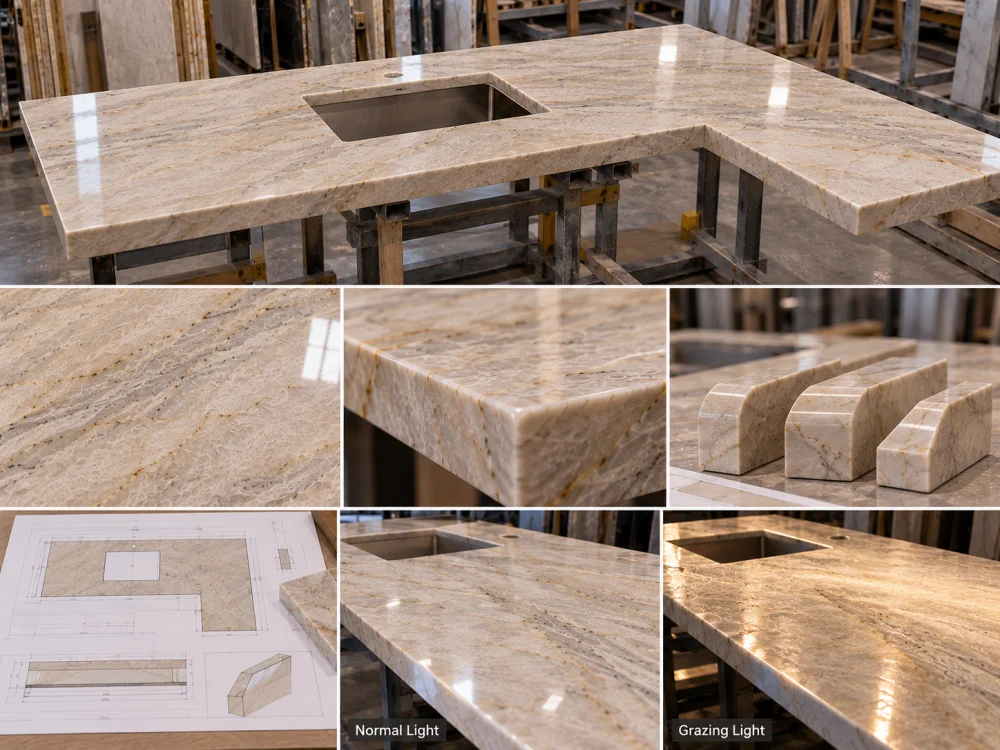
Several factors can contribute. The edge exposes the stone in cross-section, a raw or differently polished edge reflects light differently from the broad face, local mineral zones may vary through the thickness, and some factory resin treatments can deepen the appearance of the polished slab face so a newly fabricated edge appears lighter by comparison.
Not necessarily. Polishing can increase clarity, sheen, and colour depth compared with a raw sawn edge, but the edge remains a different viewing plane through a naturally variable stone. The final relationship should be reviewed on an actual finished edge where colour matching is important.
No. A lighter or different-looking edge does not by itself establish a defect. First compare the edge after the specified finishing process and consider mineral structure, slab treatment, profile geometry, lighting, and the actual slab area. If a technical concern remains, the responsible fabricator or stone professional should review the physical piece.
No universal result should be promised. Natural Stone Institute guidance notes that products intended to darken edges have not been found to be universally successful for every stone. Any proposed visual treatment should be tested on the actual material and approved for the defined project condition.
Yes, it can affect perceived appearance. Straight, bevelled, rounded, and mitred profiles present different surfaces and reflection angles to the viewer. The stone itself may be unchanged while the geometry makes the edge appear lighter, darker, or more reflective.
For visually important edges, it is useful. A worked edge sample can show the intended profile, finish, mineral cross-section, face-to-edge transition, and colour relationship more accurately than a flat face sample alone.
Send Josh the Natural Quartzite material name, current slab reference where available, project drawings, finished dimensions, surface finish, required edge profile, which edges remain visible, photographs of the questioned face and edge under consistent lighting, any known factory treatment or repair information, quantities, and delivery destination. If the appearance is highly sensitive, identify whether an actual worked edge sample is required before full production.
Project Approval SummaryA Quartzite edge should not be expected to reproduce the broad slab face as though the stone were a two-dimensional printed surface. Review the actual material through its thickness, distinguish a raw sawn edge from the final specified finish, consider whether factory resin treatment or local mineral structure contributes to the colour difference, and evaluate the edge under realistic lighting and viewing angles. Where the edge is an important design feature, approve a representative worked sample and carry that reference into final fabrication QC.
For project-based Natural Quartzite countertops, islands, vanities, table tops, waterfall components, and other fabricated pieces, HRST STONE can coordinate actual slab references, visible-edge definitions, edge-profile samples, finish review, CAD/shop drawings, cutting layouts, fabrication photographs, edge QC, piece identification, packing protection, and export documentation according to the confirmed project scope. Send Josh the stone reference, drawings, dimensions, quantities, finish, edge profile, visible-edge priorities, and delivery destination for review.