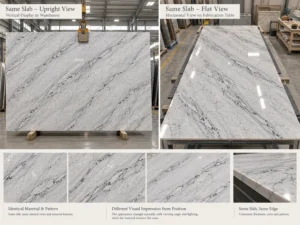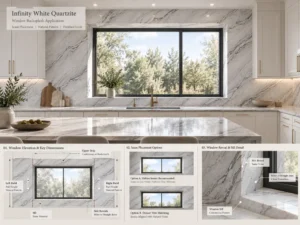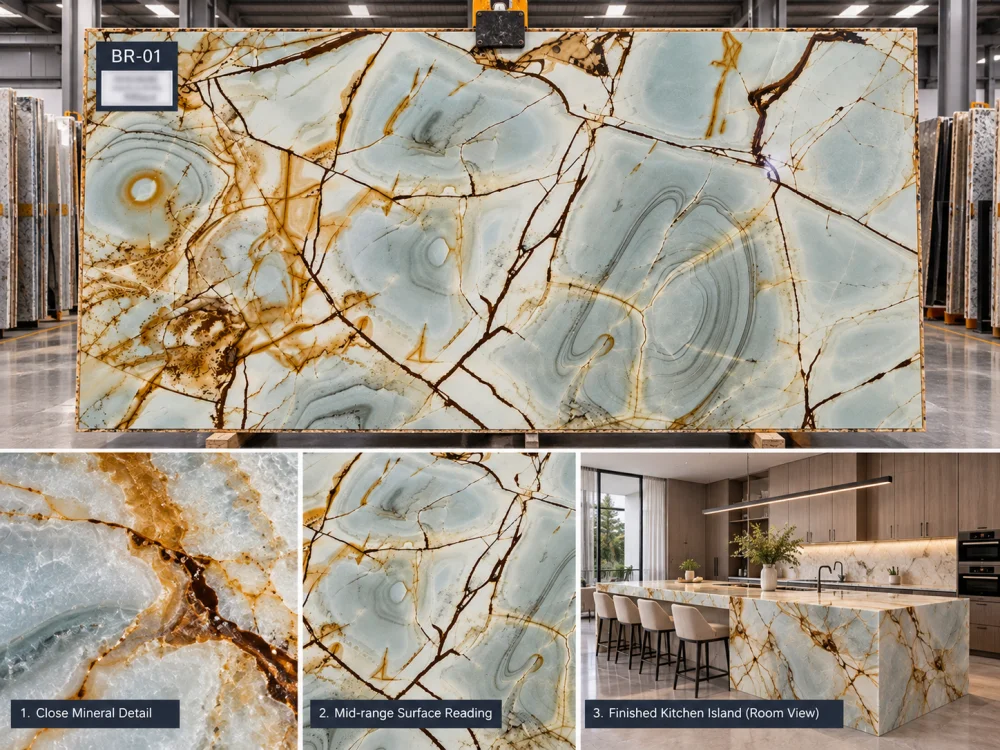
Kurze Zusammenfassung
Die Muster‑ und Maßstabsskala von Quarzit sollte aus mehr als einer Betrachtungsdistanz beurteilt werden. Eine Nahaufnahme kann Kristalle, Risse, Farbverläufe und die Oberflächenbearbeitung sichtbar machen, zeigt jedoch möglicherweise nicht, wie sich die Gesamtbewegung der Platte über eine Kücheninsel, eine Akzentwand, ein Waschtisch oder eine Empfangstheke hinweg darstellt. Prüfen Sie die gesamte Naturquarzitplatte, den vorgesehenen Ausschnitt des fertigen Elements, die wahrscheinlichen Sichtlinien im Raum, die Betrachtungsdistanz, angrenzende Oberflächen sowie die Beleuchtung, bevor Sie die visuelle Ausrichtung freigeben.
Stehen Sie 30 cm von einer Naturquarzitplatte entfernt, können Sie Kristalle, feine Mineraladern, Farbverläufe und einzelne geologische Details erkennen.
Entfernen Sie sich um einige Meter, und viele dieser Details verschwinden.
Nun kann die Platte als eine breite diagonale Bewegung, eine dunkle zentrale Masse, ein ruhiges helles Feld oder eine Abfolge großer kontrastreicher Zonen erscheinen.
Dieser Unterschied ist die Muster‑ und Maßstabsskala von Quarzit in praktischen gestalterischen Aspekten.
Sie erklärt, warum eine kleine Probe zwar schön aussieht, aber nur wenig darüber verrät, wie sich eine große Kücheninsel oder eine Akzentwand aus der Entfernung des Raumes anfühlt.
Naturquarzit sollte nicht nur aus einer einzigen Distanz betrachtet werden.
01 — NAHE ANSICHT
Erkennen Sie Kristalle, feine Mineraladern, lokale Farbveränderungen, die Oberflächenbearbeitung sowie kleinere natürliche Merkmale.
02 — ARBEITSDISTANZ
Betrachten Sie den Stein so, wie jemand eine Arbeitsplatte, einen Waschtisch, eine Bar oder eine Essfläche im normalen Gebrauch erleben würde.
03 — RAUMDISTANZ
Erfassen Sie die dominante visuelle Bewegung, den Kontrast, das Gleichgewicht sowie die Gesamtbeziehung zum Raum.
Ziel ist es nicht, eine universelle Betrachtungsdistanz festzulegen.
Die relevante Distanz ergibt sich aus der konkreten Anwendung und der Art und Weise, wie Menschen den Stein erleben werden.
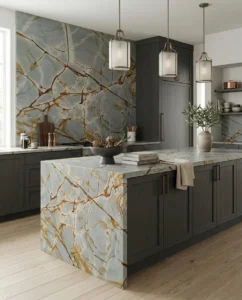
Stellen Sie sich eine Blue Roma Quarzitplatte vor.
Aus nächster Nähe fällt die Aufmerksamkeit auf einzelne kristalline Strukturen, dunkle verzweigte Mineraladern und kleinere Farbverläufe.
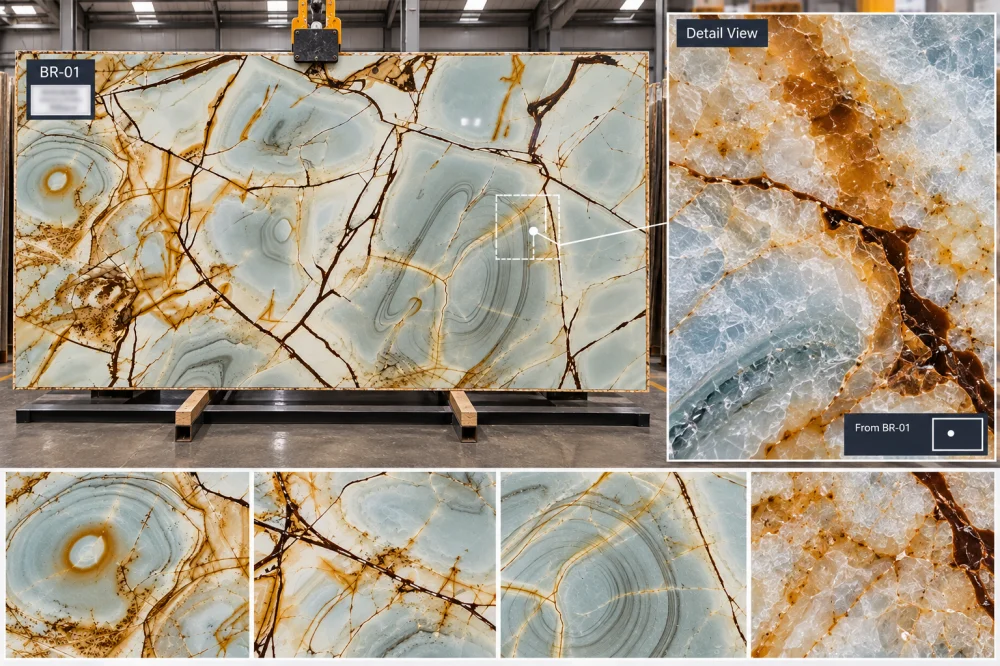
In Arbeitdistanz beginnen diese lokalen Details, sich zu größeren geologischen Gruppen zusammenzuschließen.
Vom Eingang des Raumes aus kann die dominante Wahrnehmung hingegen die Beziehung zwischen breiten blaugrauen Flächen, dunkleren Bewegungen und großen kontrastreichen mineralischen Strukturen sein.
Keine dieser Perspektiven ist zwangsläufig “richtiger” als die andere.
Sie beantworten unterschiedliche gestalterische Fragen.
Eine kleine Probe kann nützlich sein, um Folgendes zu prüfen:
Doch eine kleine Probe kann die Merkmale auslassen, die die vollständige Platte in Raumdistanz definieren.
KLEINE PROBE
Hilft bei der Beantwortung der Frage: Wie sieht und fühlt sich dieser lokale Bereich des Materials an?
GANZE PLATTE
Hilft bei der Beantwortung der Frage: Wie verteilt sich die geologische Bewegung über den verfügbaren Stein?
Aus diesem Grund sollte eine Nahaufnahme die Überprüfung der gesamten Platte unterstützen, statt sie zu ersetzen.
Es folgt ein weiterer Schritt.
Eine komplette Platte mag zwar groß genug sein, um eine Ausstellung im Showroom zu dominieren, während das fertige Projekt nur einen bestimmten Ausschnitt dieser Platte verwendet.
Der Kunde wird die ungenutzten Teile nicht erleben.
Er wird jedoch das fertige Ausschnittstück.
Für die Muster‑ und Maßstabsskala von Quarzit, that transformation is critical.
Suppose a dramatic Patagonia Quartzite slab contains several visually different geological areas.
A kitchen island uses only the central portion.
The correct design question is therefore not simply:
“Do we like this slab?”
Sondern:
“What will this particular part of this slab look like when it becomes this particular island?”
THE CROP TEST
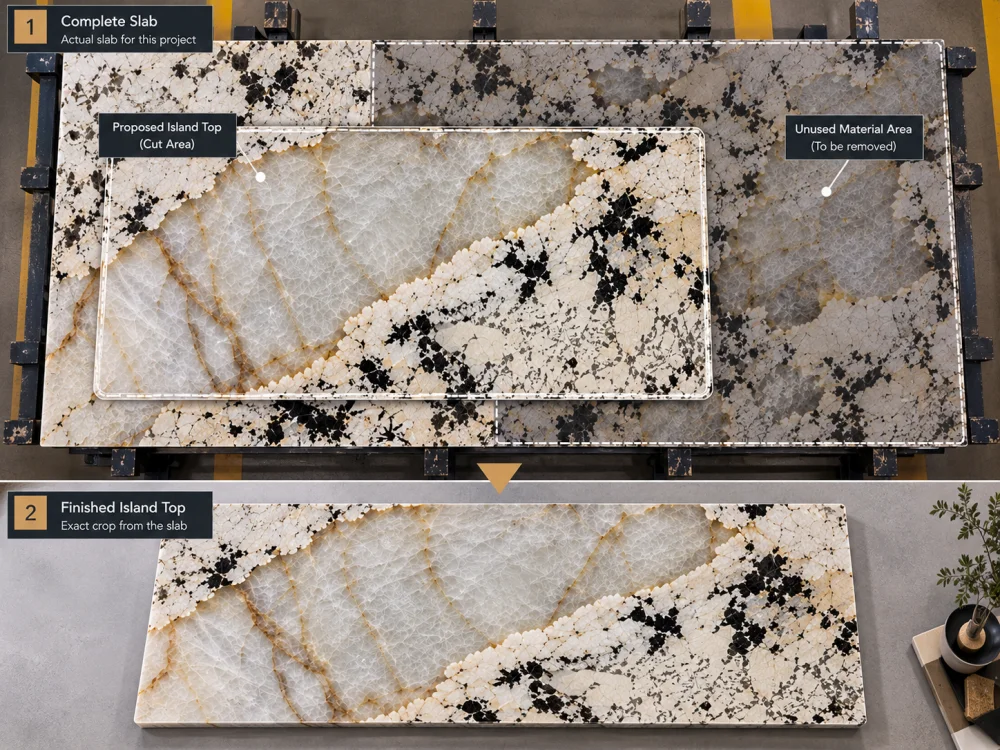
Schritt 1: View the complete identified slab.
Schritt 2: Overlay the actual finished-piece outline.
Schritt 3: Hide or visually reduce the material outside that outline.
Schritt 4: Rotate the crop into its intended installed orientation.
Schritt 5: Review the resulting composition from the likely room view.
Step 6: Decide whether the dominant pattern is positioned where the design intends it to be.
Some Natural Quartzite slabs appear extremely active when viewed closely.
At room distance, many small features visually merge.
The result may become much calmer than the close photograph suggests.
This can happen when:
A close photograph can therefore exaggerate the importance of local detail relative to the installed room experience.
Pattern scale is not only about the physical size of a vein or mineral area.
Contrast matters.
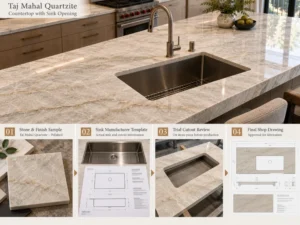
A relatively narrow dark feature crossing an otherwise pale Taj Mahal Quartzite island may become highly noticeable from the entrance to a room.
Meanwhile, a much larger low-contrast tonal transition may disappear into the overall composition.
ROOM-DISTANCE QUESTION
When you stop studying individual stone details, what becomes the first feature your eye reads?
That question is often more useful than asking whether the slab has “large” or “small” veins.
A stone surface does not exist without a viewpoint.
For an island, ask where the viewer is likely to first see it:
For a hotel reception counter, the dominant view may begin much farther away.
For a bathroom vanity, the primary experience may be comparatively close.
For a feature wall, the full composition may be visible immediately on entering the room.
Different applications therefore create different pattern-scale questions.
KITCHEN ISLAND
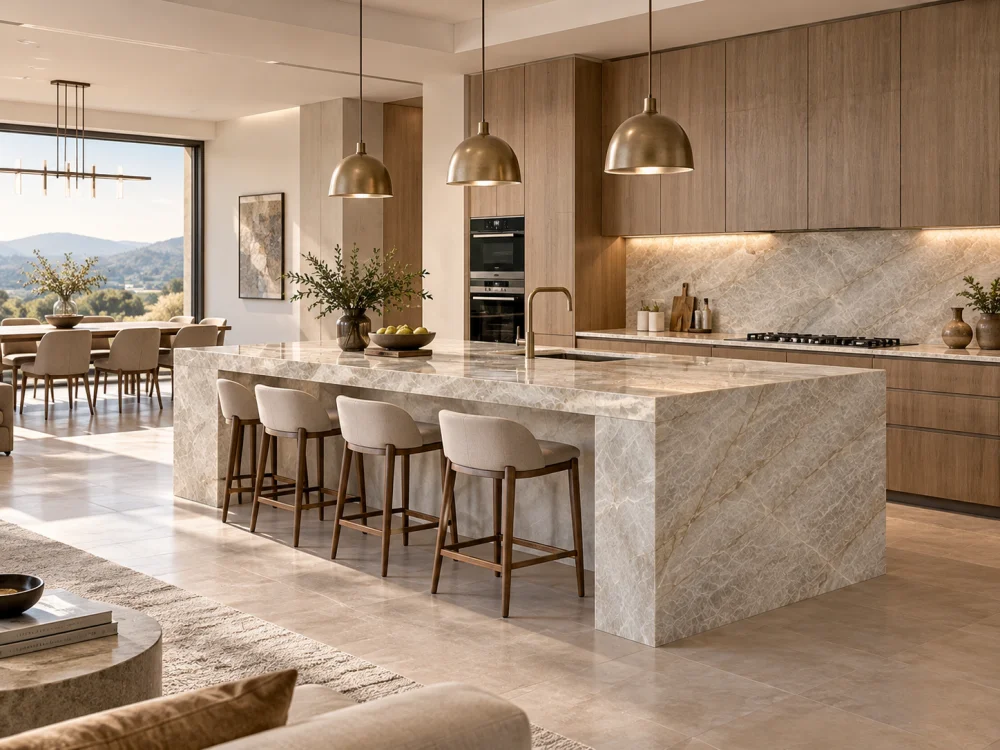
Review both normal working views and longer views from connected living or dining areas.
VANITY
Local pattern and finish may carry greater visual weight because the user is normally closer to the surface.
FEATURE WALL
Large-scale composition can dominate because much of the installation may be visible at once.
HOTEL RECEPTION
Review the stone from the approach path as well as from the counter itself.
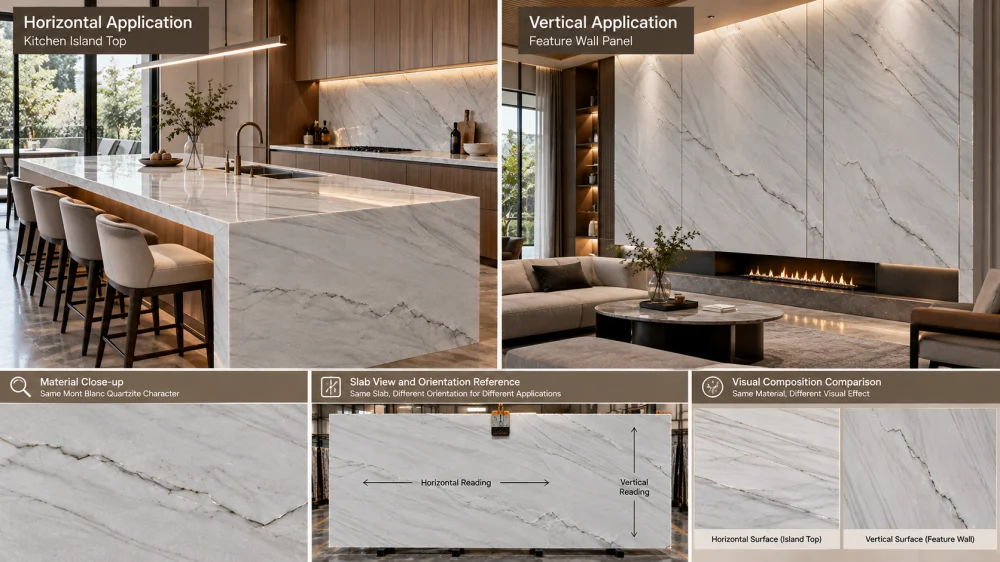
Orientation changes the composition.
A long movement running across a horizontal island may visually lengthen the surface.
The same geological movement used vertically on a wall can create a different visual emphasis.
Waterfall applications add another question because a horizontal surface turns downward into a vertical face.
DO NOT REVIEW ONLY THE FLAT CUTTING PLAN
When the application changes orientation, review the finished faces in the orientation in which the room will actually present them.
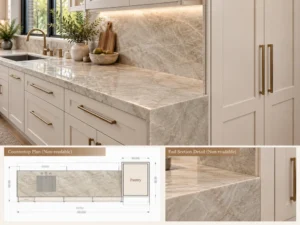
A waterfall island is a useful example.
First, the project needs to understand the relationship between the top and vertical return at the mitred edge.
Second, it needs to step farther back and read the entire object as one composition.
A convincing corner detail does not automatically guarantee that the complete island composition will feel balanced from the main room sightline.
Pattern scale is also relational.
Place the same Quartzite beside quiet warm-white cabinetry and its darker mineral features may become more prominent.
Place it beside strongly grained timber and the visual relationship changes again.
Useful comparisons can include:
The objective is not to make every material match.
It is to understand which element will dominate the composition from the intended view.
Lighting does not create a different slab, but it can change which characteristics are visually emphasized.
Directional light may make surface reflection more noticeable.
Strong side lighting may emphasize certain local transitions.
Different room brightness and surrounding colours can also affect visual perception.
Therefore, avoid using one dramatically lit showroom photograph as the sole basis for approving die Muster‑ und Maßstabsskala von Quarzit.
USEFUL REVIEW SET
Complete slab photograph + closer material detail + proposed finished-piece crop + installed orientation + representative room view + adjacent finish references.
A large-scale pattern is not automatically better than a fine-scale pattern.
A quiet slab is not automatically more suitable than a dramatic slab.
Those are design choices.
Pattern scale describes how the visual structure reads at the relevant size and distance.
The project then decides whether that reading supports the intended design.
This distinction keeps the discussion factual:
Beobachtung: “A high-contrast mineral band becomes the dominant feature when the proposed island crop is viewed from the room entrance.”
Design Decision: “We want that band to remain the focal point.”
The first statement describes what the layout shows.
The second records the project’s preference.
A phone photograph can be useful evidence, but the framing matters.
A close photograph may fill the entire screen with an area that represents only a small percentage of the full slab.
For remote Quartzite selection, request a sequence rather than one image:
Frame 1 — Full Slab: All four slab edges visible.
Frame 2 — Pair / Slab Set: Related slabs shown together where relevant.
Frame 3 — Mid-Range: Enough distance to read major movement.
Frame 4 — Detail: Local mineral structure and finish.
Frame 5 — Proposed Crop: Finished-piece outline shown against the actual slab.
Frame 6 — Room Context: Drawing, elevation or visual reference showing how the finished surface will be experienced.
A rendering can help a customer understand scale.
For example, it can show whether a large dark movement is expected to sit near the center or edge of an island.
But the rendering should remain connected to the actual selected slab.
Do not let a generic digital stone texture replace the real slab photograph.
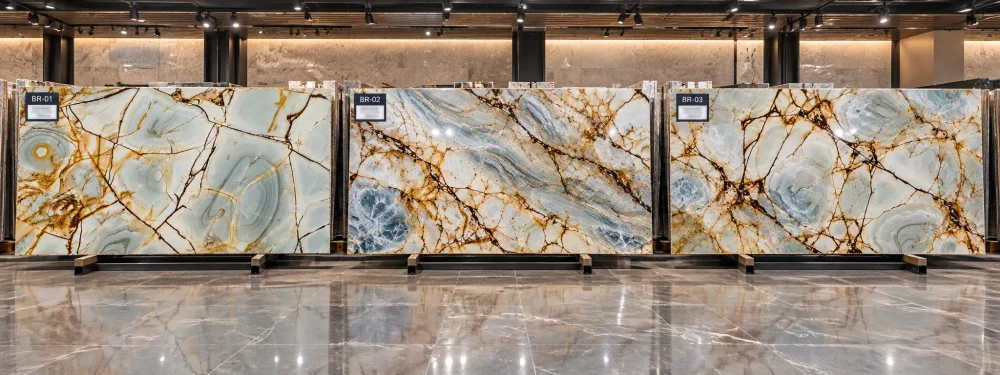
This is particularly important when choosing between several slabs of the same commercial material.
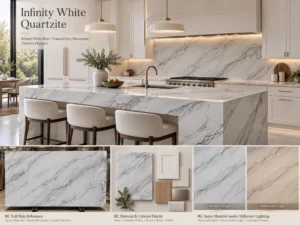
Imagine three slabs that share a similar local colour palette.
At close range, all three may seem acceptable.
From farther away:
Slab A may read as one broad diagonal movement.
Slab B may contain two competing high-contrast areas.
Slab C may read more evenly across its full width.
The close-up details did not necessarily reveal that difference.
The complete composition did.
Once a slab has been selected, the question changes again.
The project is no longer choosing only between slabs.
It is deciding which parts of those slabs become visible finished surfaces.
THE DESIGN QUESTION CHANGES
During Selection:
Which slab composition supports the room?
During Layout:
Which portion of that slab should become each finished piece?
Before Cutting:
Does the proposed crop still create the intended composition from the important room views?
Instead of telling the supplier:
“We want a dramatic slab.”
give a room-based visual priority.
Example 1: “From the living-room entrance, we want the island to read mostly light, with the stronger geological movement concentrated toward the seating end.”
Example 2: “The feature wall should retain the broad central crystalline area because it is visible from across the lobby.”
Example 3: “The vanity will mainly be viewed at close range, so local mineral detail is more important than preserving the full-slab movement.”
Those instructions are much easier to translate into a slab-layout discussion.
If the answer matches the intended design priority, the pattern-scale review has done its job.
If it does not, the project may need to reconsider the slab, finished-piece crop, orientation or relationship with adjacent finishes before cutting.
Die Skala des Quarzitmusters beschreibt, wie sich die Größe, der Kontrast und die Gesamtbewegung des natürlichen Quarzits auf der fertigen Oberfläche sowie aus dem jeweiligen Betrachtungsabstand darstellen. Sie umfasst mehr als nur einzelne Adern oder mineralische Details.
Eine kleine Probe kann lokale Farbnuancen, Oberflächenbeschaffenheit, Textur und mineralische Eigenschaften veranschaulichen, doch sie kann die umfassende geologische Struktur ausblenden, die eine vollständige Platte, Insel oder Wand aus größerer Entfernung dominiert.
Es gibt keinen einzigen, universellen Betrachtungsabstand. Prüfen Sie den Stein aus nächster Nähe, aus einem üblichen Arbeitsabstand sowie anhand der typischen Sichtlinien im jeweiligen Raum, die sich durch die konkrete Anwendung ergeben. Eine Hotelwand, eine Kücheninsel und ein Waschtisch im Badezimmer können jeweils unterschiedliche Abstände für die visuelle Begutachtung erfordern.
Review both. The full slab shows overall geological distribution, while the proposed cut area shows what the customer will actually see after fabrication. The finished-piece crop should also be reviewed in its intended installed orientation.
Nicht unbedingt. Kontrast, Farbe, Ausrichtung, umgebende Oberflächenbeschaffenheiten, Beleuchtung und Betrachtungsabstand können allesamt beeinflussen, welche Merkmale visuell dominieren. Ein relativ kleines, kontrastreiches Merkmal kann mehr Aufmerksamkeit auf sich ziehen als eine deutlich größere, kontrastarme Fläche.
Ein Rendering kann dazu beitragen, den Raumkontext und die Designintention zu vermitteln, sollte jedoch das tatsächlich ausgewählte Plattenbild sowie das vorgeschlagene Schnittmuster nicht ersetzen. Generische digitale Texturen können die jeweilige Platte oder das fertig geschnittene Stück möglicherweise nicht exakt abbilden.
Ja. Prüfen Sie sowohl die lokale räumliche Beziehung am Übergang vom Obergeschoss zum Erdgeschoss als auch die Gesamtkomposition der Insel hinsichtlich wichtiger Sichtachsen der Räume. Eine gute Eckbeziehung und eine ausgewogene Raum‑Entfernungs‑Komposition sind miteinander verbunden, jedoch unterschiedliche visuelle Aspekte.
Senden Sie Josh die ausgewählten Plattenreferenzen, Vollplattenfotos, Projektzeichnungen, Abmessungen der Fertigteile, das vorgeschlagene Layout, die vorgesehene Ausrichtung, wichtige Raumansichten, angrenzende Oberflächenreferenzen sowie die visuelle Priorität, die der fertige Stein gemäß Ihren Vorstellungen erreichen soll.
Review the Stone at the Scale of the Finished Room
HRST STONE can coordinate full-slab photographs, selected board references, CAD/shop drawings, proposed cutting layouts, visible-face orientation, project finish references and pre-fabrication visual review for Natural Quartzite orders. For pattern-sensitive islands, walls, vanities, reception counters and custom stone furniture, send Josh the actual slab references, finished dimensions, drawings and important room sightlines so the layout discussion can remain tied to the selected material.
© HRST STONE / XIAMEN HRST STONE CO., LTD. Alle Rechte vorbehalten.