Ausschnitte für Quarzitspülen: Warum Eckdetails der Genehmigung durch den Fabrikanten bedürfen
Post navigation
Kurze Zusammenfassung
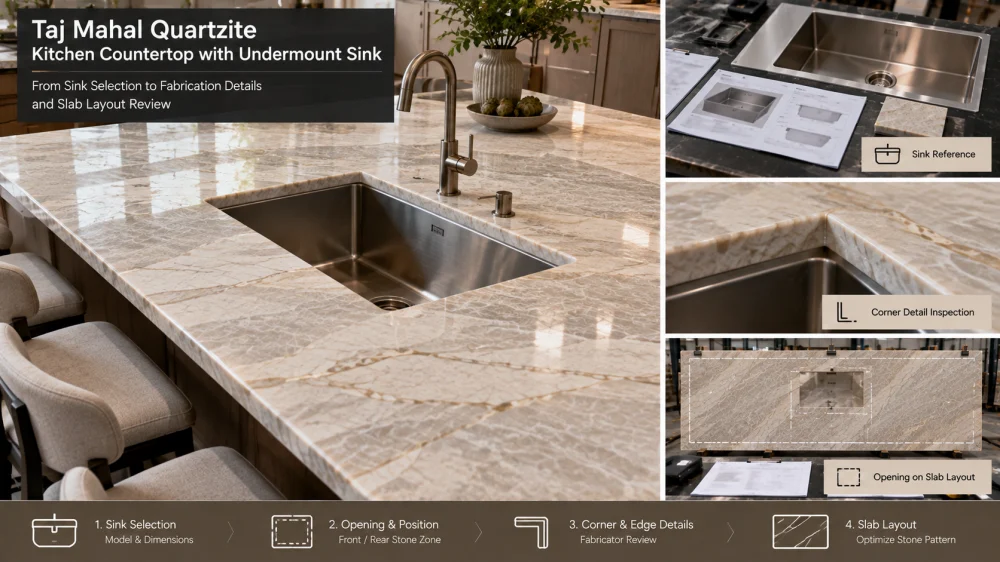
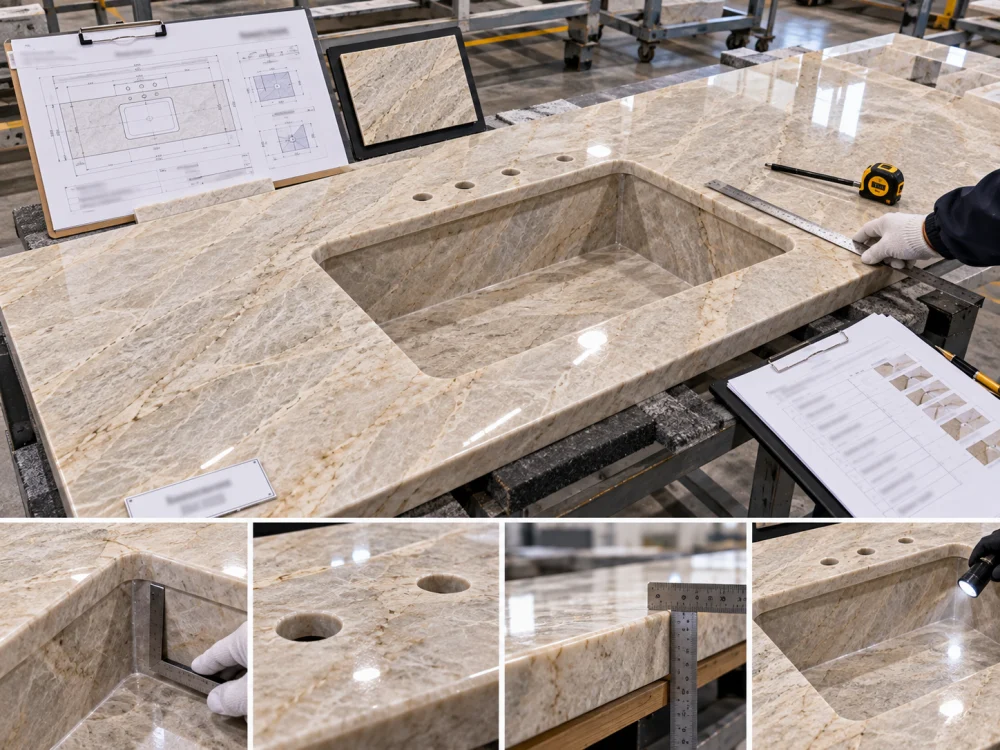
Ausschnitte für Quarzit-Spülen sollten nicht lediglich anhand eines generischen Eckradius oder einer ungefähren Spülenabmessung festgelegt werden. Der verantwortliche Verarbeiter benötigt das aktuelle Spülenmodell, Herstellerangaben oder eine genehmigte Schablone, die Montageart, die Anforderungen bezüglich des Ansatzes, die Arbeitsplattenzeichnung, das tatsächliche Plattenlayout, die Geometrie der benachbarten Steine, die Anforderungen an sichtbare Kanten, den Stützrahmen sowie weitere projektspezifische Fertigungsinformationen. Die Eckgeometrie ist Teil der gesamten Öffnung – kein isolierter Wert, der einfach aus einem anderen Projekt übernommen werden sollte.
Ein Käufer betrachtet möglicherweise eine Arbeitsplattenzeichnung und stellt eine scheinbar einfache Frage:
“Welchen Radius sollen wir an den Spülen-Ecken verwenden?”
Bei natürlichem Quarzit sollte diese Frage in der Regel zusammen mit den konkreten Projektinformationen an den zuständigen Verarbeiter weitergeleitet werden.
Der Grund liegt nicht darin, dass Eckdetails geheimnisvoll wären. Vielmehr handelt es sich bei einer Spülenöffnung um eine komplex miteinander verbundene Fertigungsbedingung.
Das Eck befindet sich innerhalb einer Öffnung. Diese Öffnung wiederum liegt innerhalb eines Arbeitsplattenbauteils. Dieses Bauteil stammt aus einem bestimmten Bereich einer natürlichen Platte und steht in Wechselwirkung mit der Spüle, den sichtbaren Kanten, den Armaturlöchern, den nahegelegenen Fugen, den Stützbedingungen sowie den Handhabungsanforderungen.
Wenn man all diesen Kontext außer Acht lässt und nur eine universelle Eckgröße fordert, kann dies aus einer projektspezifischen Fertigungsentscheidung eine ungestützte Regel machen.
Betrachten Sie zuerst den gesamten Ausschnitt, bevor Sie sich dem Eck widmen
ANATOMIE EINER SPÜLENAUSSENDECKUNG
01 — Spüle
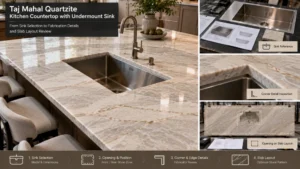
cristallo-quartzite-sink-cutout-corner-detail
Genauer Hersteller, Modell und Produktversion.
02 — Montagebedingung
Untertisch-, Oberflächen- oder bündig montierte Ausführung, Vorhangfront-Anordnung oder ein anderes projektspezifisches System.
03 — Öffnung
Die tatsächliche Geometrie des Steinausschnitts, abgeleitet aus den genehmigten Fertigungsinformationen.
04 — Ecken
Eckgeometrie als Teil der vollständigen Öffnung, nicht als isoliertes Detail.
05 — Sichtbare Schnittkante
Besonders relevant, wenn eine Untertisch-Montage die gefertigte Öffnungskante freilegt.
06 — Umgebender Stein
Frontschienen, Rückenschienen, Seitenbereiche sowie der verbleibende Stein rund um nahegelegene Löcher, Fugen oder Kanten.
07 — Tatsächliche Plattenposition
Die Lage des gesamten Arbeitsplattenbauteils und der Öffnung innerhalb der ausgewählten natürlichen Quarzitplatte.
Dies ist die nützliche Bewertungsskala für Quarzit-Spülenausschnitte.
Die Gesamtspülengröße ist nicht gleich der Größe des Steinausschnitts
Einer der häufigsten Fehler besteht darin, eine Gesamtspülenabmessung zu erhalten und sie als Öffnung der Arbeitsplatte zu betrachten.
GESAMTSCHÜSSELGRÖßE
Beschreibt die äußeren Abmessungen des Spülengehäuses, des Randes, des Flansches oder einer anderen vom Hersteller definierten Produktgröße.
STEINAUSCHNITT
Definiert die Öffnung, die gemäß den genehmigten Spülen- und Projektinformationen tatsächlich im Quarzit gefertigt wird.
Diese sollten nicht automatisch als identische Maße angesehen werden.
Insbesondere bei einer vom Eigentümer bereitgestellten Spüle sollte das Fertigungsteam die genauen Produktinformationen erhalten, statt aufgefordert zu werden, eine unwiderrufliche Öffnung aus einem Foto, einer ungefähren Kataloggröße oder einem generischen Spülen-Symbol abzuleiten.
Für Projekte, bei denen die Spüle separat vom Stein erworben wird, siehe den entsprechenden Leitfaden unter Quarzit-Aufträge mit vom Eigentümer gelieferten Spülbecken für das umfassendere Spezifikationspaket, das vor der Fertigung abgestimmt werden sollte.
Warum das Eck nicht isoliert betrachtet werden kann
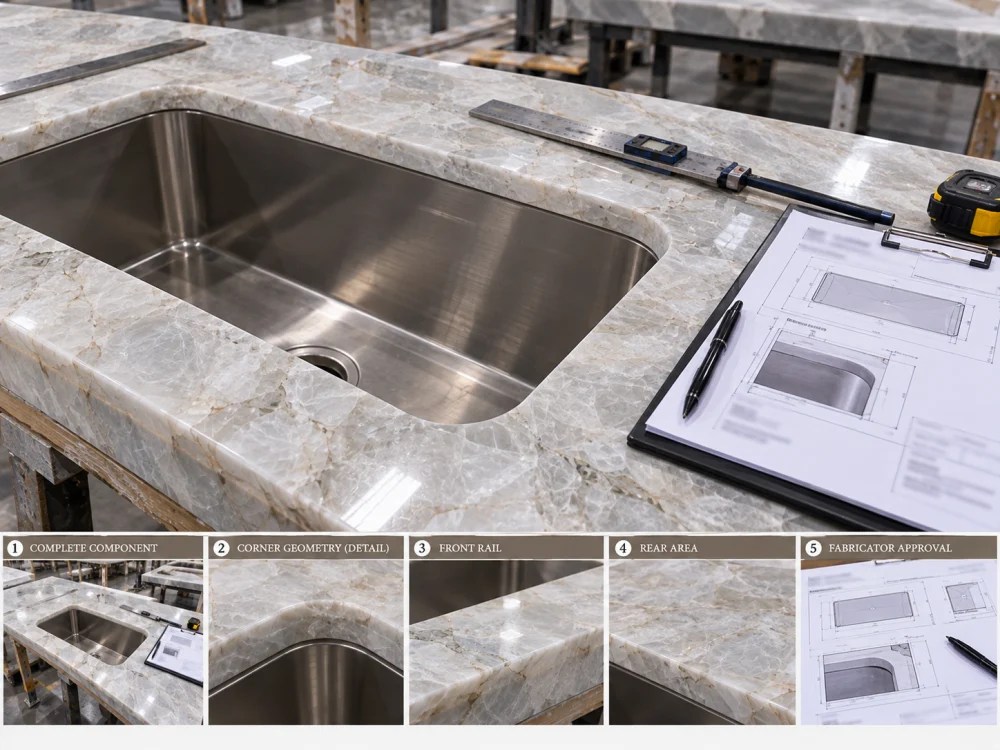
Stellen Sie sich vor, Sie zoomen in eine Ecke einer Untertisch-Spülenöffnung hinein.
Das Eck selbst mag wie ein kleines geometrisches Detail erscheinen, doch der Verarbeiter muss dessen Beziehung zu mehreren umliegenden Bedingungen berücksichtigen.
Nahegelegene Bedingung
Warum sie in die Überprüfung gehört
Spülen-Schablone
Definiert die beabsichtigte Öffnungsbeziehung für die tatsächliche Spüle, statt einer ungefähren Form.
Ansatz
Ändert die sichtbare Beziehung zwischen der Spülen-Schüssel und der fertigen Steinausschnittöffnung, sofern zutreffend.
Front-/Rückstein
Die Öffnung hinterlässt um sich herum verbleibenden Stein; diese Geometrie sollte als Teil des gesamten Bauteils überprüft werden.
Armatur-/Zubehörlöcher
Weitere Öffnungen können innerhalb derselben Arbeitsplattenzone entstehen.
Nahegelegene Fuge oder Kante
The sink opening should be reviewed in the geometry of the finished component, not as a floating shape.
Natural stone condition
The proposed cutout position should be reviewed against the actual selected slab where material features are relevant.
Corner Radius Is Not a Universal Quartzite Number
A buyer may search for a single recommended minimum radius for every Natural Quartzite sink opening.
This article deliberately does not provide one.
Fabrication Boundary
The appropriate corner geometry should be reviewed by the responsible fabricator against the actual sink information, opening geometry, material, countertop component, machining approach, surrounding stone, support and installation context. A number used on another project should not automatically become the specification for the current one.
The buyer’s job is therefore not to invent a radius.
The buyer should make sure the fabricator receives enough controlled information to make and approve the project-specific fabrication decision.
The Cutout Has Four Corners, but They Do Not Exist in Isolation
On a drawing, it is tempting to focus on C1, C2, C3 and C4 as four identical geometric points.
In the real countertop, their surroundings can differ.
C1 — Front Left
Review in relation to the front stone section, side condition and actual slab position.
C2 — Front Right
Review in relation to the front stone section and any nearby edge, seam or project feature.
C3 — Rear Right
Review together with rear stone geometry, faucet or accessory openings where applicable, and the surrounding layout.
C4 — Rear Left
Review using the same controlled project information and actual component geometry.
The C1–C4 labels are only a communication device. They do not prescribe a fabrication method or imply that different radii are required.
The benefit is that a reviewer can say “check the condition near C3” instead of sending an ambiguous cropped photograph.
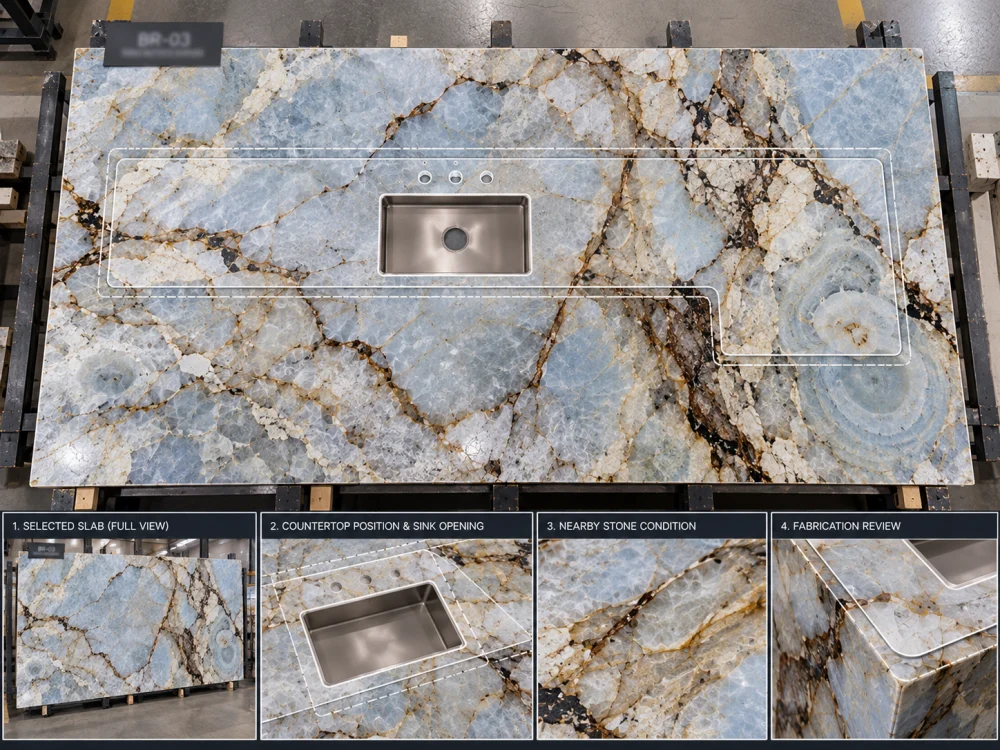
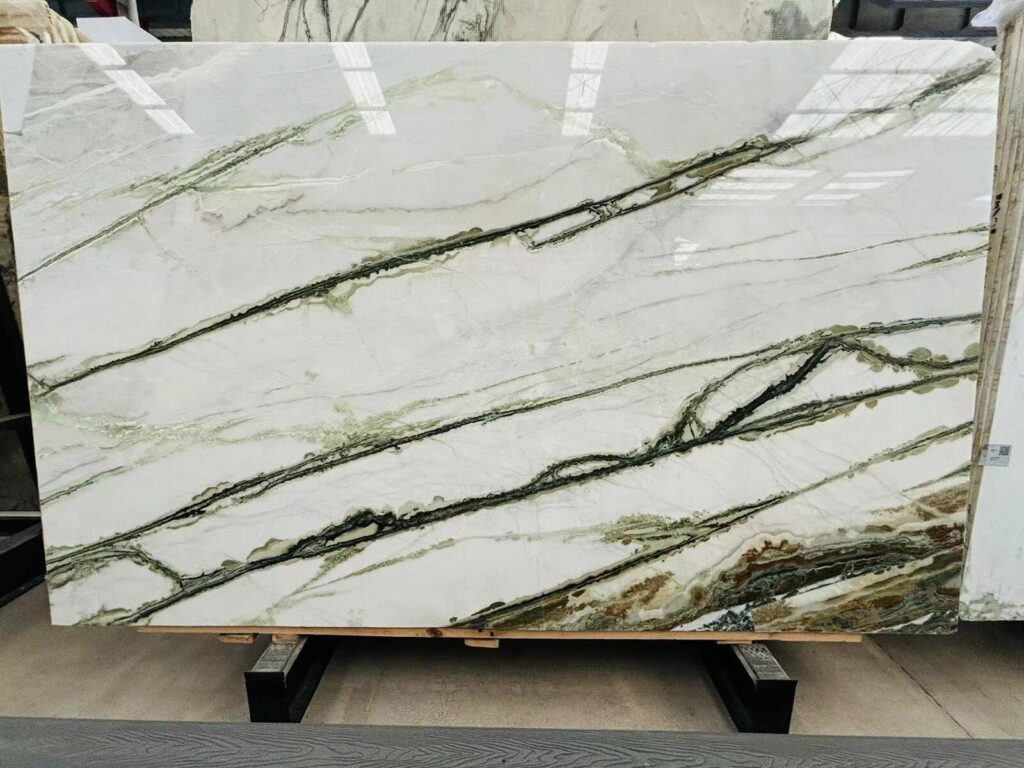
Natural Stone Makes Slab Position Relevant
Natural Quartzite is not a visually or structurally uniform manufactured sheet.
cristallo-quartzite-sink-cutout-corner-detail
The selected slab can contain changing mineral structures, natural fissures, crystalline areas, tonal transitions and other geological features.
That does not mean every visible feature is a defect.
It does mean that the sink cutout should be considered within the actual slab layout when the material condition is relevant to fabrication.
Identified Natural Quartzite slab + proposed finished countertop outline + actual sink cutout position + nearby stone conditions + current drawing revision.
What If a Natural Feature Passes Near a Sink Corner?
Do not classify the condition from a photograph alone and do not automatically assume the entire slab must be rejected.
First locate the feature relative to the finished geometry.
A useful technical review can distinguish:
Condition outside the finished piece
The area may not remain in the fabricated countertop.
Condition inside the finished piece but away from the opening
Its relevance should be reviewed against the actual application and project requirements.
Condition near the sink opening, narrow stone area, seam or other critical geometry
Escalate it to the responsible fabricator for project-specific review before cutting.
This same location-based principle is useful when reviewing repairs or other documented slab conditions: the meaningful question is not only what the condition looks like, but where it falls in relation to the finished component.
The Sink Opening Must Follow the Current Drawing Revision
Consider this sequence:
Drawing R01
Preliminary sink position
↓ Sink Model Changes
↓ Drawing R02
Updated opening information
↓ Layout Review
↓ Drawing R03
Current fabrication proposal
If R03 is current, a screenshot from R01 should not quietly remain the cutting instruction.
This is especially important because the change may affect more than the opening itself. It can affect the countertop layout, faucet-hole position, surrounding stone geometry, slab nesting and other coordinated details.
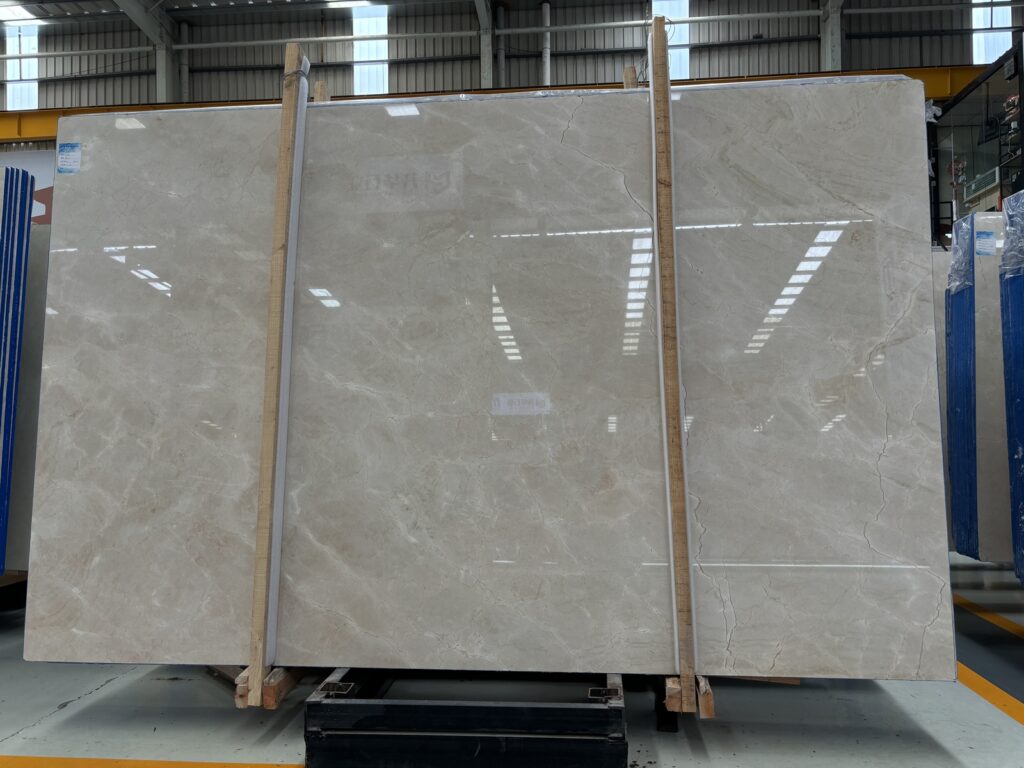
Undermount Sinks Add a Visible Edge Question
With an undermount sink, part of the cut opening may remain visible after installation.
blue-roma-quarzit-spülen-aussparung-plattenlayout
The project therefore needs more than an opening outline.
Depending on the approved design and sink system, the fabrication information may need to identify:
the intended reveal relationship;
which cut surfaces remain visible;
the required finish of those visible surfaces;
corner appearance;
sink alignment; and
other applicable interface details.
“Undermount sink” alone does not completely define the finished stone opening.
Watch the Stone That Remains Around the Opening
The opening is only one part of the geometry.
The remaining Quartzite matters too.
FRONT ZONE
Stone between the sink opening and the finished front edge.
REAR ZONE
Stone behind the opening, potentially interacting with faucet and accessory holes.
SIDE ZONES
Stone between the opening and countertop ends, seams or adjacent conditions.
BETWEEN OPENINGS
Stone remaining between a sink and another opening where the design includes more than one cutout.
This is another reason not to specify a sink corner independently from the complete countertop geometry.
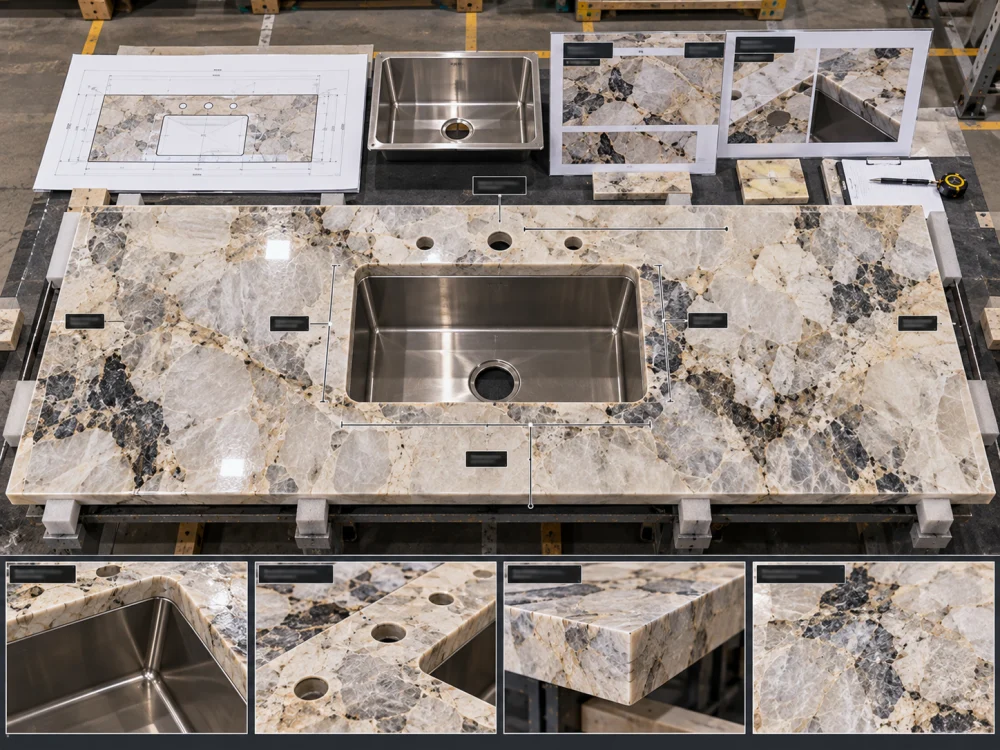
Faucet Holes Belong on the Same Coordination Drawing
A sink opening may be approved correctly while a nearby faucet or accessory hole is still missing, outdated or incorrectly positioned.
Where applicable, coordinate:
faucet model information;
number of holes;
hole locations;
soap dispenser or accessory openings;
Beziehung zum Spülbecken;
backsplash or rear-edge relationship; and
cabinet / installation interfaces.
The objective is to review the countertop as one fabricated component rather than approving each opening in isolation.
The Fabricator Approval Gate
Instead of giving buyers a universal corner specification, use a controlled release gate.
DO NOT RELEASE THE SINK OPENING UNTIL THE PROJECT HAS RESOLVED THE APPLICABLE INPUTS
Interfaces: Relevant cabinet, support or site information
Bestimmungsort: Project delivery location for quotation and logistics coordination
HRST can then coordinate the confirmed information into the shop drawing and fabrication review instead of asking the factory to interpret a sink photograph or approximate opening.
FAQ
1. Why do Quartzite sink cutout corners need fabricator approval?
Da die Ecke Teil der gesamten Spülenöffnung und der fertigen Arbeitsplattengeometrie ist, sollte der verantwortliche Fertiger vor dem Zuschneiden die konkreten Angaben zur Spüle, die Öffnung, den umgebenden Stein sowie die Lage der Platte – soweit relevant –, das Bearbeitungsverfahren, die Stützung und weitere projektspezifische Fertigungsbedingungen prüfen.
2. What corner radius should be used for a Quartzite sink cutout?
Für jede Arbeitsplatte aus natürlichem Quarzit gibt es keinen universellen Radius, den diese Anleitung vorschreiben könnte. Die geeignete Eckgeometrie ist vom verantwortlichen Verarbeiter unter Berücksichtigung der jeweiligen Spüle, der zugelassenen Öffnungsmaße sowie der Material- und Projektbedingungen zu bestimmen.
3. Is the overall sink size the same as the Quartzite cutout size?
Nicht automatisch. Die Gesamtabmessungen der Spüle beziehen sich auf das Spülenprodukt, während die Steinaussparung die in der Arbeitsplatte ausgeführte Öffnung definiert. Verwenden Sie für die tatsächliche Spüle die entsprechenden Herstellerangaben oder die genehmigten Projektunterlagen, anstatt eine Gesamtabmessung unmittelbar in eine Schnittanweisung umzurechnen.
4. Does an undermount sink require a finished Quartzite cut edge?
Ein Unterbau kann dazu führen, dass ein Teil der vorgefertigten Öffnung sichtbar bleibt. Das Projekt sollte daher die gewünschte Sichtkante sowie die Anforderungen an die sichtbare Oberfläche festlegen, während der verantwortliche Fertiger das jeweils zutreffende Fertigungsdetail bestätigt.
5. Should the sink cutout be checked against the actual Quartzite slab?
Wenn slabenspezifische natürliche Merkmale oder Layoutbedingungen die vorgesehene Arbeitsplatte beeinflussen können, kann eine Überprüfung der Öffnung anhand der tatsächlich ausgewählten Platte dem Verarbeiter helfen, die fertige Geometrie vor dem Zuschneiden zu beurteilen.
6. Can a sink rendering or product photograph be used for final Quartzite cutting?
Ein Rendering oder ein Foto kann die Designabsicht vermitteln, sollte jedoch nicht die für die tatsächliche Öffnung erforderlichen, kontrollierten Fertigungsinformationen ersetzen. Verwenden Sie das exakte Spülenmodell, aktuelle technische Informationen, gegebenenfalls die genehmigte Schablone sowie die aktuelle Arbeitsplattenzeichnung.
7. What happens if the sink model changes after the cutout drawing is approved?
Die Öffnung ist vor der Fertigung erneut zu prüfen. Ersetzen Sie nicht einfach den Modellnamen der Spüle, während Sie weiterhin eine Öffnung oder Zeichnung verwenden, die für ein anderes Produkt zugelassen ist.
8. What should I send HRST STONE for a Quartzite sink cutout review?
Senden Sie Josh die Referenzen zu den Materialien und Platten aus natürlichem Quarzit, die aktuelle Arbeitsplattenzeichnung, die fertigen Abmessungen, den genauen Hersteller und das Modell der Spüle, die technischen Unterlagen oder das entsprechende Schablonendokument, die Montageart, die Anforderungen an die Sichtkante, die Bohrungen für Armaturen und Zubehörteile, die Anforderungen an sichtbare Kanten, die relevanten Schnittstellen sowie den Lieferort.
Project-Specific Cutout Coordination
HRST STONE can coordinate selected Natural Quartzite slabs, CAD/shop drawings, sink information, cutting layouts, fabrication records, QC photographs and export packing around the confirmed project scope. For irreversible sink openings, the current approved fabrication information should remain identifiable before cutting begins.
Hi, I am the author of this article. I have been working in the field of Natural Stone for more than 15 years. If you need customized Natural Stone services, please feel free to contact me.