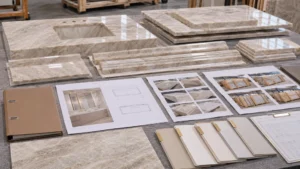
Quartzite factory-to-site handover should preserve one traceable chain from the approved natural stone and fabrication drawings to the finished pieces, crates and site locations. A useful handover package is not simply a folder containing photographs and PDFs. It should allow the receiving team to identify what was supplied, which drawing revision controlled fabrication, where each important piece is packed, what QC was completed, what remains open, and which documents should be used during receiving and installation.
أ quartzite handover document index is a controlled list of the drawings, schedules, inspection records, photographs and logistics documents used to transfer project information from stone selection and fabrication through delivery and site installation.
The exact index should match the project.
A single residential vanity package may need only a compact set of drawings, QC photographs and packing information. A hotel, villa, apartment development or commercial feature wall may require hundreds of individually identified pieces distributed across multiple rooms, crates and shipments.
The principle remains the same: important decisions should remain connected to the physical pieces after they leave the factory.
Natural stone projects generate information at several different stages.
The architect may issue design drawings. The buyer approves slabs. The stone factory develops cutting drawings. Production creates individual pieces. QC photographs document finished work. Packing reorganizes those pieces into transport groups. Logistics introduces crate and shipment references. Finally, the site team needs to convert everything back into room locations and installation sequence.
If those stages use unrelated numbering systems, traceability can disappear even when every individual document looks professional.
For example, the factory may know a countertop as Piece K-07 while the packing list describes only “Crate 3 — kitchen stone.” The site drawing may identify the same component only by room elevation.
If an installer opens Crate 3 and finds several similar quartzite pieces, the missing connection between these records creates unnecessary interpretation on site.
A stronger system preserves the relationship:
Approved Slab → Cutting Drawing → Piece K-07 → QC Record → Crate 03 → Kitchen Location
The document index tells each participant where the evidence for that chain can be found.
Its purpose is to tell the next team which documents exist, which revision is current, what each document controls and how the information connects to the physical quartzite pieces.
A practical handover package can be divided into document groups rather than storing every file in one undifferentiated folder.
| Index Group | Typical Documents | السؤال الرئيسي المُجاب عليه |
| 01 — Project Control | Project reference, document index, release status, key contacts | Which information controls this handover? |
| 02 — Material Identity | Material name, slab references, full-slab photographs, finish | Which physical quartzite was used? |
| 03 — Approved Drawings | Final shop drawings, elevations, cutting layouts, sections | What was the approved fabrication basis? |
| 04 — Piece Register | Piece IDs, sizes, finish, room or location, orientation | What is each finished component? |
| 05 — Factory QC | Measurements, surface checks, edge QC, cutout checks, photographs | What was checked before packing? |
| 06 — Layout / Dry Lay | Dry-lay overview, sequence photographs, layout approval where required | How do related pieces fit visually or sequentially? |
| 07 — Packing | Packing list, piece-to-crate schedule, packing photographs | Where is each piece during transport? |
| 08 — Shipment | Shipment references and loading records relevant to handover | Which transport movement contains the material? |
| 09 — Site Receiving | Receiving inspection, discrepancy record, crate-opening evidence | What actually arrived? |
| 10 — Completion Records | Installed-location record, final photographs, remnant or spare-piece register | What should remain after installation? |
Not every project needs every document type.
The index should be proportional to the complexity of the stone package. The important requirement is that omitted records are omitted intentionally rather than because nobody knew who should prepare them.
The handover package should begin with the physical stone identity.
Recording only the commercial material name is often insufficient for a natural quartzite project because individual slabs can vary in tone, movement, mineral distribution and usable geometry.
Where specific slabs were reserved and approved, preserve their board or slab references.
The material section can include:
This information becomes particularly useful when a site team later asks why two installed pieces look different or when a replacement is required years after completion.
A controlled slab reservation should therefore transition into fabrication records rather than disappear once cutting begins.
The handover package should make the final fabrication basis easy to identify.
Earlier drawing revisions may remain valuable as design history, but the installer should not need to compare several nearly identical PDFs to determine which dimensions were actually used for production.
The index should identify the current handover drawing as one of the following, depending on the project’s terminology:
The exact naming convention can vary.
What matters is that the revision, date and status are controlled.
Natural Stone Institute terminology describes a shop drawing as a detailed fabrication and installation drawing that can communicate layout, dimensions, materials, finishes, joinery and other information needed for fabrication or installation.
For a quartzite handover, that makes the final shop drawing one of the most important bridge documents between the factory and the installation team.
Factory QC photographs can show valuable physical evidence, but they should not become a substitute for dimensional drawings.
A photograph may show that a vanity top contains one sink cutout and a polished front edge.
The approved drawing should still control:
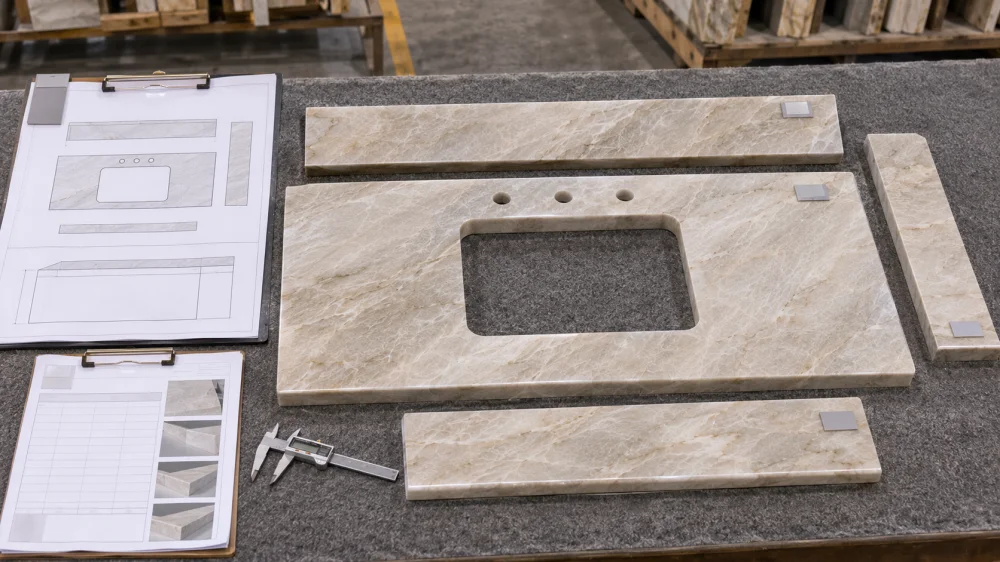
Use photographs to prove condition and configuration. Use drawings to control geometry.
The piece register is one of the most valuable documents in a multi-component quartzite project.
It acts as the central translation between the drawing, physical stone, QC record, packing list and room location.
A useful register can include:
| المجال | Example Purpose |
| معرّف القطعة | Stable identity used through fabrication, QC and packing |
| Drawing Reference | Connects the physical component to approved geometry |
| Room / Area | Identifies intended installation location |
| Component Type | Countertop, wall panel, threshold, vanity, stair or other piece |
| الحجم النهائي | Provides receiving and QC reference |
| Finish / Visible Edge | Confirms visible fabrication requirement |
| Orientation / Sequence | Supports vein direction and adjacent-piece installation |
| QC Status | Shows whether the piece passed, was reworked or remains open |
| Crate ID | Allows site staff to locate the physical component |
The exact codes do not need to follow one universal format.
The important rule is that the piece ID should remain stable.
If Piece W-14 is called W-14 on the cutting drawing, it should not become “Panel 7” during QC and “Stone B” on the packing list unless a controlled cross-reference explains the change.
Use one stable piece reference wherever practical and carry it through the drawing, QC record, dry-lay review, packing list and installation-location schedule.
The site team does not necessarily need every internal production checklist created by the factory.
The handover package should contain the QC evidence that helps confirm the supplied work and interpret the finished pieces at destination.
Depending on the project, useful QC records can include:
The record should make exceptions visible.
If a piece was reworked after the first QC photograph, the handover should not present the superseded photograph as though it represents the final shipped condition.
The final record should correspond to the condition released for packing.
Dry-lay evidence is useful when multiple pieces depend on sequence, orientation or visual continuity.

It may be particularly valuable for:
A useful dry-lay record should show the full relevant sequence rather than only close-up beauty photographs.
Piece references should connect the dry-lay arrangement to the drawings.
If the installation sequence is important, the same relationship should continue into packing.
على سبيل المثال:
Dry Lay Sequence 01–12 → Piece IDs W01–W12 → Crates 04–05 → Site Elevation A
This helps prevent a factory-approved visual sequence from being lost during packing and reconstructed incorrectly at destination.
The packing list should be more than a commercial count of crates.
For a project stone package, it can function as a location tool for the site team.
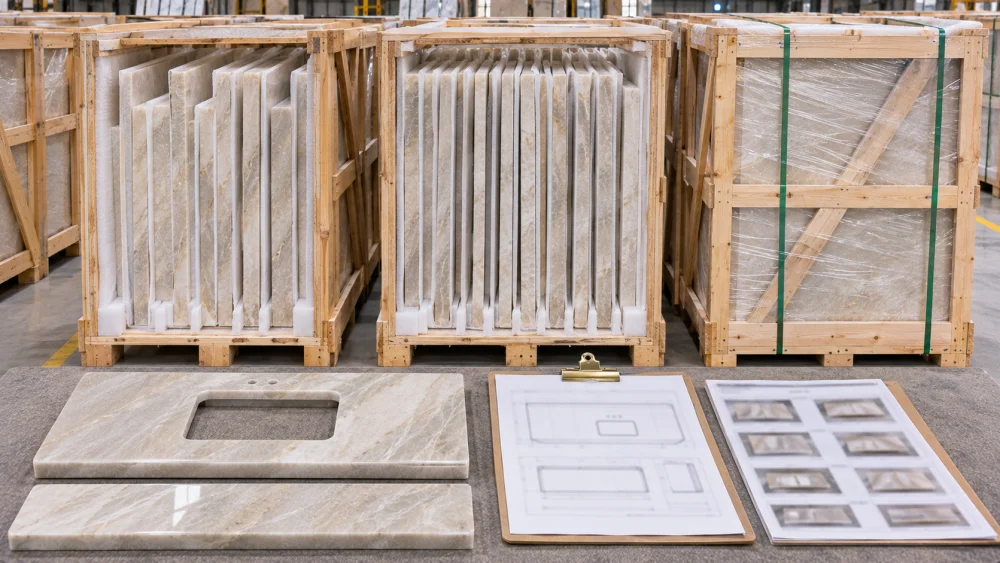
A practical packing schedule can identify:
The handover index should also identify the associated packing photographs where those records were required by the order.
For fragile or complicated components, the photographs may show the finished piece before packing, internal supports, vulnerable-edge protection and the closed crate.
This allows the receiving team to compare the arrival condition with the factory release condition without mixing those photographs with unrelated production images.
The factory handover should not end when the container or truck leaves the loading area.
The document package should prepare the site team to receive the material.
Before arrival, the receiving party should be able to answer:
How many crates are expected?
Which pieces belong in each crate?
Which crates should be opened first?
Which components belong to which room?
Which drawing should be used to check them?
What should be photographed before packaging is discarded?
Which condition should trigger a discrepancy report?
If the shipment contains several phases or containers, the handover should also distinguish them clearly.
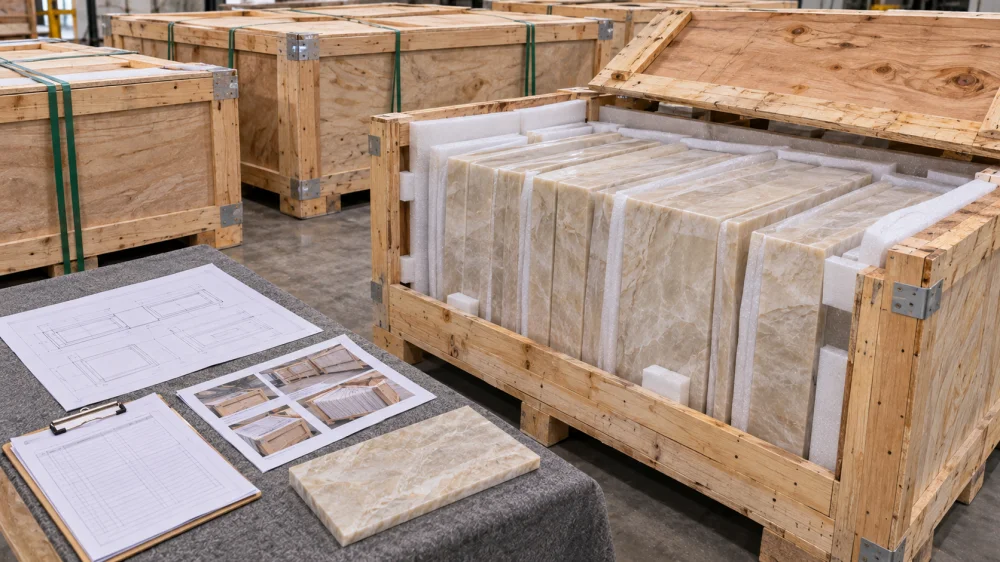
A simple site receiving record can track:
Shipment → Crate → Piece → Arrival Condition → Disposition
Possible dispositions may include:
Do not discard packing evidence before documenting a suspected transport issue.
Likewise, do not treat an unopened damaged crate as proof that every stone component inside it is damaged. Record the condition and proceed through a controlled inspection.
A document index loses much of its value if it contains several versions of the same file without identifying which one controls the work.
Each important document should therefore carry enough information to distinguish it from previous versions.
A compact index can contain:
Document Number → Document Title → Revision → Date → Status → Prepared By → Handover Relevance
| Index Field | ما أهمية ذلك |
| Document Number | Provides a stable reference independent of file-name changes |
| Title | Explains what the document controls |
| المراجعة | Distinguishes current and superseded information |
| التاريخ | Supports chronology and review history |
| الحالة | Shows whether the document is approved, final, for reference or still open |
| Source / Owner | Identifies responsibility for the information |
Do not create a false universal vocabulary for document status. A contractor may use different codes from an architect, developer or stone supplier.
Use the project’s agreed document-control convention and explain it in the index where necessary.
Do not leave the revision only in an email while the handover index continues pointing to an obsolete drawing.
The following structure can be adapted to residential, hospitality and commercial quartzite projects.
00 — Handover Index
00-01 Master Document Index
00-02 Handover Status / Open-Item Register
00-03 Project Contact and Responsibility Reference
01 — Material
01-01 Approved Material Reference
01-02 Slab / Board Register
01-03 Full-Slab Photographs
01-04 Material Substitution Record, if applicable
02 — Drawings
02-01 Final Shop Drawing Set
02-02 Final Cutting Layouts
02-03 Relevant Sections and Details
02-04 Piece Location / Elevation Drawings
03 — Piece Register
03-01 Finished-Piece Schedule
03-02 Piece ID to Drawing Cross-Reference
03-03 Room / Zone Allocation
04 — Factory QC
04-01 Dimensional QC
04-02 Finish and Edge QC
04-03 Cutout / Drilling QC
04-04 Final Piece Photographs
04-05 Rework / Exception Records where applicable
05 — Dry Lay / Visual Sequence
05-01 Dry-Lay Overview
05-02 Piece Sequence Reference
05-03 Approved Visual Arrangement where required
06 — Packing
06-01 Master Packing List
06-02 Piece-to-Crate Register
06-03 Internal Packing Photographs where required
06-04 Closed-Crate Record
07 — Shipment
07-01 Shipment Reference
07-02 Container / Vehicle Allocation where relevant
07-03 Loading Record
08 — Site Receiving
08-01 Receiving Checklist
08-02 Arrival Condition Photographs
08-03 Quantity / Damage Discrepancy Register
08-04 Hold / Release Record
09 — Completion
09-01 Installed-Location Record
09-02 Completion Photographs
09-03 Spare Piece / Remnant Register where applicable
09-04 Final Project Record
This structure is a template, not a mandatory international standard.
A project should remove irrelevant folders and add contract-specific records rather than generating documents merely to make the index look complete.
A strong handover system should not disappear after the installers leave.

The final project archive can support future repairs, extensions and replacement orders.
Useful completion information may include:
This does not guarantee that an exact quartzite match will be available years later.
Natural stone varies, original slabs may have been consumed, and installed surfaces can change visually through use, maintenance, refinishing and lighting.
However, a complete archive gives the future project team a much stronger starting point than a commercial material name and several old phone photographs.
There is no single document that replaces all others. The master index is useful because it identifies the current records, while the final shop drawings, piece register, QC evidence and packing list connect the physical quartzite to fabrication and site installation.
No. Include the photographs that provide useful project evidence, such as selected slab references, final QC, dry-lay sequence, packing condition and other agreed checkpoints. Internal duplicate or superseded photographs do not need to make the final package harder to use.
For multi-piece project work, using the same stable piece references across drawings, QC, packing and site-location records greatly improves traceability. If different numbering systems must be used, provide a controlled cross-reference.
No. A packing list explains what is inside each transport package, but it normally does not replace the approved shop drawing, piece-location drawing, installation sequence or other project-specific technical information.
Earlier revisions may be retained as project history if required, but they should be clearly identified as superseded and separated from the current installation basis. The handover index should make the latest applicable revision unambiguous.
When sequence, vein direction or visual relationships matter, yes. The useful dry-lay record should connect visible pieces to stable piece IDs so the approved relationship can be recreated during installation.
Send the selected quartzite, project drawings, piece schedule, quantities, finish requirements, required QC checkpoints, dry-lay requirements where applicable, packing and labeling requirements, site or room allocation information, destination and any required document-control format. Define the required handover records before packing so the necessary evidence can be collected while the work is still visible.
Keep the physical identity, approved geometry, piece number, QC status, crate location and site destination connected. Make the current revisions obvious, record open items separately, and preserve the final package after installation for future matching or replacement work.
Buyer Next Step: Define the required document index before final QC and packing so the factory knows which records must be completed before shipment release.