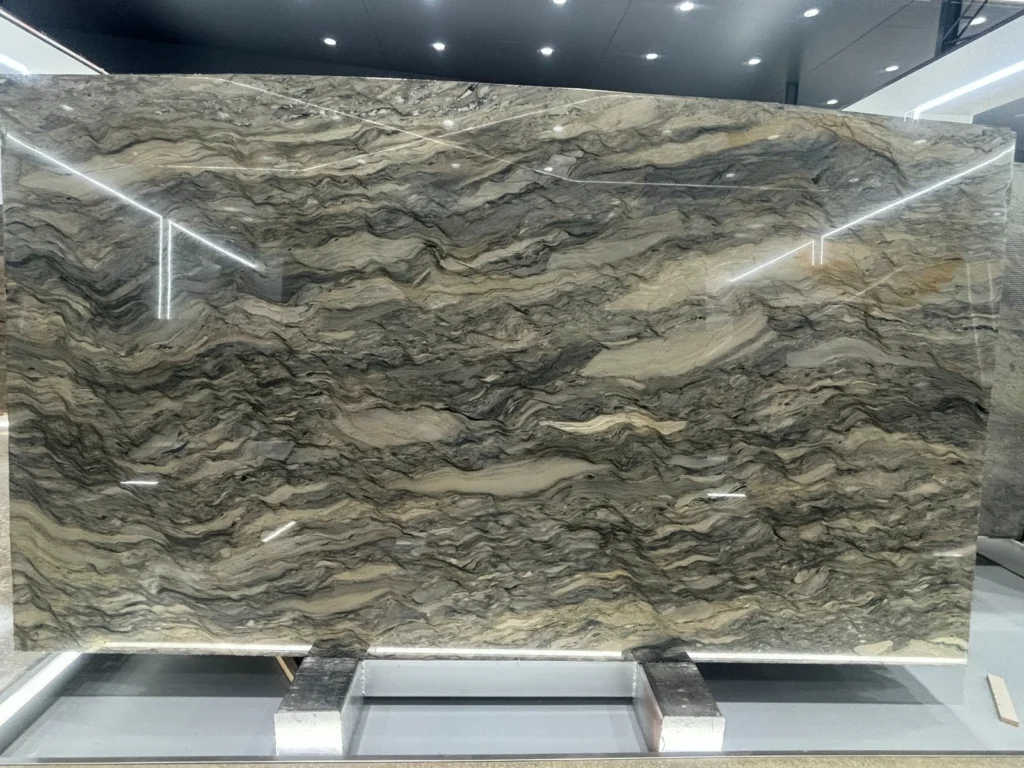


Quartzite hearth extensions and vertical fireplace surrounds should be specified as two separate stone supply items, even when they use the same natural Quartzite. A hearth extension is a horizontal area associated with the fireplace front and potentially with required floor protection. A vertical surround forms the facing around the fireplace opening. Their dimensions, exposed edges, substrates, thermal requirements, handling and installation interfaces differ. Before quoting or cutting stone, define each scope against the exact fireplace appliance instructions and current architectural drawings.
А Quartzite hearth extension is a horizontal natural-stone component or group of components forming part of the area extending in front of or around a fireplace opening, according to the particular architectural and appliance design.
А Quartzite vertical fireplace surround consists of natural-stone facing pieces installed around the vertical plane of a fireplace opening, such as side jambs, a head panel, returns and related wall cladding.
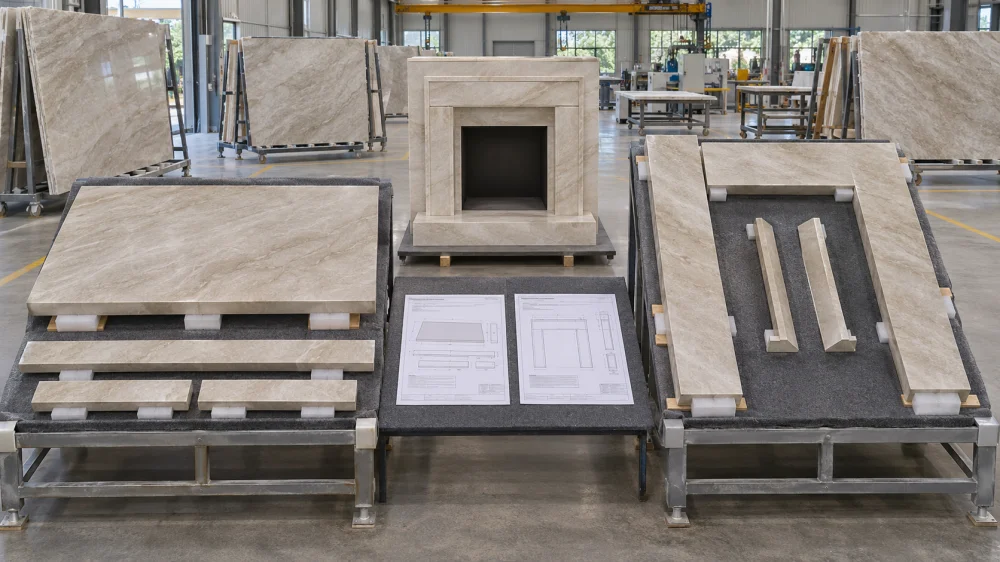
Both can contribute to one coordinated fireplace design, but they are not interchangeable supply descriptions.
Start with orientation and function.
The hearth extension is primarily a horizontal element associated with the floor or raised hearth construction. Depending on the selected fireplace appliance, it may be part of a required protective assembly or may be a separate decorative design feature.
The vertical surround is primarily a wall-facing assembly around the fireplace opening. It defines the visible fireplace frame and interacts with the appliance front, adjacent walls, backing and support details.
They are often shown in one interior rendering. However, the procurement schedule should distinguish them.
| Supply Consideration | Quartzite Hearth Extension | Quartzite Vertical Surround |
| Ориентация | Horizontal floor-level or raised-hearth surface | Vertical wall-facing surfaces around the opening |
| Typical Components | Hearth slab, front extension, side extension pieces, raised-hearth top and relevant edge returns | Left jamb, right jamb, head panel, vertical returns and upper wall panels |
| Primary Dimensional Reference | Fireplace opening, finished floor level and approved hearth extent | Appliance opening, front / trim datum and architectural elevation |
| Technical Interface | Floor protection, substrate, height, perimeter and transition to flooring | Facing limits, backing, anchorage, appliance trim and service access |
| Important Visible Details | Front edge, exposed sides, top finish, floor junction and corners | Opening edges, jambs, head-panel joint, returns and vertical stone pattern |
| Installation Handling | Horizontal placement, bearing, floor interface and safe handling | Vertical positioning, temporary support, permanent support and panel sequence |
The distinction should remain visible in the quotation and piece schedule, even when the project intends the natural Quartzite movement to look continuous across the horizontal and vertical elements.
A fireplace may be wood-burning, gas, electric or another specified type.
Its installation instructions can affect the required hearth construction, facing boundaries, combustible-material clearances and the finished position of the stone.
A design rendering does not establish those requirements.
Before defining the stone supply, obtain:
The qualified fireplace installer or responsible designer should establish which instructions and local requirements apply.
For example, some wood-burning fireplace instructions specify a hearth extension and describe protective layers in addition to the visible noncombustible finishing surface.
Other appliances may use different floor-protection rules or may not require the same hearth-extension arrangement.
Therefore, do not apply one generic hearth depth, width or thermal-resistance requirement to every fireplace.
For projects using Heat & Glo appliances, the manufacturer provides a model-specific fireplace manual directory. The relevant instructions must be checked for the actual selected model.
First confirm the selected fireplace’s applicable installation conditions. Then define the stone dimensions and the boundaries of each supply item.
The hearth extension should be defined in plan and section.
A statement such as “one Quartzite hearth slab” is not enough for a custom project.
Identify the finished hearth outline and its intended relationship to the fireplace opening.
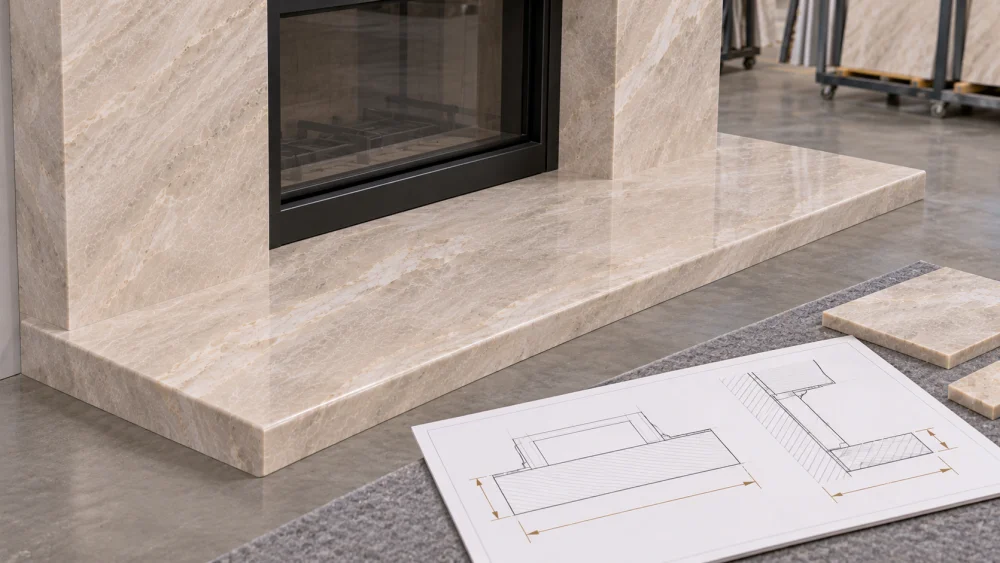
The drawing should show:
Where the hearth extension is required for floor protection, its extent must meet the applicable appliance instructions and other governing requirements.
Do not reduce the protected area simply to improve slab yield or align the stone with nearby furniture.
Record the finished elevation relative to the adjoining floor and appliance opening.
Distinguish:
Толщина камня — the actual natural-stone section being supplied.
Finished Hearth Height — the top-of-stone elevation relative to the room floor.
Complete Hearth Assembly Depth — the combined thickness of stone, bedding, any required protective layers and supporting construction.
These are not necessarily equal.
A thick-looking raised hearth may be a complete constructed platform rather than a single massive Quartzite slab.
The front and side edges may be visible from normal room viewing positions.
Specify the approved profile, edge finish and corner treatment.
An eased edge, bevel, rounded edge or fabricated mitred profile can create different visual proportions.
Where the hearth meets a floor finish, identify whether the stone is flush, raised or connected by another approved transition detail.
The hearth stone should have an appropriate supporting arrangement for its actual geometry and service conditions.
The stone supplier can document the piece dimensions and fabrication, but the responsible project party should establish the substrate, loading, bedding and any additional protective assembly requirements.
This is the most important technical and commercial distinction in the hearth package.
Natural Quartzite is generally a noncombustible stone material.
However, noncombustibility alone does not establish the thermal resistance or complete protective performance of a hearth assembly.
Heat can pass through stone.
Depending on the appliance, the complete hearth protection may involve additional layers or components.
К ним могут относиться:

Not every fireplace requires all of these components.
Some appliances require different arrangements or permit particular exceptions.
The complete approved assembly must be determined for the exact appliance, not inferred from the name of the stone.
A thicker Quartzite piece does not automatically satisfy a particular hearth-protection requirement.
Where an appliance specifies a thermal-resistance criterion, the responsible technical reviewer must assess the required assembly using appropriate documented material properties and the specified calculation or approved construction method.
The Natural Stone Institute’s R-value technical bulletin explains that thermal conductivity and resistance can matter when natural stone separates a heat source from combustible materials.
Its published reference values should not be treated as proof of the thermal performance of every individual commercial Quartzite variety.
If the supplier is providing only the finished Quartzite slab, describe the offer accordingly.
Например:
Not included unless separately stated: Design or certification of the complete hearth-protection assembly, insulation, protective metal components, site substrate preparation, installation, appliance approval or local-code compliance.
The exact contract may include additional materials or services. The important point is to describe them explicitly.
Do not imply that the word “hearth” in a stone quotation guarantees a compliant complete floor-protection system.
The vertical package is different because it is arranged around the fireplace opening and installed against or within a wall assembly.
A project may use two side jambs and a head panel, but other designs have full-height stone walls, inside returns, mantel features or additional panels.
The quotation should identify the actual pieces rather than automatically assuming a standard three-piece surround.
Specify each jamb’s:
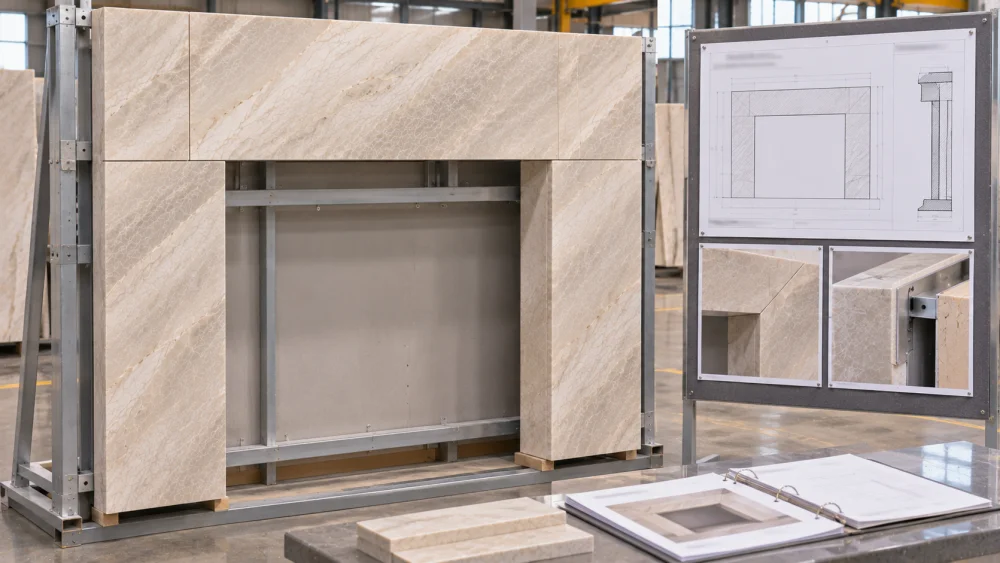
Record the head-panel geometry and its position relative to the appliance front and adjacent wall.
The drawing should include the current opening dimensions, joint arrangement, supporting detail and permitted facing boundary.
Where the design uses a large head panel, identify whether it is one stone component or several related pieces.
A return may turn from the front wall into the depth of the fireplace opening.
That return can conflict with the appliance frame, glass, decorative front or removable trim if the geometry is not coordinated.
Do not allow the stone to bridge over required air openings or cover service components.
The stone package should state whether it includes only fabricated facing pieces or any approved mounting components.
The responsible project team should establish the vertical support method, backing suitability, clearance conditions and applicable installation details.
A large stone head panel should not be treated as self-supporting merely because its edges appear to rest near the side jambs.
The junction between the two supply items is a small detail with major consequences for fabrication and installation.
It determines how the bottom of the vertical jambs relates to the horizontal hearth surface.
Several arrangements may be possible depending on the appliance and architectural design.
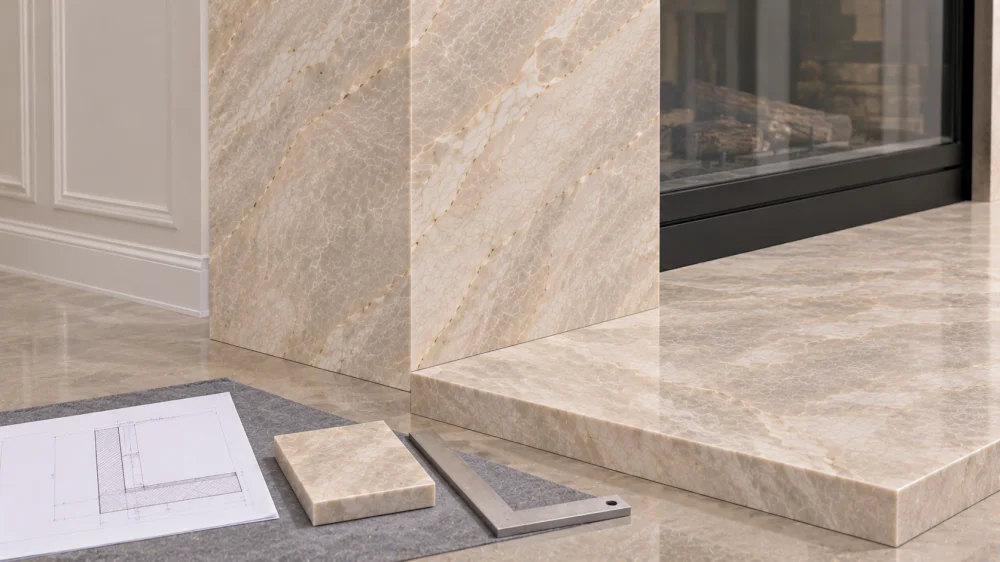
The vertical stone may finish at a defined line above the horizontal slab.
The joint position and any required separation should be shown on the current section.
The design may show the jambs extending down to the hearth.
Confirm whether the apparent contact is a direct bearing condition, a visual junction with a controlled joint, or another engineered assembly detail.
The horizontal stone may extend beyond both jambs.
This can be visually effective, but it may change the slab width, exposed edge length, handling requirements and the location of the joint with adjacent flooring.
A raised hearth may contain a horizontal top plus vertical fascia or return pieces.
Those fascia pieces belong in the hearth supply schedule unless the contract deliberately assigns them elsewhere.
They should not disappear between the horizontal-hearth quotation and the vertical-surround quotation.
Hearth Finished Level → Jamb Bottom Detail → Joint / Return → Appliance Front Reference → Current Revision
Do not combine the entire fireplace stone package into one undefined line such as:
“Quartzite fireplace surround — one set.”
That may be convenient for a preliminary budget, but it is weak as a detailed supply specification.
Use separate line items with distinct piece schedules.
| Quotation Field | Item H — Hearth Extension | Item V — Vertical Surround |
| Материал | Selected natural Quartzite / approved reference | Selected natural Quartzite / approved reference |
| Чертёж | Hearth plan and section / current revision | Surround elevation and sections / current revision |
| Piece Schedule | Horizontal slabs and any hearth fascia or returns | Jambs, head panel, wall pieces and returns |
| Size / Thickness | Finished hearth dimensions and stone thickness | Finished panel dimensions and stone thickness |
| Заканчивать | Specified horizontal surface and perimeter finish | Specified vertical surface and exposed edges |
| Special Processing | Floor-transition edges, shaped corners, fascia or joints | Opening edges, mitres, returns, slots or other approved details |
| Technical Scope | Clarify whether protection layers and site support are excluded | Clarify whether backing, anchorage and installation are excluded |
| Packing / Delivery | Identified horizontal pieces with protected perimeter edges | Identified facing panels with protected opening edges and returns |
Both items may use the same material and appear under one overall fireplace project reference.
However, their quantities, fabrication operations and acceptance criteria should remain distinguishable.
Where the buyer requests pricing by square metre, also identify work that is not adequately described by surface area alone, such as special edge fabrication, complex cutouts, multiple small components or fabricated returns.
Do not invent a standard percentage price difference between a hearth slab and a surround panel. The actual cost depends on usable slab yield, processing, handling and project scope.
Potentially, if the slab dimensions, quality, pattern, quantity and approved cutting layout permit it.
For a luxury fireplace project, the designer may want the natural movement to relate across the hearth and the wall-facing pieces.
That can be visually attractive, but it should not override technical requirements or efficient material handling.
Before allocating the pieces, consider:
For example, a prominent mineral feature may be selected for the upper surround while a quieter slab zone is allocated to the horizontal hearth.
Alternatively, the design may request a controlled visual transition from the hearth into the jambs.
Neither approach automatically guarantees perfect pattern continuity around the fireplace opening.
The Quartzite layout approval guide explains how identified slabs, finished-piece positions, pattern direction and drawing revisions should be included in the buyer’s visual review.
For this project, the layout should clearly identify which components belong to Item H and which belong to Item V.
A complete fireplace dry-fit can help review the relationship between the pieces.
However, each supply item still needs its own fabrication checks.

For the horizontal pieces, verify:
The factory should confirm the stone against its approved drawings.
The supplier’s dimensional QC does not independently verify that the installed floor-protection assembly meets the fireplace manual.
For the vertical pieces, verify:
Where a full surround is assembled for review, use a stable protected fixture and a verified opening template.
Do not present the factory dry-fit as proof that the fireplace itself has been safely installed or commissioned.
After checking each item separately, review the shared details.
Confirm the intended relationship between:
Hearth Front / Top → Jamb Bottom → Opening Geometry → Side Returns → Finished Stone Joint
This is particularly important when a raised hearth is built from multiple stone components or when the surround and floor are installed by different teams.
The site team should be able to identify the horizontal and vertical components without reconstructing the packing list from photographs.
A practical piece schedule can use separate prefixes.
H-01: Main hearth-extension slab.
H-02: Hearth side piece or fascia.
V-01: Left surround jamb.
V-02: Right surround jamb.
V-03: Surround head panel.
These identifiers are illustrative only.
The actual project should use a stable ID system connected to the current drawings, factory QC and packing schedule.
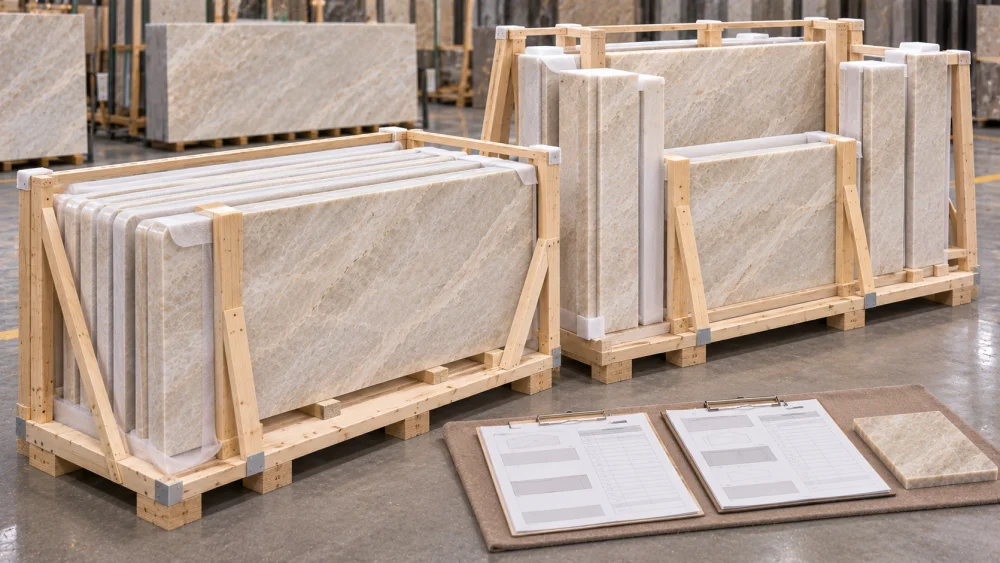
A broad horizontal hearth slab may have long exposed edges and large faces requiring careful support.
Vertical jambs and head pieces may have delicate returns, inside corners and opening edges.
Finished stone should be packed with appropriate rigid support, edge protection, restraint and component identification.
For suitable flat pieces packed upright, reinforced wooden frames and closely arranged panels with very thin protective interleaving may be used as part of an appropriate packing design.
Do not create large unsupported spaces between heavy stone panels using thick soft foam blocks.
The packing method should suit the actual piece sizes, weights and export requirements.
The receiving team should have:
The Указатель документов по передаче кварцитового завода объекту explains how piece IDs should remain connected to drawings, QC, crates and installed locations.
Separating the two stone supply items does not transfer all technical responsibility to the stone supplier.
A project can define the responsible parties as follows.
| Принятие решения по проекту | Typical Responsible Party | Необходимые сведения |
| Appliance Installation Requirements | Qualified fireplace installer / responsible project designer | Exact model, applicable manual and local requirements |
| Hearth Protection Assembly | Responsible fireplace / architectural design and installation team | Approved protection extent, layers and relevant performance requirements |
| Vertical Facing / Support | Responsible architectural / structural / installation team | Backing, support, fixing and appliance-facing limits |
| Quartzite Fabrication | Stone supplier / fabricator within agreed scope | Approved dimensions, profiles, layouts and piece schedule |
| Site Installation and Final Verification | Appointed installers and relevant project professionals | Current drawings, site conditions and installation records |
The actual division of responsibilities depends on the project contract and applicable jurisdiction.
The stone supplier should not claim to certify fireplace safety or the complete hearth assembly unless that specific service is explicitly within its qualified and agreed scope.
The horizontal and vertical stone packages can be approved together commercially while retaining different fabrication and technical hold points.
Before cutting, confirm the following project-specific information.
Shared Release Question: Do the two sets meet correctly at the hearth-to-surround junction without changing an appliance requirement or leaving an unassigned construction responsibility?
If the appliance model changes, or the hearth protection is revised, assess both affected packages before continuing fabrication.
Item V — Vertical Surround: Approve the wall-facing geometry, opening, visible returns and relevant fabrication interfaces.
Shared Interface: Confirm the completed hearth-to-jamb relationship and the applicable appliance installation requirements.
Buyer Next Step: Send HRST STONE a two-part stone schedule, the current fireplace appliance information, hearth plan, surround elevation, joint sections, selected Quartzite and project delivery requirements. Request separate quotation lines and piece IDs for the horizontal and vertical stone components.
A hearth extension is a horizontal stone component or group of components associated with the area in front of or around the fireplace, potentially forming part of a required floor-protection assembly. A vertical surround consists of wall-facing stone pieces such as side jambs, a head panel and returns around the fireplace opening.
Yes, where the selected stone, available slabs, technical requirements and approved construction allow it. They may use the same natural Quartzite for visual continuity, but their dimensions, finishing, support conditions and technical approval scopes should remain separately documented.
No. A noncombustible stone face does not automatically establish the thermal resistance or construction of the complete hearth-protection assembly. Follow the requirements for the exact appliance and have the responsible design or installation professional confirm any protective layers and other necessary components.
Not under one universal rule. Requirements vary with the appliance type, exact model, installation configuration and applicable local regulations. Some appliances specify hearth extensions or floor protection, while others may use different requirements or permitted arrangements.
For custom project supply, separate quotation lines are recommended. They make it easier to identify the horizontal hearth pieces, vertical facing panels, edge processing, special details, quantities, technical exclusions, packing and delivery responsibilities.
Use the current hearth plan, fireplace elevation and coordinated section to establish the finished level, jamb termination, joint geometry and appliance reference. Do not assume direct stone contact, bearing or a zero-gap joint without checking the actual assembly requirements.
A combined dry-fit can help confirm the visible junction, piece alignment and finished geometry, but each item still requires its own fabrication checks. A stone factory dry-fit does not replace verification of the appliance installation, hearth protection, vertical anchorage or other technical conditions.
Send the selected Quartzite or slab references, exact fireplace appliance and manual where available, approved hearth plan, surround elevation and sections, horizontal and vertical piece dimensions, thickness, finish, exposed-edge details, quantity, packing requirements, delivery destination and the agreed scope for backing, protection layers, supports and site installation.