Cotações de Lajes de Quartizito: Área Bruta, Área Líquida e Carga Mínima
Post navigation
Resumo Rápido
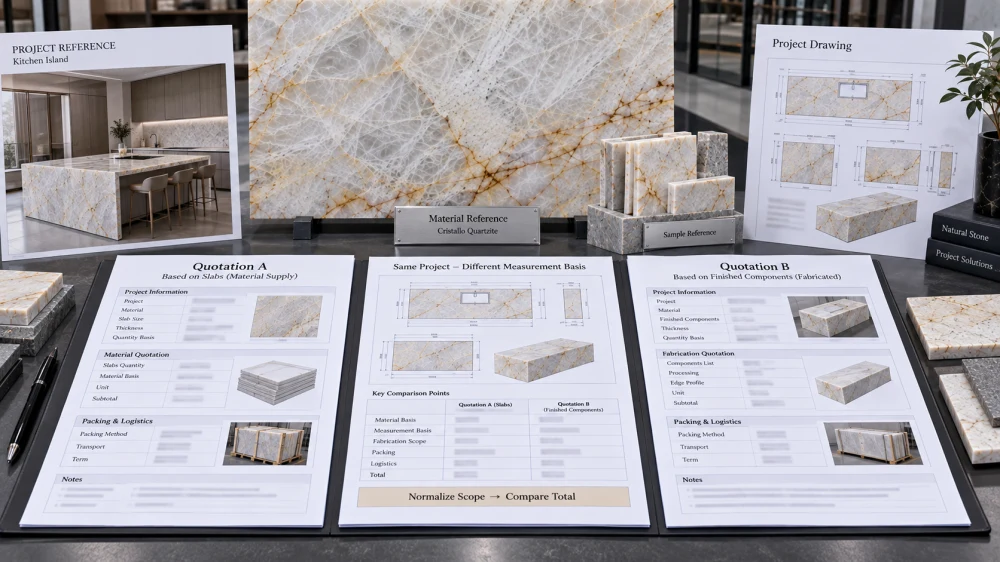
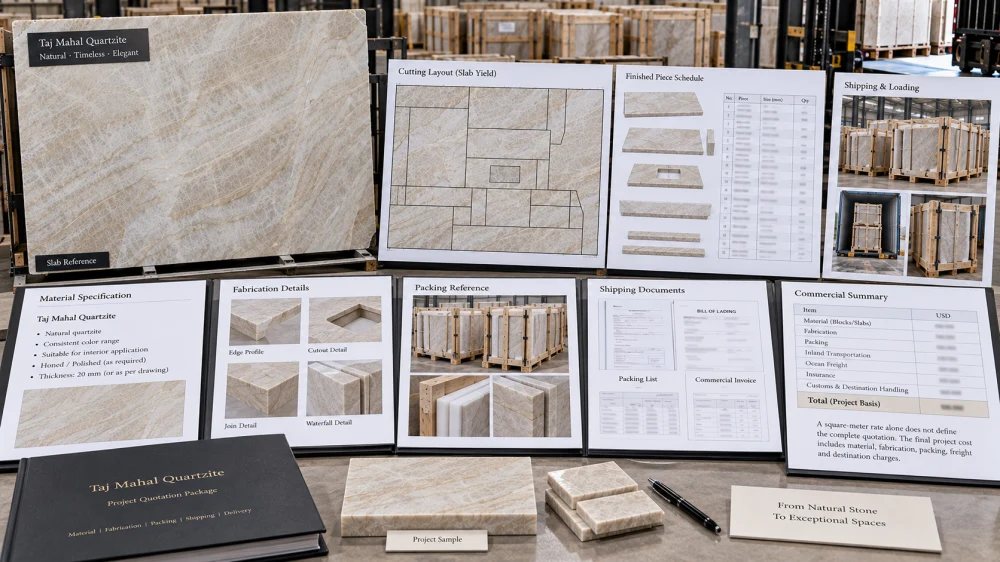
Uma cotação de laje de quartzito deve especificar qual área está sendo medida e qual área efetivamente será cobrada. Área bruta da laje, área útil de corte, área líquida acabada e área passível de cobrança são conceitos distintos. Além disso, pode haver uma cobrança mínima mesmo quando o projeto demanda menos material. Antes de comparar duas cotações, normalize o material, a quantidade de lajes, a base de medição, a fabricação, a embalagem, o frete, a moeda e as condições de entrega — não apenas o preço por metro quadrado.
Um projeto necessita de 12 m² de quartzito natural acabado.
O fornecedor A cotou 15 m².
O fornecedor B cotou 12 m².
O fornecedor C apresenta 12 m² de peças acabadas, mas aplica uma cobrança mínima mais alta.
Qual cotação de laje de quartzito é realmente mais barata?
Não é possível responder apenas com base nesses valores de área.
Primeiro, determine o significado de cada número.
A comparação mais útil é:
Área Acabada Necessária → Consumo Real de Material → Base de Área Cotada → Cobrança Mínima → Escopo de Fabricação → Embalagem → Frete → Total Comparável
Quatro Termos de Área que os Compradores Devem Manter Separados
O maior erro em cotações é tratar cada valor de metro quadrado como se representasse a mesma coisa.
Termo de Área
Significado Prático
Pergunta do Comprador
Área Bruta da Laje
Área total representada pelas dimensões da laje ou pela base de área da laje informada pelo fornecedor
Estou comprando a laje inteira?
Área Utilizável da Laje
Área que, na prática, pode contribuir para o layout de corte aprovado após considerar as restrições específicas do projeto
Quanto da laje é útil para minhas peças?
Área Líquida Acabada
Área calculada dos componentes acabados necessários segundo a base de medição estabelecida
Quanto de pedra acabada há no meu desenho?
Área Passível de Cobrança
Área ou quantidade que o fornecedor realmente utiliza para o cálculo comercial
Qual quantidade é multiplicada pela tarifa cotada?
Essas quantidades às vezes podem ser iguais.
Muitas vezes, não são.
O Que É Área Bruta em uma Cotação de Laje de Quartzito?
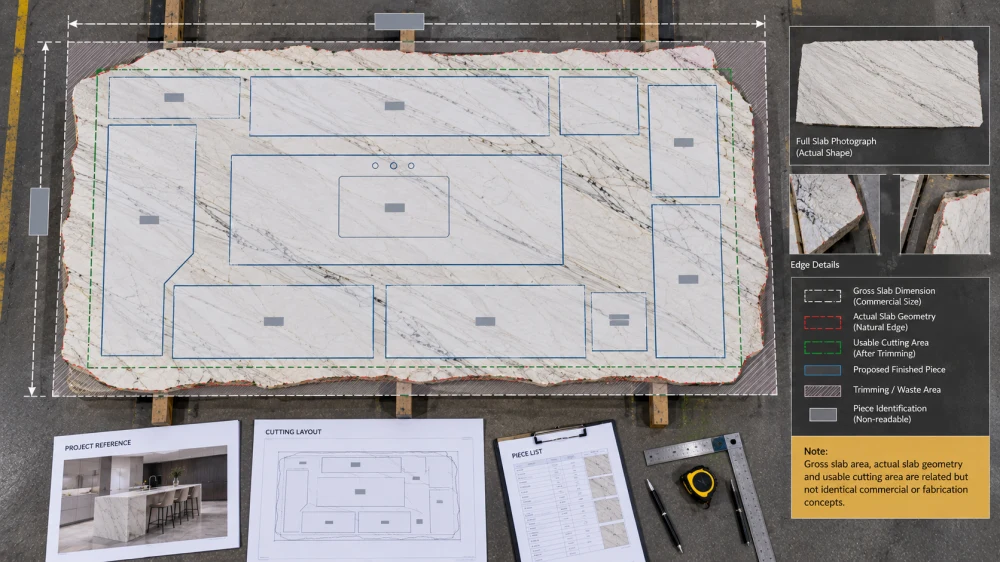
Para uma transação envolvendo lajes, a área bruta geralmente refere-se à área representada pelas dimensões da laje ou pela base de medição informada pelo fornecedor.
Para uma ilustração simples em forma retangular:
mont-blanc-quartzite-area-bruta-da-laje-área-útil
Comprimento da laje × Largura da laje = Área Bruta da Laje
Mas isso não significa que cada centímetro quadrado desse retângulo bruto possa virar uma bancada acabada.
Lajes de quartzito natural podem apresentar:
geometria irregular do perímetro;
áreas excluídas pelo layout aprovado;
características naturais que afetam a posição específica de determinada peça;
requisitos de aparar as bordas;
zonas de prioridade visual;
restrições de direção de movimento; e
outras limitações específicas ao layout da laje.
É por isso que a área bruta da laje não deve ser automaticamente considerada como rendimento útil de corte.
A área líquida só é útil se a cotação definir claramente o que significa “líquido”.
Uma cotação pode usar a área líquida para descrever a soma das peças retangulares acabadas.
Outra pode calcular a área dos componentes acabados de maneira diferente.
Um terceiro fornecedor pode evitar completamente esse termo e, em vez disso, cotar:
complete slabs;
finished pieces;
linear-meter processing;
per-piece fabrication;
material consumption; or
a complete project package.
Quotation Rule
Never compare two “net area” figures until both suppliers have explained how the area is calculated and which commercial items are included in that figure.
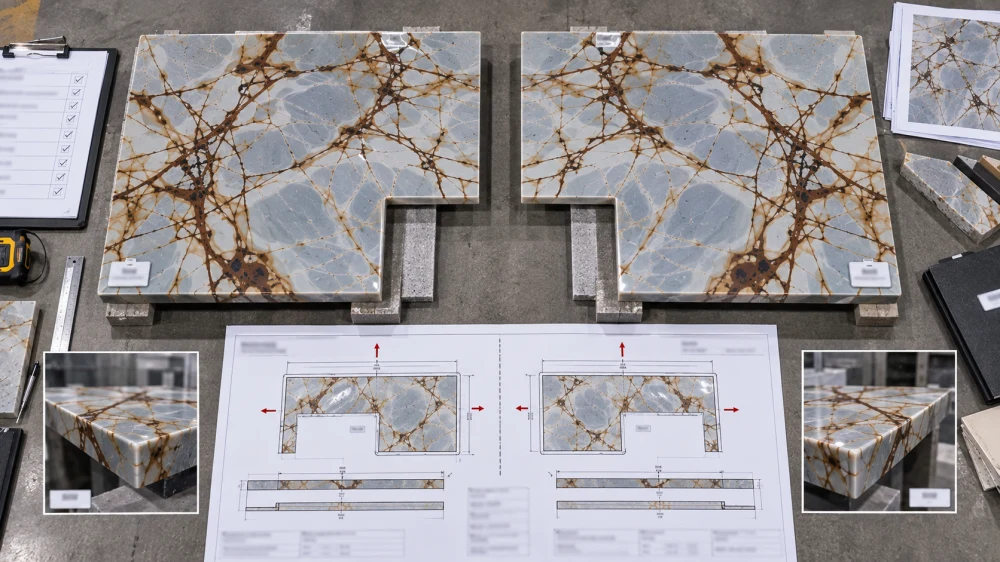
Finished Area Is Not the Same as Raw Material Consumption
Suppose the finished drawings contain a certain number of square meters of countertops, wall panels, vanity tops, or other components.
The factory may need more raw slab area than the finished net area because the pieces must actually fit inside real slabs.
“How much waste does the factory want to charge me for?”
It is a consequence of fitting the required finished geometry into actual natural-stone slabs under the approved project constraints.
What Is a Minimum Charge?
A minimum charge is a commercial rule under which the supplier charges at least a stated minimum amount, quantity, slab count, processing quantity, or other agreed commercial basis even when the immediate project requirement is smaller.
There is no single universal Natural Quartzite minimum charge.
Depending on the supplier and scope, a minimum may relate to:
a complete slab;
a minimum number of slabs;
a minimum material quantity;
a minimum fabrication amount;
a minimum processing charge;
a minimum packing requirement;
a special-order material commitment; or
another clearly stated commercial basis.
The quotation should state which one applies.
Minimum Charge Does Not Mean Minimum Order Quantity
These terms can overlap commercially, but they are not automatically the same.
Term
Questão que Responde
MOQ
What is the minimum quantity the supplier will accept as an order?
Taxa mínima
What is the minimum commercial amount or quantity basis that will be charged?
A supplier could theoretically accept a small quantity while still applying a minimum processing or commercial charge.
Always confirm the actual quotation rather than assuming the two terms are interchangeable.
Why Might a Small Project Be Charged for a Full Slab?
This is one of the most important questions for buyers of premium Natural Quartzite.
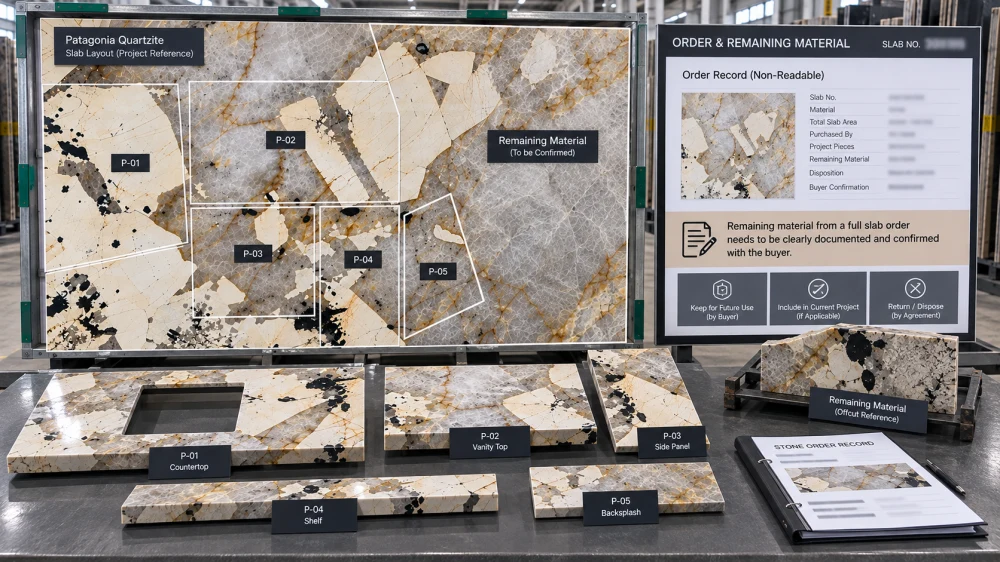
Imagine a project requires only part of one slab.
The supplier may still quote the complete slab if the commercial arrangement requires the buyer to purchase that slab rather than only the area physically converted into finished pieces.
That does not automatically mean the unused material is “waste.”
Ask what happens to the balance.
Possible commercial arrangements can include:
the buyer purchases the complete slab and the balance remains part of the order;
the balance is fabricated into spare pieces if agreed and practical;
the balance is packed with the order if agreed;
the supplier retains the balance under an agreed commercial arrangement; or
another written disposition is used.
The quotation should make this clear before payment.
A Lower Price per Square Meter Can Produce a Higher Total
Consider a hypothetical comparison.
One supplier offers a lower material rate but charges complete slabs and excludes fabrication.
Another supplier shows a higher finished-piece rate but includes some fabrication and uses a different chargeable quantity.
The first $/m² can be lower while the completed commercial scope is higher.
This is why procurement teams should compare:
Comparable Total ÷ Comparable Scope
rather than ranking quotations by the first unit rate visible on the page.
Packing and Freight Can Change the Area Economics
Area pricing does not end at the factory invoice.
Raw slabs and finished pieces can require different packing and shipping arrangements.
For a project quotation, confirm whether the price includes:
slab packing or frame requirements;
reinforced export crates for finished pieces;
internal protection;
proteção de bordas e cantos;
loading;
export documentation;
ocean freight;
destination charges;
duties or taxes where applicable; and
final delivery where quoted.
A quote that looks expensive at the material line can be more complete commercially, while a low material rate may leave several later costs outside the proposal.
Ask for the Quotation Formula in Plain Language
BUYER QUOTATION CHECK
01 — What quantity is my project drawing asking for?
02 — How much raw Quartzite is required?
03 — Am I purchasing complete slabs or only finished pieces?
04 — What does “gross area” mean in this quotation?
05 — What does “net area” mean in this quotation?
06 — What quantity is actually chargeable?
07 — Is there a minimum charge?
08 — What happens to unused slab material?
09 — Which fabrication items are included?
10 — Is packing included?
11 — What Incoterm / delivery scope applies?
12 — What is the final comparable total?
What Should a Clear Quartzite Slab Quote Show?
For an international project, a useful quotation can identify:
nome do material;
actual slab reference or selection basis where applicable;
The goal is not to make every supplier use the same quotation format.
The goal is to make the commercial basis understandable enough to compare.
Perguntas frequentes
1. What is gross area in a Quartzite slab quote?
Gross area generally refers to the overall slab-area basis stated in the quotation, often related to the slab dimensions. It should not automatically be interpreted as usable cutting area or finished project area. Confirm the supplier’s exact measurement method in the quotation.
2. What is net area in a Quartzite quote?
A área líquida pode referir-se à área calculada das peças acabadas ou a outra base de medição definida pelo fornecedor. Como o termo, por si só, não é suficientemente preciso, os compradores devem esclarecer exatamente como a área líquida é calculada e se resíduos, fabricação, recortes, bordas ou outros itens são incluídos ou excluídos.
3. Why can finished Quartzite area be smaller than the chargeable area?
As peças finalizadas devem ser cortadas a partir de placas reais. As dimensões das placas, a geometria das peças, as margens de corte, a orientação, a seleção visual, as juntas, os recortes, as exigências de correspondência e outras restrições de arranjo podem fazer com que o consumo de matéria-prima seja superior à área final acabada. Uma taxa mínima separada também pode influenciar a quantidade comercial.
4. What does minimum charge mean on a Quartzite quotation?
Significa que o fornecedor aplica um valor mínimo comercial, quantidade, número de lajes, base de processamento ou outra cobrança definida, mesmo quando a necessidade imediata é menor. Não existe um valor mínimo universal para todos os fornecedores de quartzito natural ou para todos os projetos; portanto, a base deve ser estabelecida por escrito.
5. If I pay for a full Quartzite slab, do I own the remaining offcut?
Não faça suposições em nenhum dos casos. Confirme o acordo comercial antes de efetuar o pedido. A cotação ou o registro do pedido deve especificar o que ocorre com os materiais não utilizados, incluindo se são enviados, transformados em peças de reposição, armazenados, retidos ou tratados de outra forma.
6. Is minimum charge the same as MOQ?
Não necessariamente. O MOQ define a quantidade mínima que um fornecedor está disposto a aceitar como pedido, enquanto a taxa mínima refere-se ao valor ou à quantidade mínimos comerciais que serão cobrados. A cotação oficial deve especificar ambos, caso sejam aplicáveis.
7. How should I compare two Quartzite slab quotes?
[Normalize o material, a espessura, o acabamento, a quantidade de lajes, a área finalizada, a quantidade cobrável, o valor mínimo de cobrança, o escopo de fabricação, a embalagem, o frete, a moeda, a validade da cotação e as condições de entrega. Compare o mesmo escopo comercial concluído, em vez de considerar apenas o preço por metro quadrado anunciado.].
Regra do orçamento finalDo not compare Quartzite quotations until every area figure has a commercial meaning. Keep the chain visible: Finished Requirement → Actual Slab Consumption → Gross / Net Measurement Basis → Chargeable Quantity → Minimum Charge → Fabrication → Packing → Freight → Comparable Total.
For project-based Natural Quartzite quotations, HRST STONE can review current drawings, finished dimensions, actual slab requirements, cutting layouts, fabrication scope, packing requirements, and shipping destination before preparing the commercial scope. Send Josh the material name, dimensions, quantities, finish, drawings, edge and cutout requirements, packing requirements, and delivery destination so the quotation can clearly separate material, fabrication, packing, and logistics.
Hi, I am the author of this article. I have been working in the field of Natural Stone for more than 15 years. If you need customized Natural Stone services, please feel free to contact me.
Fabricante e Fornecedor de Mármore, Granito, Quartzito, Ágata da China - HRST STONE
Bem-vindo à HRST STONE!
Olá, gostaria de saber mais sobre seus produtos. Você poderia compartilhar informações sobre preços, quantidade mínima de pedido, opções de personalização e amostras?