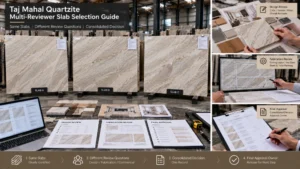
Como comparar uma amostra de quartzito reacabada com o acabamento original
Post navigation
Resumo Rápido
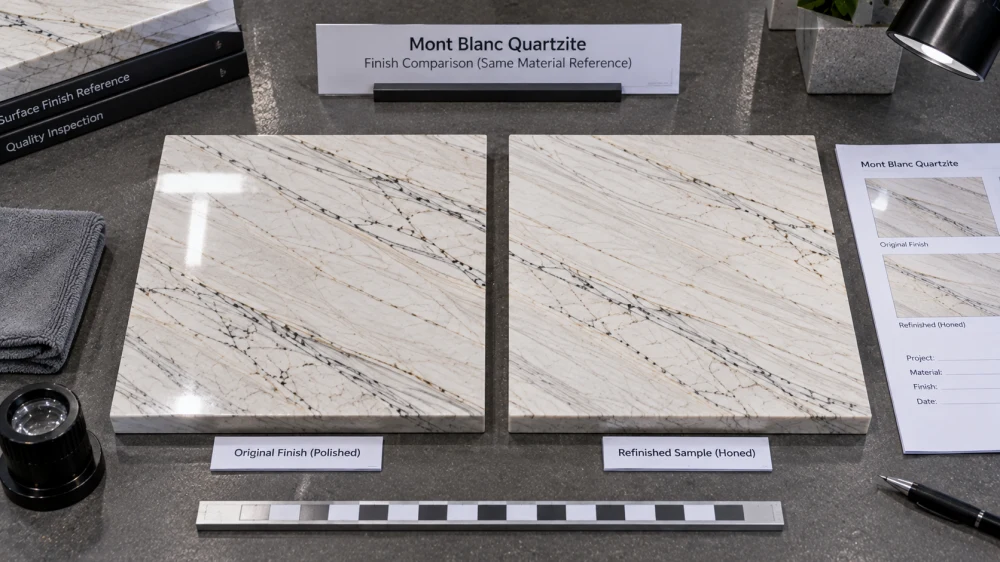
Compare uma amostra de quartzito reprocessada com a referência original, sob as mesmas condições de limpeza, secagem, iluminação, visualização e orientação. Não julgue apenas pela denominação “polido”, “afiado”, “escovado” ou “acabamento em couro” aplicada a ambas as amostras. Avalie o brilho, o comportamento da luz refletida, a profundidade da cor, a textura, a clareza, as marcas visíveis, a uniformidade entre borda e face, bem como a aplicação pretendida. Registre exatamente qual referência original e qual amostra reprocessada foram aprovadas, pois uma comparação baseada em uma pequena amostra não aprova automaticamente todas as lajes ou todos os elementos acabados.
Um projeto em quartzito possui um acabamento aprovado.
Posteriormente, uma amostra é reprocessada porque a superfície original precisa ser reproduzida, ajustada, reparada ou harmonizada durante a fabricação.
A nova amostra parece semelhante.
Mas será que é suficientemente parecida para liberar o restante do trabalho?
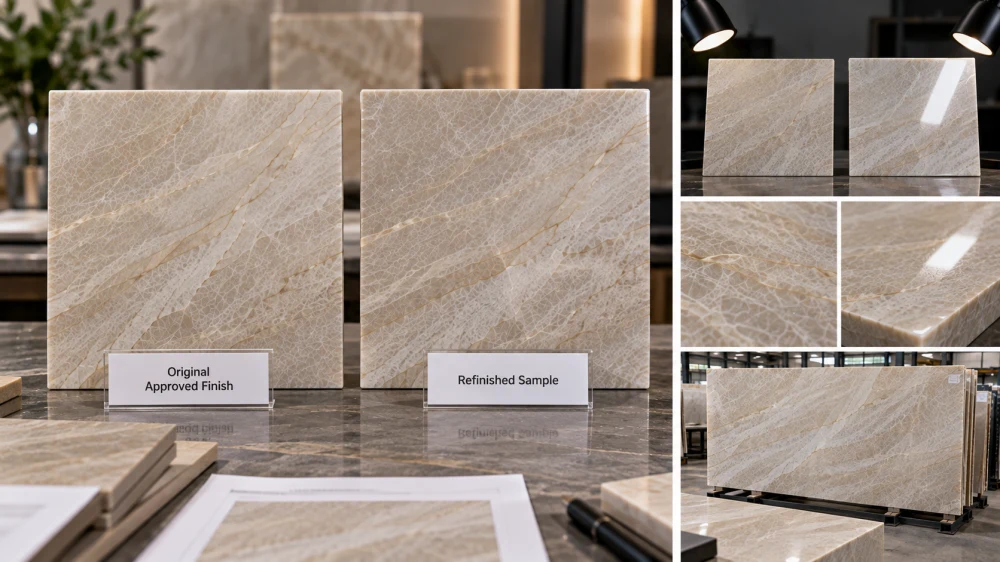
Uma comparação eficaz não deve depender da memória nem de uma única fotografia. A equipe do projeto deve comparar a amostra de quartzito reprocessada diretamente com uma referência original identificada, sob condições controladas.
A sequência de avaliação é:
Referência Original → Amostra Reprocessada → Mesmas Condições de Visualização → Brilho → Profundidade da Cor → Textura → Uniformidade da Superfície → Relevância em Áreas Maiores → Limite de Aprovação
Primeiro, Confirme o Que Significa “Acabamento Original”
Antes de comparar superfícies, identifique a referência.
“Igualar o acabamento original” é muito vago se o projeto tiver várias possíveis origens.
A referência pode ser:
a amostra de controle original aprovada;
uma amostra mantida da laje selecionada;
uma maquete aprovada;
um componente acabado previamente aprovado;
uma área definida de uma laje real; ou
outra referência específica ao projeto, acordada por escrito.
Registre informações suficientes para que outro avaliador possa identificar a mesma referência posteriormente.
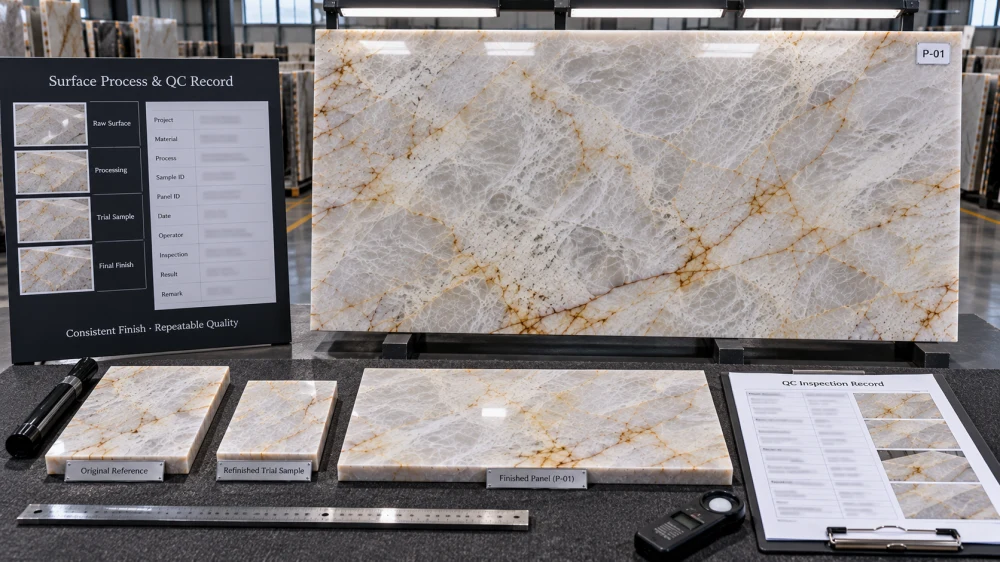
PAR DE REFERÊNCIAScomparacao-amostra-quartzito-reacabada-acabamento-original
Referência Original: ID da Amostra / Peça
Material: Referência Real de Quartzito Natural
Acabamento Original: Descrição do Acabamento Aprovado pelo Projeto
Amostra Reprocessada: ID da Amostra / Peça
Processo Proposto: Processo de Fabricação Registrado
Escopo da Avaliação: Área / peças às quais a decisão pode ser aplicada
Compare Semelhante com Semelhante Sempre que Possível
A comparação mais robusta utiliza duas superfícies que minimizam variáveis não relacionadas.
Se possível, compare a área reprocessada com uma referência original proveniente da mesma seleção de material e de uma zona de pedra razoavelmente comparável.
Isso é importante porque o quartzito natural pode variar em:
tom de fundo;
concentração mineral;
caráter cristalino;
veios ou movimentação;
porosidade local;
fissuras naturais;
condição da resina ou do reforço; e
outros aspectos específicos de cada laje.
Se duas amostras provêm de zonas de pedra visivelmente diferentes, parte da aparente diferença pode decorrer do material em si, e não do processo de reprocessamento.
Não Compare uma Amostra Molhada com uma Amostra Seca
As condições da superfície podem distorcer a comparação antes mesmo de considerar a qualidade do acabamento.
Ambas as referências devem ser avaliadas sob condições acordadas.
Para uma comparação visual normal, verifique se ambas as superfícies estão:
limpa;
seca;
livres de resíduos temporários de polimento;
livres de poeira solta;
livre de película protetora temporária;
não intencionalmente umedecidas para intensificar a cor; e
ready for the intended approval review.
Comparison Rule
Do not approve a finish match when one surface is wet, dirty, freshly coated, covered by temporary residue, or otherwise being viewed in a different condition from the reference surface.
Use the Same Lighting for Both Samples
Finish is partly perceived through reflected light.
A surface can appear more polished, flatter, darker, lighter, richer, or more textured simply because the lighting changed.
Place the original and refinished references side by side where practical.
Then review them under the same:
light source;
direção da luz;
approximate intensity;
distância de visualização;
viewing angle;
sample orientation; and
surrounding visual environment.
This does not require a complicated laboratory setup for every aesthetic approval.
It requires enough consistency that the team is comparing the stone rather than comparing two different viewing environments.
Do Not Judge a Quartzite Finish from One Viewing Angle
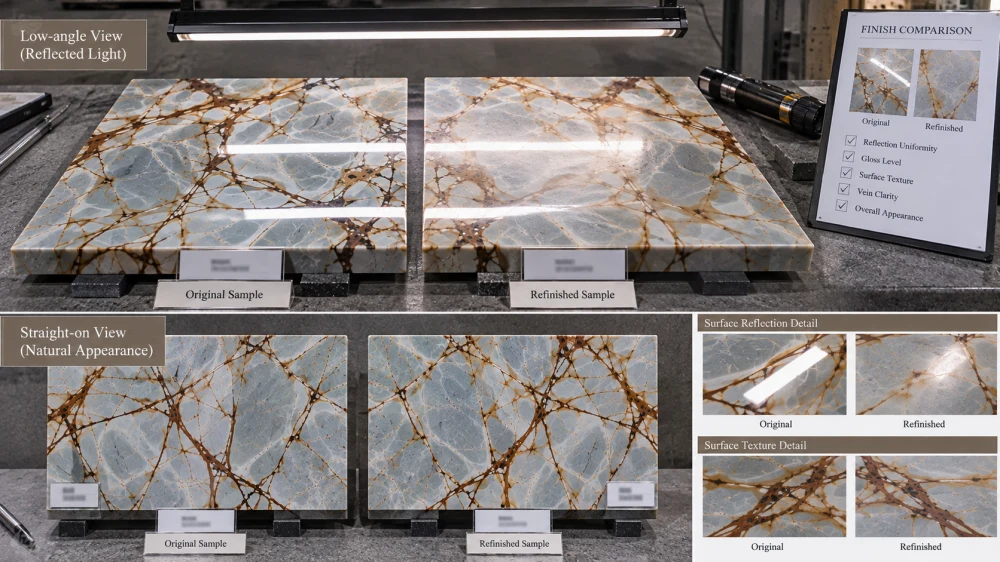
A finish can appear similar when viewed straight on but noticeably different when light moves across the surface.
Review the pair from several controlled positions:
Front View → Low-Angle View → Reflected-Light View → Close Surface View → Normal Project Viewing Distance
Low-angle observation can be particularly useful for seeing differences in sheen, polishing transitions, surface waviness, localized dull areas, or texture that are less obvious in a straight-on photograph.
Compare Sheen Before Comparing Color
One of the first checks should be reflected-light behavior.
Does the refinish create visible processing bands?
Does the surface change abruptly near an edge or repaired area?
A finish may have the correct general category but still show a visibly different sheen.
For example, two surfaces can both be described as honed while one reads significantly flatter or more reflective than the other.
Then Compare Color Depth and Mineral Definition
Surface finish can change how the same stone is perceived.
A higher-reflection surface can make some colors and mineral structures appear deeper or more visually pronounced, while a lower-reflection finish can make the overall appearance softer.
During the comparison, look at:
background color depth;
contrast between mineral zones;
clarity of crystalline areas;
dark-mineral intensity;
warm or cool visual shift;
vein definition; and
overall visual depth.
The purpose is not to demand artificial uniformity from Natural Quartzite.
It is to determine whether the refinishing process has introduced an unacceptable visual difference from the agreed reference.
Separate Natural Stone Variation from Finish Variation
This is one of the hardest parts of a finish comparison.
Suppose the refinished sample looks slightly darker than the original.
Possible explanations may include:
different surface sheen;
different stone zone;
different mineral concentration;
different lighting;
different surface condition;
residual moisture or processing residue; or
a combination of factors.
Do not automatically attribute every visual difference to the refinishing operation.
Control the variables first.
Texture Matters Even When Color Looks Correct
A photograph taken from above may make two samples look almost identical in color.
Touch and low-angle light may reveal a different surface.
Depending on the specified finish, review:
smoothness;
micro-texture;
directional processing marks;
brush character;
leathered relief;
local depressions;
edge transitions; and
consistency across the reviewed area.
Aesthetic texture should be compared against the approved project reference rather than against a generic idea of what every Quartzite surface should feel like.
Use a Comparison Matrix Instead of “Looks Good”
Revisão do item
Original Reference
Refinished Sample
Decisão
Overall sheen
Record observation
Record observation
Accept / Adjust / Review
Reflection uniformity
Record observation
Record observation
Accept / Adjust / Review
Color depth
Record observation
Record observation
Accept / Adjust / Review
Mineral / vein definition
Record observation
Record observation
Accept / Adjust / Review
Surface texture
Record observation
Record observation
Accept / Adjust / Review
Processing marks
Record observation
Record observation
Accept / Adjust / Review
Edge-to-face transition
Record observation
Record observation
Accept / Adjust / Review
Should You Measure Gloss?
For some projects, a visual comparison between approved physical references may be sufficient.
For others, especially where a contractual finish requirement or tighter production control is needed, the responsible parties may choose to use an agreed measurement method or instrument in addition to visual review.
The important point is not to invent a universal gloss number for Natural Quartzite.
If a numerical sheen or gloss criterion is required, define:
do método de medição;
instrument;
measurement geometry where relevant;
locais de medição;
condição da amostra;
acceptable project range; and
who approves the criterion.
A number without a defined method is not a complete acceptance criterion.
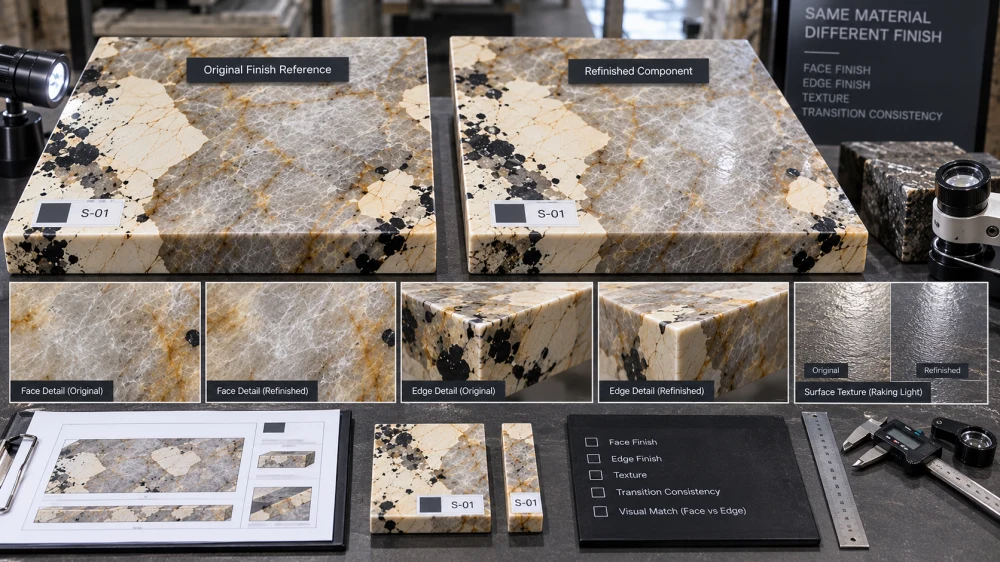
Compare the Face and the Edge Separately
Countertops, vanity tops, stairs, tables, reception counters, and other fabricated components often expose both a large face and one or more finished edges.
A refinished face may match the original reference while the edge reads differently because it was processed using a different sequence, tool, direction, or access condition.
Check separately:
Main Face → Straight Edge → Profiled Edge → Miter / Return → Local Refinished Area
Only the surfaces that are relevant to the finished project need to be included, but they should not be assumed to match automatically.
A Small Sample Can Hide Large-Area Finish Variation
A 100 × 100 mm or similarly small sample can be useful for developing a finish.
But it does not reproduce every condition of a large island, wall panel, or long countertop.
Large surfaces can reveal:
polishing bands;
changes in sheen across processing passes;
textura direcional;
localized dull areas;
surface waviness;
variação entre zonas minerais; e
transitions between factory-finished and locally refinished areas.
Do Not Let Refinish Approval Become a Blanket Slab Approval
This is the most important approval boundary in the article.
Approving one refinished sample may establish that a proposed surface process produces an acceptable result on the material reviewed.
It does not automatically prove that:
every slab will look identical;
every mineral zone will respond identically;
every large component will have identical sheen;
every previously treated area will respond the same way;
every edge will match the face automatically; or
the result will appear identical under every site lighting condition.
Natural Quartzite remains slab-specific.
The approval should therefore say what it actually releases.
Write the Approval Boundary Before Bulk Refinishing
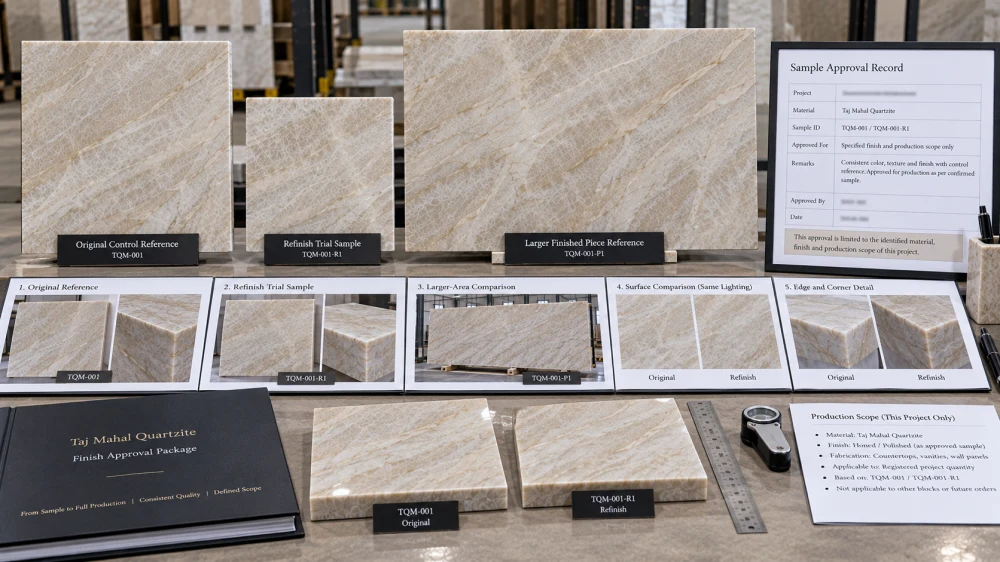
REFINISH APPROVAL RECORD
□ Original reference ID recorded
□ Refinished sample ID recorded
□ Material / slab relationship recorded
□ Proposed finish process recorded
□ Samples reviewed clean and dry
□ Same lighting and viewing conditions used
□ Overall sheen compared
□ Color depth compared
□ Texture compared
□ Processing marks reviewed
□ Face / edge relationship checked where relevant
□ Larger-area review completed if required
□ Photographs retained
□ Aprovador nomeado registrado
□ Pieces / slabs covered by approval identified
□ Re-review trigger defined
When Should the Finish Be Reviewed Again?
A previous sample approval should be reconsidered when a meaningful variable changes.
Exemplos incluem:
a different slab group;
a visibly different mineral zone;
a different finishing sequence;
different equipment or process where relevant;
a change from face processing to edge processing;
a change from small sample to large panel;
a previously treated or repaired area;
a different specified finish; or
another condition outside the recorded approval scope.
The goal is not to create unnecessary approvals.
It is to avoid extending one controlled sample result to materially different conditions without review.
What Should the Supplier Provide for a Refinish Review?
For the confirmed stone and fabrication scope, useful evidence may include:
quartzite-refinish-sample-final-approval-record
original reference sample identification;
refinished sample identification;
actual slab or piece reference;
finish description;
record of the proposed refinishing process;
side-by-side photographs;
reflected-light photographs;
close surface photographs;
relevant edge photographs;
larger-area review where required; and
written approval and release scope.
The project team should separately define any contractual appearance tolerance, instrument-based requirement, site acceptance procedure, maintenance requirement, or specialist technical criterion that applies.
Perguntas frequentes
1. How should I compare a refinished Quartzite sample with the original finish?
Identifique a referência original e a amostra reprocessada, coloque-as sob as mesmas condições de limpeza, secagem, iluminação, orientação e visualização, e compare o brilho, a reflexão, a profundidade da cor, a definição dos minerais, a textura, as marcas de processamento e as relações relevantes entre a borda e a face. Registre o resultado em vez de confiar na memória.
2. Should a refinished Quartzite sample be compared wet or dry?
Para uma comparação visual normal do acabamento, ambas as amostras devem ser avaliadas sob a mesma condição de superfície acordada. Comparar uma superfície úmida com uma seca pode distorcer a profundidade da cor, o contraste e o brilho, tornando a comparação do acabamento pouco confiável.
3. Can two honed Quartzite samples still look different?
Sim. O termo “honed” descreve uma categoria de acabamento, mas, por si só, não garante que haja brilho, textura, profundidade de cor, marcas de processamento ou resposta visual idênticos entre diferentes amostras. Compare as referências reais do projeto em condições controladas.
4. Is a photograph enough to approve a refinished Quartzite finish?
[FOTO_1] As fotografias são úteis para documentação e revisão remota, mas a exposição da câmera, o balanço de branco, reflexos, compressão e configurações da tela podem afetar a aparência. Quando a correspondência do acabamento é visualmente crítica, as fotografias devem servir de apoio, em vez de substituir automaticamente a avaliação da amostra física ou representativa acordada.[/FOTO_1].
5. Should gloss be measured when comparing Quartzite finishes?
Pode ser útil quando o projeto exige um critério numérico de brilho, mas o método, o instrumento, os locais de medição, as condições da amostra e a faixa aceitável devem ser definidos. Não existe um único valor universal de brilho que deva ser aplicado a todos os acabamentos em quartzito natural.
6. Can one approved refinished sample release all Quartzite slabs for production?
Não automaticamente. A aprovação deve identificar qual material, grupo de lajes, processo de acabamento, tipo de componente e escopo de produção ela abrange. Variações na pedra natural e alterações no processamento ou na escala podem exigir uma nova revisão.
7. When should a Quartzite refinish sample be reviewed again?
A reavaliação é adequada quando ocorre uma alteração significativa em variáveis, como o grupo de lajes, a zona mineral, o processo de acabamento, o tipo de superfície final, as condições das bordas, a escala amostra‑painel ou outra condição fora do escopo original de aprovação.
Final Finish-Matching RuleDo not approve a refinished Quartzite surface because it “looks close” in one photograph. Keep the comparison controlled: Original Reference → Refinished Sample → Same Surface Condition → Same Lighting → Sheen → Color Depth → Texture → Scale-Up Check → Written Approval → Defined Production Scope.
For project-based Natural Quartzite fabrication, HRST STONE can coordinate actual slab and sample references, finish-sample preparation, CAD/shop drawings, fabrication records, QC photographs, larger-area finish review, piece identification, packing, and export documentation for the confirmed stone scope. Send Josh the material name, original finish reference, proposed finish change, dimensions, quantities, drawings, visible surfaces, and delivery destination before bulk refinishing or fabrication release.
Hi, I am the author of this article. I have been working in the field of Natural Stone for more than 15 years. If you need customized Natural Stone services, please feel free to contact me.
Fabricante e Fornecedor de Mármore, Granito, Quartzito, Ágata da China - HRST STONE
Bem-vindo à HRST STONE!
Olá, gostaria de saber mais sobre seus produtos. Você poderia compartilhar informações sobre preços, quantidade mínima de pedido, opções de personalização e amostras?