
Introduction: Why Segmented Curved Marble Panels Dominate Real Projects
In real-world construction, segmented curved marble panels are far more common than fully CNC-carved stone elements. While CNC curved marble panels provide seamless geometry, they are often limited by cost, material waste, and machining time. In contrast, segmented curved marble panels offer a practical and scalable solution that can be applied across a wide range of architectural projects.
Segmented curved marble panels are widely used in hotels, shopping malls, office buildings, and large residential developments. They allow designers to achieve curved surfaces without requiring excessive material removal. This makes them particularly suitable for large-radius applications where CNC carving would be inefficient.
If you are not familiar with the overall system of curved stone fabrication, you can first review:
곡선형 대리석 패널 제작 가이드. This article explains how segmented curved marble panels fit into the full fabrication process.
To understand how flat slabs are prepared before segmentation, you can also refer to:
flat marble slabs to curved stone panels.
For projects requiring high precision comparison, CNC methods are explained here:
CNC curved marble panels.
What Are Segmented Curved Marble Panels
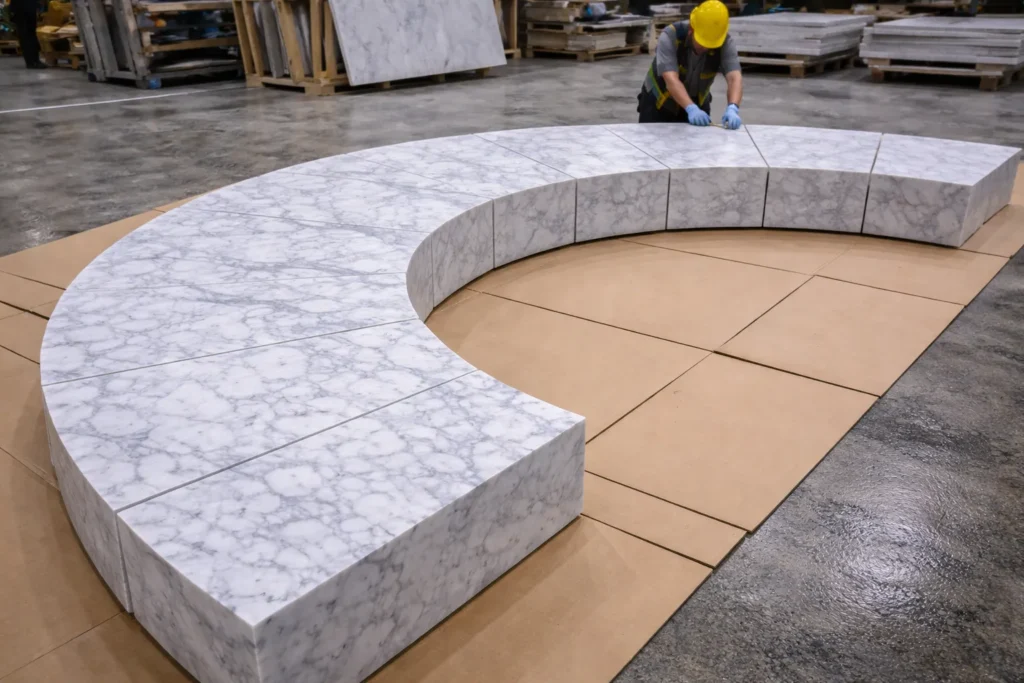
Segmented curved marble panels are created by dividing a curved surface into multiple flat stone pieces. Each segment is cut with a slight angular adjustment so that when all pieces are installed together, they form a continuous curve. This method does not require bending or heavy material removal, making it more efficient than other fabrication techniques.
The success of segmented curved marble panels depends on how accurately each segment is designed and fabricated. Even small errors in angle or size can accumulate across multiple panels, resulting in visible gaps or inconsistent curvature. Therefore, precise planning and fabrication are essential.
Why Segmented Curved Marble Panels Are Cost-Effective
One of the main advantages of segmented curved marble panels is cost efficiency. Unlike CNC carving, which removes a large volume of material, segmentation uses standard slab thickness with minimal waste. This reduces both material cost and processing time.
In addition, segmented curved marble panels are easier to transport because each piece is smaller and less prone to breakage. This reduces logistics risk and allows for more flexible packaging solutions. For large-scale projects, these factors can significantly impact overall project cost.
Joint Control: The Most Critical Factor
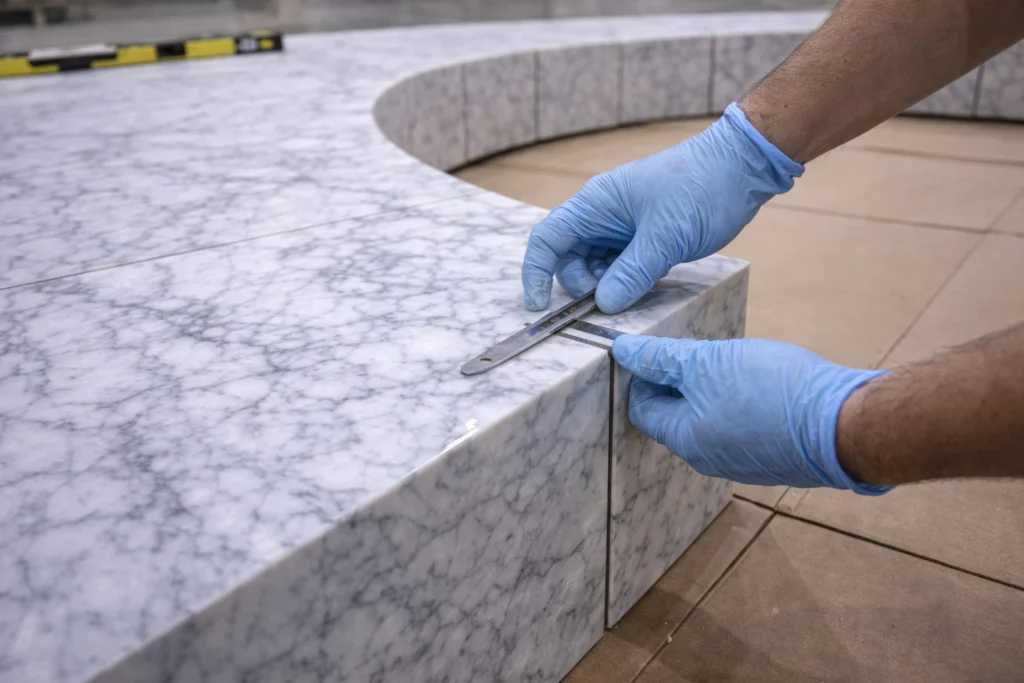
The most important aspect of segmented curved marble panels is joint control. Joints must be carefully designed to ensure that they are visually minimal while maintaining structural stability. The width and alignment of joints determine whether the final surface appears smooth or fragmented.
Joint control begins in the design phase. The number of segments must be calculated based on the radius and viewing distance. Smaller segments create a smoother visual effect but increase fabrication complexity. Larger segments reduce cost but may make the curvature appear faceted.
During fabrication, each segment must be cut with precise angles to match the overall radius. Even slight deviations can result in cumulative errors that affect the final installation. Therefore, factories often perform dry layout tests before packing to verify alignment.
| Segment Width | Visual Effect | Cost Impact | Recommended Use |
|---|---|---|---|
| Small (≤100mm) | Very smooth curvature | High cost | Luxury interiors, close viewing distance |
| Medium (100–300mm) | Balanced appearance | Moderate cost | Hotels, commercial interiors |
| Large (≥300mm) | Visible faceting | Low cost | Exterior facades, long-distance viewing |
Fabrication Process of Segmented Curved Marble Panels
The fabrication of segmented curved marble panels begins with digital modeling. The curved surface is divided into segments using design software. Each segment is assigned a specific angle and dimension based on its position within the curve.
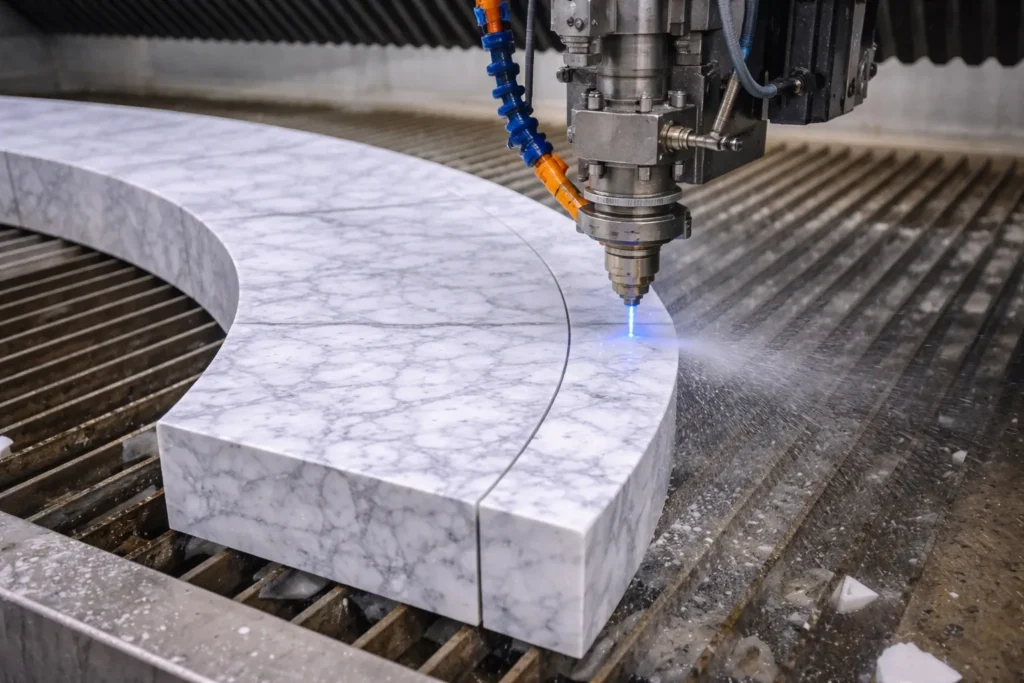
Once the design is finalized, slabs are cut into individual pieces. Each piece is processed according to its required angle. Edge finishing is critical because joint lines must be consistent across all segments. After cutting, the panels are labeled and organized according to installation sequence.
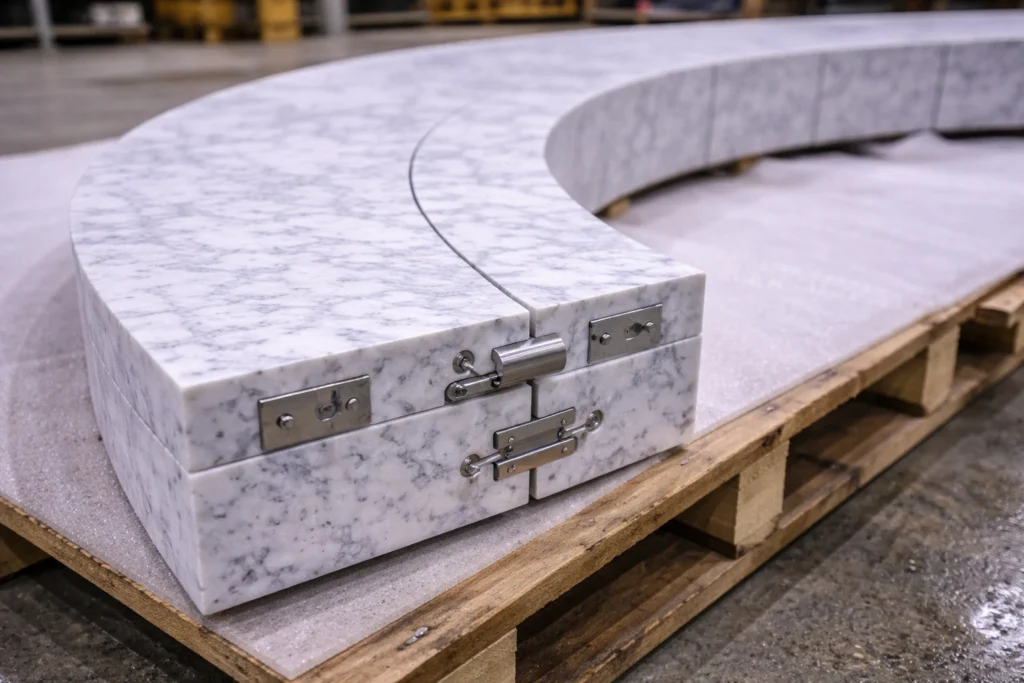
Before shipment, factories typically perform a dry assembly to ensure that all segments align correctly. This step is essential for preventing installation issues on site.
Installation Strategy for Segmented Curved Marble Panels
Installation of segmented curved marble panels requires careful sequencing. Panels must be installed in the correct order to maintain the intended curvature. Incorrect sequencing can lead to misalignment and visible inconsistencies.
Anchoring systems must also be designed to support each segment securely. Because the panels are arranged along a curve, load distribution differs from flat installations. Proper anchoring ensures that panels remain stable over time.
During installation, joints must be adjusted carefully to maintain consistent spacing. This requires skilled labor and precise measurement. Even minor misalignment can disrupt the visual flow of the curve.
Visual Performance of Segmented Curved Marble Panels
When properly executed, segmented curved marble panels can achieve a high level of visual continuity. The joints become less noticeable as viewing distance increases, creating the appearance of a smooth curved surface.
Lighting conditions also influence visual performance. In well-lit environments, joint lines may become more visible, requiring tighter control of joint width. In softer lighting conditions, the segmentation effect is less pronounced.
Material selection plays a role as well. Uniform marble tends to hide joints more effectively than highly veined materials. Therefore, material choice should be aligned with design expectations.
Common Problems in Segmented Curved Marble Panels
One common issue is joint misalignment, which occurs when segments are not fabricated or installed correctly. This can result in uneven spacing or visible gaps between panels. Another issue is inconsistent curvature, which may occur if segment angles are not calculated accurately.
Transport damage is another risk. Because segmented curved marble panels consist of multiple pieces, improper packaging can lead to edge damage. This can affect joint quality during installation.
These problems can be minimized through proper planning, quality control, and communication between factory and installation teams.
| Problem | 원인 | Solution |
|---|---|---|
| Joint misalignment | Incorrect angle cutting | Dry layout before shipment |
| Visible gaps | Poor installation control | Adjust joint spacing on site |
| Curvature inconsistency | Wrong segment calculation | Recalculate radius segmentation |
| Edge damage | Improper packaging | Use reinforced packing |
When to Choose Segmented Curved Marble Panels
Segmented curved marble panels are ideal for projects with large-radius curves and budget constraints. They are also suitable for projects requiring flexibility in installation and replacement. Compared to CNC methods, segmentation offers a more practical solution for large-scale applications.
However, for small-radius or high-precision projects, CNC curved marble panels may still be the better choice. The decision should be based on project requirements, budget, and design expectations.
| Project Condition | Segmented Panels Suitability |
|---|---|
| Large radius wall | Highly suitable |
| Small radius curvature | Not recommended |
| Budget-controlled projects | Best solution |
| High-end seamless design | Limited suitability |
Pre-Production Planning and Technical Review
Before producing segmented curved marble panels, it is important to review design drawings, confirm segment dimensions, and evaluate material selection. Early technical review helps prevent errors that could affect fabrication and installation.
If your project involves segmented curved marble panels, you can directly
문의하기 for technical support and fabrication evaluation.
자주하는 질문
1. What are segmented curved marble panels?
They are curved surfaces formed by assembling multiple flat marble segments.
2. Why are segmented curved marble panels widely used?
Because they balance cost, fabrication efficiency, and visual performance.
3. Are joints visible?
They can be minimized with proper design and installation.
4. Are they cheaper than CNC panels?
Yes, because they reduce material waste and machining time.
5. Do they require special installation?
Yes, correct sequencing and joint alignment are critical.


