Introduction: Why CNC Curved Marble Panels Define High-End Stone Projects
In modern architectural stone fabrication, CNC curved marble panels have become the most reliable solution for achieving precise radius geometry. Unlike traditional fabrication methods, CNC technology allows marble slabs to be transformed into curved surfaces with controlled accuracy and repeatability. This makes CNC curved marble panels essential in projects where visual continuity and dimensional precision are critical.
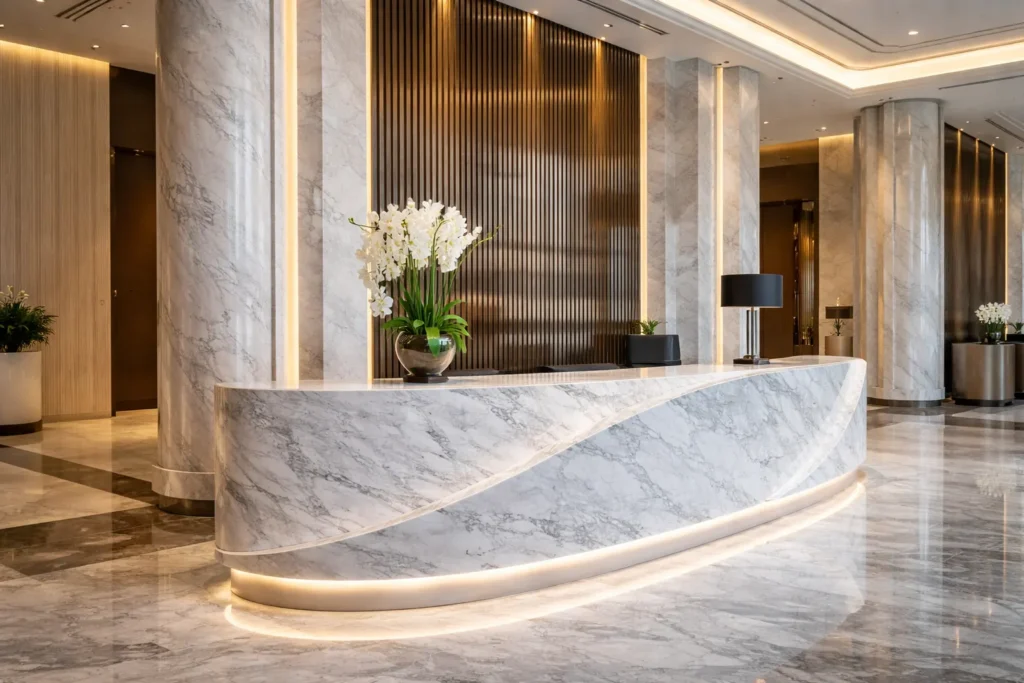
CNC curved marble panels are commonly used in luxury interiors such as hotel reception areas, retail flagship stores, and custom residential designs. In these applications, even small deviations in curvature can affect the final visual result. CNC machining ensures that each panel follows the exact radius defined in the design model, allowing architects to achieve smooth and consistent curved surfaces.
If you are new to curved stone fabrication, it is recommended to first review the overall system here:
곡선형 대리석 패널 제작 가이드. This provides a complete overview of how CNC curved marble panels fit into the broader fabrication workflow.
To understand how flat slabs are prepared before CNC processing, you can also refer to:
flat marble slabs to curved stone panels. CNC curved marble panels are not created in isolation but depend on earlier material selection and engineering decisions.
How CNC Curved Marble Panels Are Produced
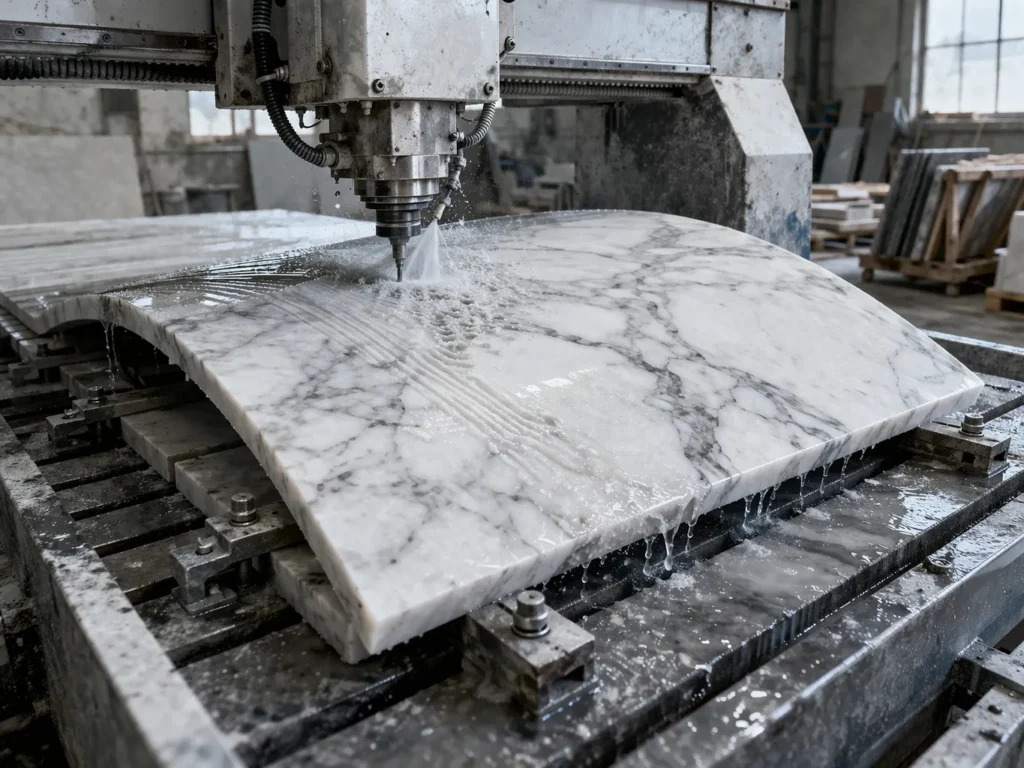
The production of CNC curved marble panels is based on a subtractive manufacturing process. A flat marble slab is secured onto a CNC machine bed, and a cutting tool removes material gradually according to a digital model. The curvature is formed by precisely controlling the depth and movement of the tool across the surface.
CNC curved marble panels are generated using toolpaths calculated through CAM software. These toolpaths determine how the cutting head moves, how much material is removed in each pass, and how the final surface is refined. The process is repeated in multiple layers until the desired curvature is achieved.
Because CNC curved marble panels rely on material removal rather than bending, slab thickness plays a critical role. Thicker slabs are required when deeper curvature is needed, as sufficient material must be available for shaping. This is one of the reasons why CNC fabrication is often more expensive compared to other methods.
Machine Types Used for CNC Curved Marble Panels
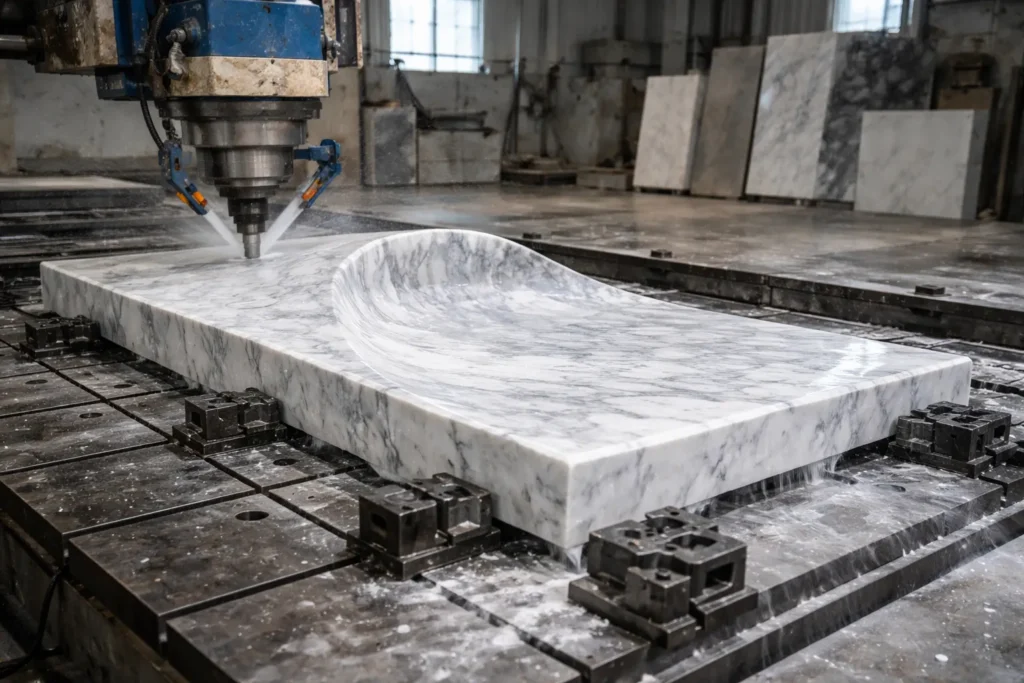
Different CNC machines are used depending on the complexity of the project. Three-axis machines are commonly used for standard CNC curved marble panels where curvature is relatively simple. These machines move along linear axes and are suitable for most architectural applications.
Five-axis CNC machines are used when CNC curved marble panels require more complex geometry. These machines allow the cutting tool to approach the material from multiple angles, enabling the creation of advanced curved forms. This is especially important in projects with non-uniform curvature or sculptural designs.
Bridge-type CNC machines are preferred for processing large slabs. Their rigid structure ensures stability during cutting, which improves the accuracy of CNC curved marble panels. However, the choice of machine must always match the design complexity and project requirements.
Tooling and Surface Quality in CNC Curved Marble Panels
The quality of CNC curved marble panels depends heavily on the cutting tools used during fabrication. Diamond tools are typically used because they can effectively cut through hard stone materials. The shape of the tool also affects the final surface, with ball-end tools being preferred for curved surfaces.
As tools wear down during production, the quality of CNC curved marble panels can deteriorate. This may result in surface irregularities or slight deviations in curvature. Regular tool maintenance and replacement are therefore essential for maintaining consistent quality.
Incorrect tool selection can also cause defects in CNC curved marble panels. For example, using an inappropriate tool diameter can lead to inaccurate radius formation. Similarly, poor-quality tools may create edge chipping or uneven surfaces.
Water Cooling and Process Stability
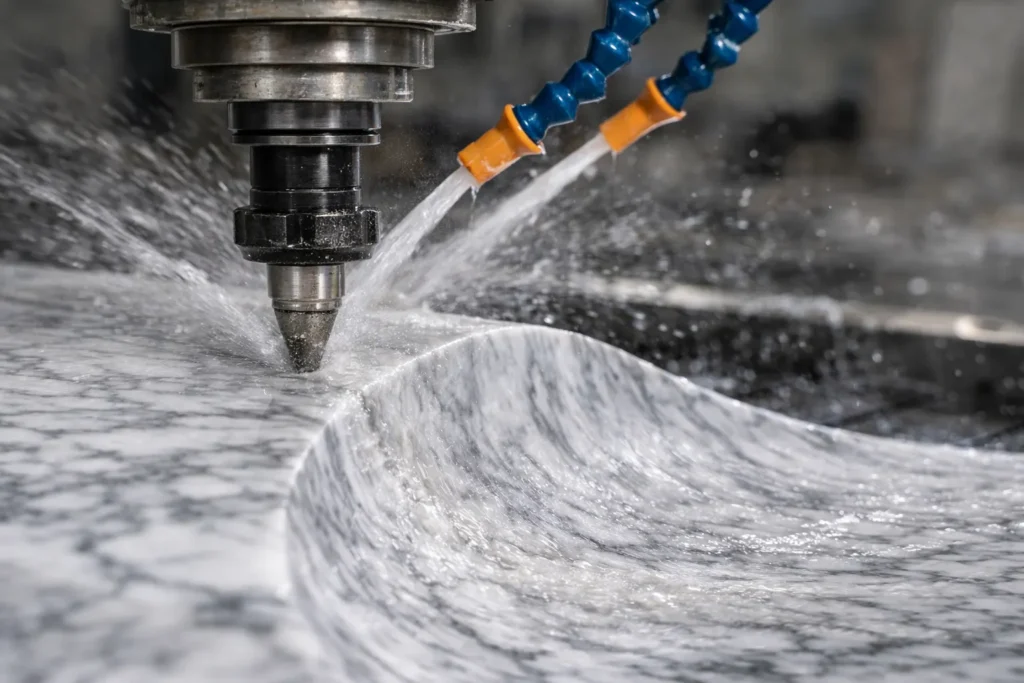
During the fabrication of CNC curved marble panels, water cooling is used to control heat generated by friction. Without proper cooling, the temperature at the cutting point can increase significantly, leading to thermal stress within the stone.
Water cooling helps maintain the stability of CNC curved marble panels by reducing heat and removing debris from the cutting area. This improves both cutting efficiency and surface quality. Inadequate cooling can lead to tool damage and material failure.
Accuracy and Tolerance in CNC Curved Marble Panels
One of the main advantages of CNC curved marble panels is their high level of accuracy. However, achieving consistent tolerance requires careful control of multiple factors, including machine calibration, tool condition, and material consistency.
Typical tolerance for CNC curved marble panels ranges from one to two millimeters. This level of precision is sufficient for most architectural applications, but tighter tolerance may be required for complex installations. Even small deviations can become noticeable when panels are installed together.
Quality control procedures are essential to ensure that CNC curved marble panels meet design specifications. This includes inspecting slabs before cutting, monitoring machine performance during fabrication, and verifying dimensions after machining.
Material Behavior and CNC Curved Marble Panels
The behavior of the stone material plays a significant role in the production of CNC curved marble panels. Uniform marble is generally easier to machine and produces more consistent results. In contrast, quartzite is harder and more abrasive, which increases tool wear and reduces cutting efficiency.
Highly veined marble can also present challenges when producing CNC curved marble panels. Veins may act as weak points, increasing the risk of cracking during machining. Therefore, careful material selection is critical for achieving successful results.
When CNC Curved Marble Panels Are the Best Solution
CNC curved marble panels are ideal for projects that require seamless curvature and high precision. They are particularly suitable for small-radius applications where segmented fabrication would create visible joints. They are also preferred in luxury projects where visual quality is a top priority.
However, CNC curved marble panels may not be the most cost-effective solution for all projects. For large-radius surfaces or projects with budget constraints, alternative methods such as segmented fabrication may be more practical.
Planning Before Producing CNC Curved Marble Panels
Proper planning is essential before producing CNC curved marble panels. This includes verifying design drawings, confirming slab thickness, and evaluating material stability. A test cut is often performed to ensure that the selected material behaves as expected during machining.
Because CNC curved marble panels are produced through material removal, errors cannot be corrected once cutting begins. This makes early technical review critical for avoiding costly mistakes.
If your project involves CNC curved marble panels, you can directly
문의하기 for technical consultation before fabrication.
자주하는 질문
1. What are CNC curved marble panels?
CNC curved marble panels are stone panels shaped using CNC machines to achieve precise curved geometry.
2. Why are CNC curved marble panels more precise?
Because they are produced using digital toolpaths that control material removal accurately.
3. Are CNC curved marble panels expensive?
Yes, due to material waste and machining time.
4. Can CNC curved marble panels be used for facades?
Yes, but weight and installation methods must be considered.
5. Do CNC curved marble panels require special installation?
Yes, proper alignment and support systems are necessary.