
블로그

CNC vs Waterjet vs 5-Axis Machining: Stone Fabrication Guide

In the world of high-end architecture, a design is only as good as its execution. You’ve likely seen the renders: sweeping parametric facades, organic marble staircases that seem to defy gravity, and intricate relief walls that tell a story in limestone. But as any seasoned project manager knows, the distance between a beautiful CAD file and a finished stone masterpiece is paved with technical hurdles.

When it’s time to move from screen to stone, the question isn’t just “how do we cut this?” but rather, “stone fabrication CNC vs waterjet vs 5 axis—which one won’t blow the budget or ruin the schedule?” Choosing the wrong stone cutting technology can lead to jagged edges, wasted material, or a bill that makes the client weep. This guide dissects the three titans of the workshop to help you choose the right tool for your next complex stone fabrication project.

The Architect’s Dilemma: 3 Common Pain Points

Before we dive into the mechanics, let’s acknowledge the headaches that keep designers up at night:

  1. The “Vanish-Act” of Detail: You design a delicate 3D texture, but the fabricator says it’s “impossible” or returns a piece that looks like it was carved with a butter knife.

  2. The Budget Blowout: Selecting a 5-axis machine for a job that a standard CNC could have handled, resulting in costs that are 3x higher than necessary.

  3. The Structural Snap: Choosing a cutting method that puts too much vibration or thermal stress on the slab, causing expensive quartzite or marble to crack during the final stage of production.

Understanding the Contenders: Roles and Definitions

To navigate complex stone fabrication, one must first understand the fundamental “DNA” of each machine.

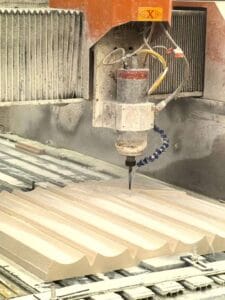
1. CNC Stone Machining (3-Axis and 4-Axis)

표준 CNC stone machining operates on a Cartesian coordinate system ($X, Y, Z$). Think of it as a highly disciplined sculptor that moves left-to-right, front-to-back, and up-and-down.

  • Best for: Flat surfaces, rebates, engraving, and basic 3D reliefs.

  • The Catch: It struggles with undercuts or steep vertical curves because the tool head is always perpendicular to the table.

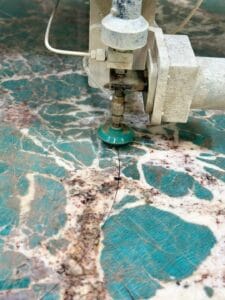
2. Waterjet Cutting

Waterjet technology uses a supersonic stream of water mixed with garnet abrasive. It is the “scalpel” of the industry.

  • Best for: Intricate 2D outlines, stone inlays (marquetry), and cutting thick slabs (up to 200mm) with extreme precision.

  • The Catch: It is strictly a “through-cutter.” It cannot create depths, pockets, or 3D carvings.

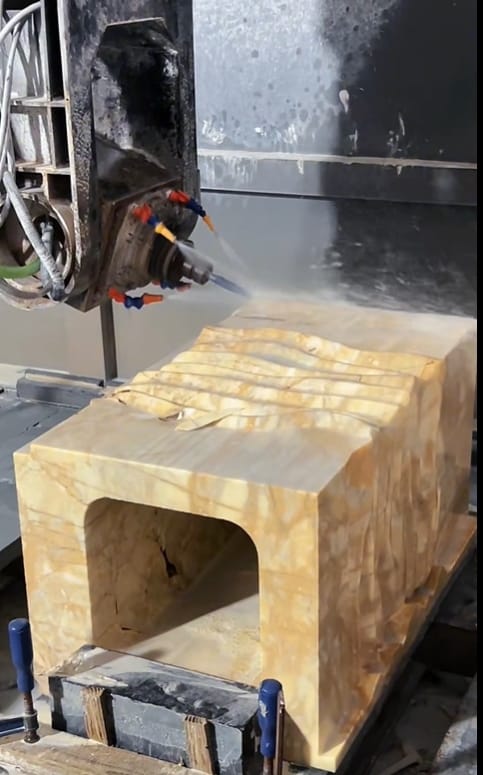
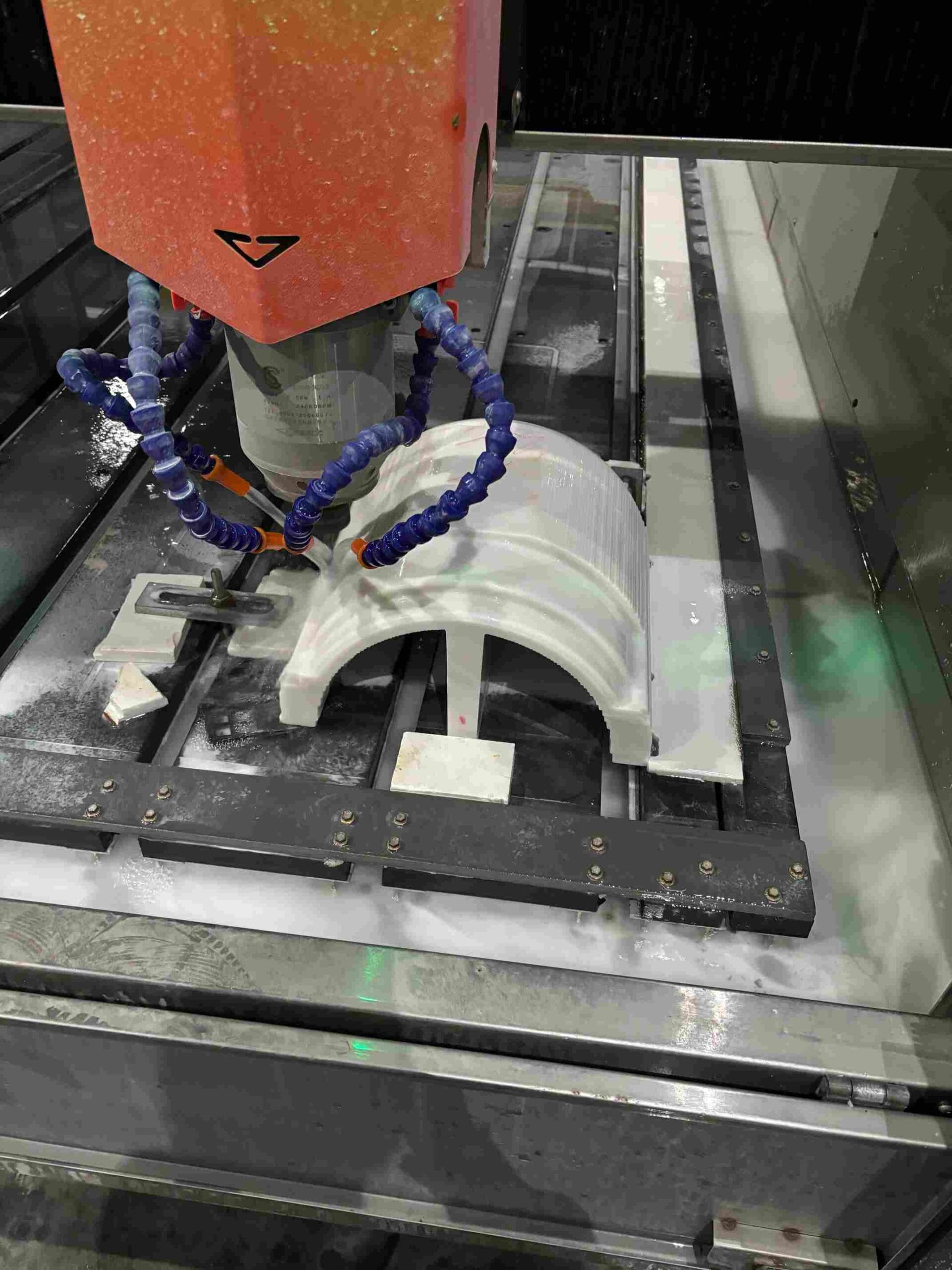
3. 5-Axis Machining

The 5-axis machine adds two rotational axes ($A$ 그리고 $B$) to the standard $X, Y, Z$. The cutting head can tilt and rotate, allowing it to approach the stone from any angle.

  • Best for: True 3D sculptures, twisted staircases, and “undercut” designs where the tool must reach beneath a lip of stone.

  • The Catch: High programming complexity and expensive hourly rates.

Head-to-Head Comparison: The Data

When deciding on stone cutting technology, use the following matrix to weigh your priorities.

FeatureCNC (3/4 Axis)Waterjet5-Axis Machining
Dimensionality2.5D (Reliefs)2D (Flat Profiles)Full 3D (Sculptural)
PrecisionHighUltra-HighHigh
Setup TimeMediumFastSlow (Complex Coding)
Material WasteModerateMinimal (Thin Kerf)Moderate
Best ForKitchen Tops / Wall PanelsFloor Inlays / MedallionsStatuary / Complex Curves

Deep Dive: Which Process for Which Shape?

The “Golden Rule” of complex stone fabrication is matching the tool’s movement to the stone’s geometry.

Scenario A: Parametric Facade Panels

If your design features a repeating geometric wave, CNC stone machining is usually the winner. Since the panels are mostly flat with varying depths, a 3-axis CNC can batch-produce these efficiently.

  • Why not 5-axis? It’s overkill. You’re paying for rotational movement you don’t need.

Scenario B: Intricate Floor Medallions

For a hotel lobby featuring interlocking marble colors, waterjet cutting is the only logical choice. The “kerf” (the width of the cut) is less than 1mm, allowing pieces to fit together like a perfect jigsaw puzzle.

  • Why not CNC? A mechanical bit has a diameter (usually 6mm-20mm) and cannot cut sharp internal corners.

Scenario C: The Spiral Solid-Stone Staircase

When the underside of a tread is curved and the side is twisted, you need 5-axis machining. The tool must “follow” the curve of the stone in a fluid, multi-directional motion to ensure a smooth finish.

  • Why not Waterjet? It cannot carve; it can only cut through.

Engineering for Success: Pro Tips for Designers

Beyond the machine choice, the success of complex stone fabrication depends on how you prepare the “Digital Twin.”

  1. Mind the “Safety Thickness”: When using 5-axis paths for thin organic shapes, always leave a 2-3mm “tolerance” in the digital model. Stone is a natural product with internal stresses; if you go too thin, the vibration of the tool will shatter the piece.

  2. Integrated Fixings: For heavy 3D wall claddings, use CNC stone machining to pre-cut the pockets for undercut anchors or T-slots. This should be done in the factory, never on-site.

  3. The Hybrid Approach: Most high-end projects use a combination. A waterjet might cut the rough “blank” of a statue to save time, followed by 5-axis milling for the detail, and finally, manual hand-finishing for the soul.

Market Insights & Future Trends

The stone industry is moving toward “Industry 4.0.” We are seeing an increase in Robotic Arm Machining (effectively 6-axis or 7-axis), which allows for even larger-scale complex stone fabrication, such as entire monolithic columns.

Sustainability is also driving the popularity of waterjets. Because they use a “cold cutting” process, there is no thermal shock to the stone, and the water can be recycled in closed-loop systems. Furthermore, the ability of waterjets to nest parts tightly reduces material waste—a critical factor when working with $1,000-per-square-metre Calacatta Borghini.

Conclusion: Making the Right Call

There is no “best” machine—only the best machine for your specific geometry and budget.

  • Choose waterjet for flat, intricate patterns and interlocking parts.

  • Choose CNC stone machining for traditional architectural elements, moldings, and shallow textures.

  • Choose 5-axis machining for the “impossible” shapes—the curves, the twists, and the true 3D forms.

~에 Quartzite Stone, we specialise in bridging the gap between ambitious design and technical reality. Whether you are sourcing premium quartzite slabs or need advice on a custom installation, our team is here to ensure your vision is set in stone—perfectly.

Ready to bring your complex design to life? Contact our engineering team today for a technical review of your CAD drawings.


FAQ: Common Questions on Stone Technology

1. Is 5-axis machining always more expensive than CNC?

Generally, yes. The hourly rate for the machine is higher, and the “CAM” (Computer-Aided Manufacturing) programming takes significantly longer. However, for a very complex part, it might be cheaper because it can finish the piece in one setup, whereas a 3-axis CNC would require the stone to be moved and recalibrated multiple times.

2. Can waterjets cut through 100mm granite?

Yes. Modern waterjets can cut through stone up to 200mm thick, though the speed decreases as the thickness increases.

3. Which method is best for preventing cracks in fragile marble?

Waterjet is often safest for fragile materials because it exerts very little lateral force on the stone. CNC and 5-axis machining involve physical bits “pushing” against the material, which can cause vibrations.

4. What file types do I need for these machines?

For waterjet (2D), a clean .DXF or .DWG is standard. For CNC and 5-axis (3D), you will need to provide .STEP, .IGES, or .STL files.

5. Does the machine finish determine the final polish?

No. While these machines can get the stone very close to the final shape, a high-gloss polish usually requires secondary oscillating heads or manual polishing by a craftsman.

6. Can I use these technologies for sintered stone or porcelain?

Absolutely. In fact, waterjet is the preferred method for sintered stone to avoid the internal tension issues common with mechanical cutting.


References & Authority Links

관련 상품

포르토 생 로랑 대리석

모로코 채석장에서 공급되는 포트 생 로랑 대리석은 디자인과 건축에서 유행을 타지 않는 우아한 선택입니다. 짙은 검은색 또는 짙은 회색 배경이 고급스러운 분위기를 연출하며, 복잡한 결이 깊이와 시각적 흥미를 더합니다. 대비되는 색상이 우아하고 세련된 외관을 연출하여 전체적인 디자인을 더욱 돋보이게 합니다. 포트 생 로랑 대리석은 다양한 디자인 스타일에 매끄럽게 통합되는 다재다능한 디자인 덕분에 건축가와 디자이너들 사이에서 인기가 높습니다. 풍부한 색상과 독특한 결 무늬는 각 조각을 하나의 예술 작품으로 만들어 건축 및 디자인 작업에서 세련미와 우아함을 상징합니다.

자세히 보기 »

베르데 거북 규암

Verde Tortoise Quartzite는 비 오는 날 숲의 잔재와 같은 녹회색의 돌입니다. 거북이 껍질과 거북이 껍질 모양으로 인해 프로젝트 바닥이나 악센트 벽 또는 욕실 조리대 또는 샤워 공간 디자인에 이상적인 옵션이 될 수 있습니다.

자세히 보기 »

중국 팔리산드로 대리석

Palissandro Marble은 중국에서 채석된 은청회색 대리석의 일종입니다. 이 석재는 외부 - 내부 벽 및 바닥 응용 프로그램, 기념물, 조리대, 모자이크, 분수, 수영장 및 벽 덮개, 계단, 창틀 등 및 기타 디자인 프로젝트에 특히 좋습니다.

자세히 보기 »

자수정 준보석

아름다운 보라색을 띠는 인기 있는 준보석인 자수정은 평온함, 영성, 마음의 명료함을 상징합니다. 장신구, 장식품 및 조리대에 자주 사용됩니다. 자수정의 경도는 석영과 유사하여 긁힘과 일상적인 마모에 강합니다.

자세히 보기 »