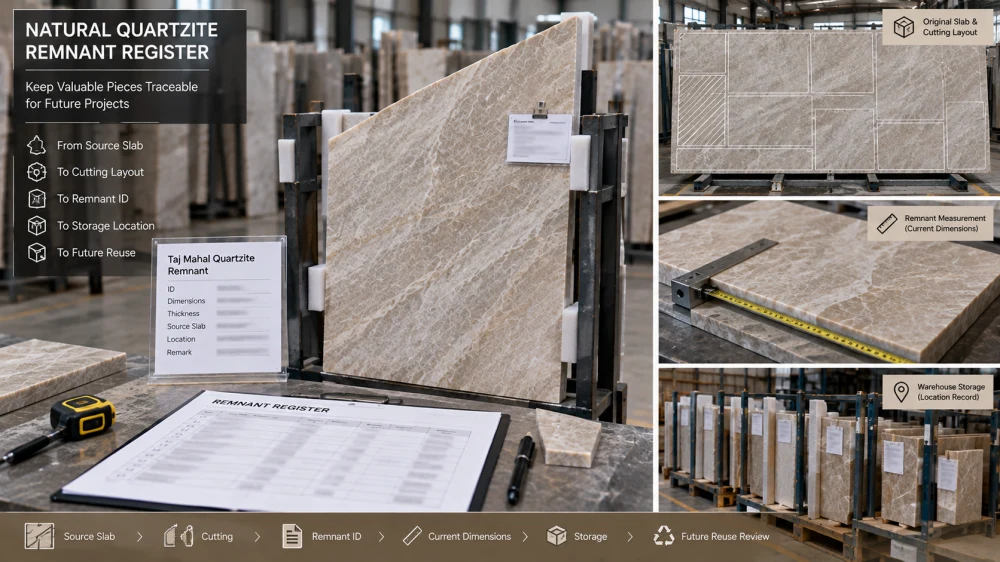
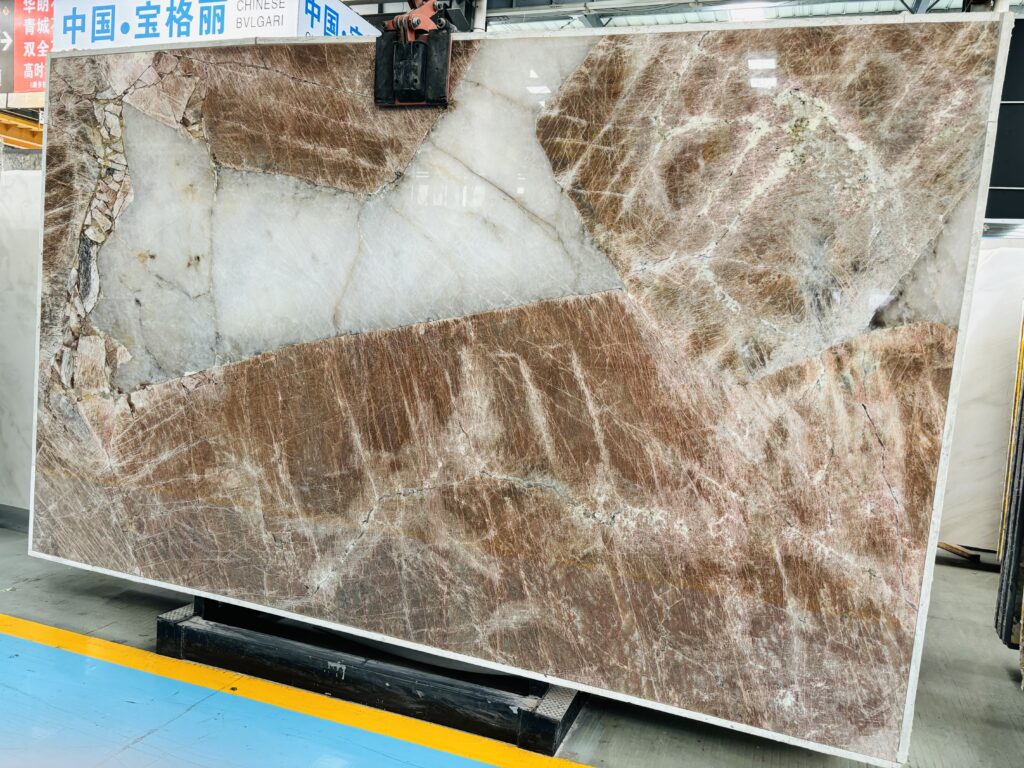
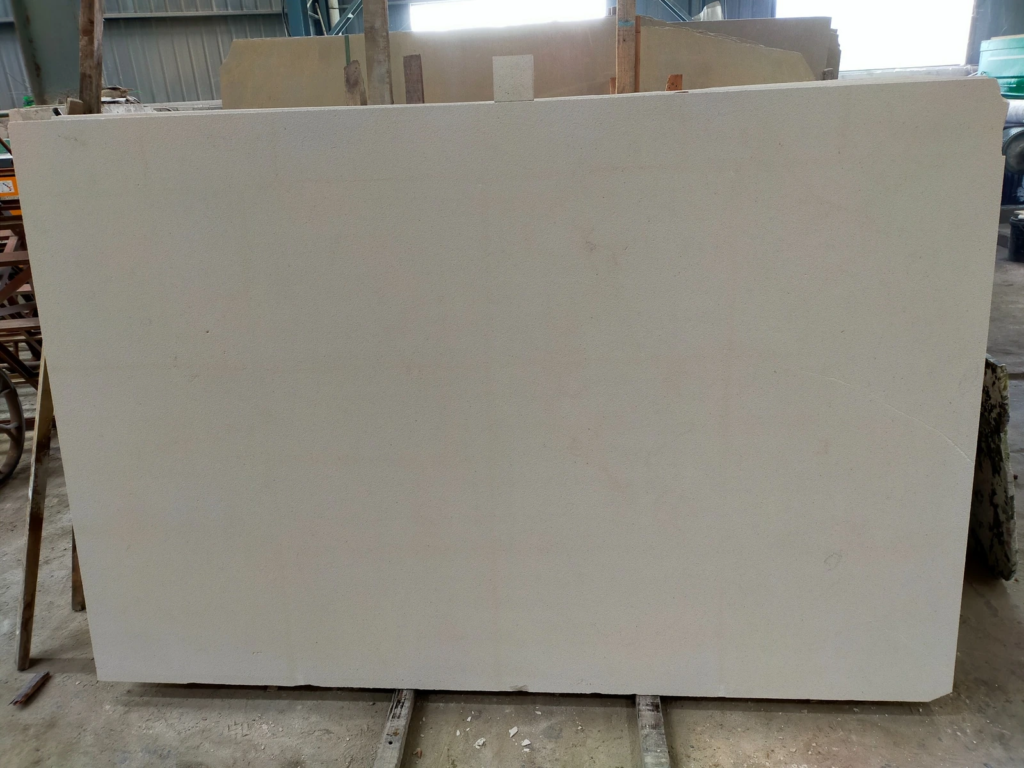
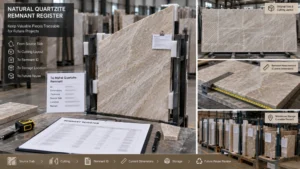
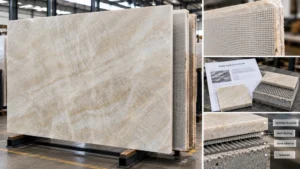
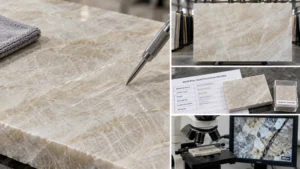
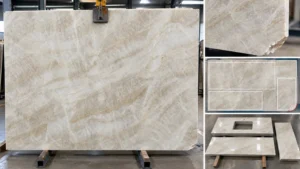
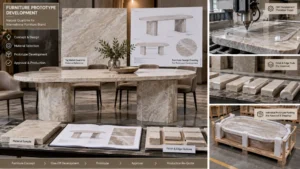
A Quartzite remnant register keeps useful leftover stone connected to its physical identity after the original slab has been cut. Each retained piece should have a stable remnant ID linked, where known, to its source slab, actual dimensions, thickness, visible face, finish, condition, photographs, storage location, status, and later recut history. The register helps a team find and evaluate a remnant again; it does not automatically prove that the piece is suitable, available, reserved, or large enough for a future project.
A Natural Quartzite project is completed, but several useful pieces remain.
Six months later, a replacement vanity top is needed.
The warehouse still has matching stone—but which piece came from the original slabs?
How large is it now?
Was it already recut?
Which face is finished?
Where is it stored?
This is the purpose of a Quartzite remnant register.
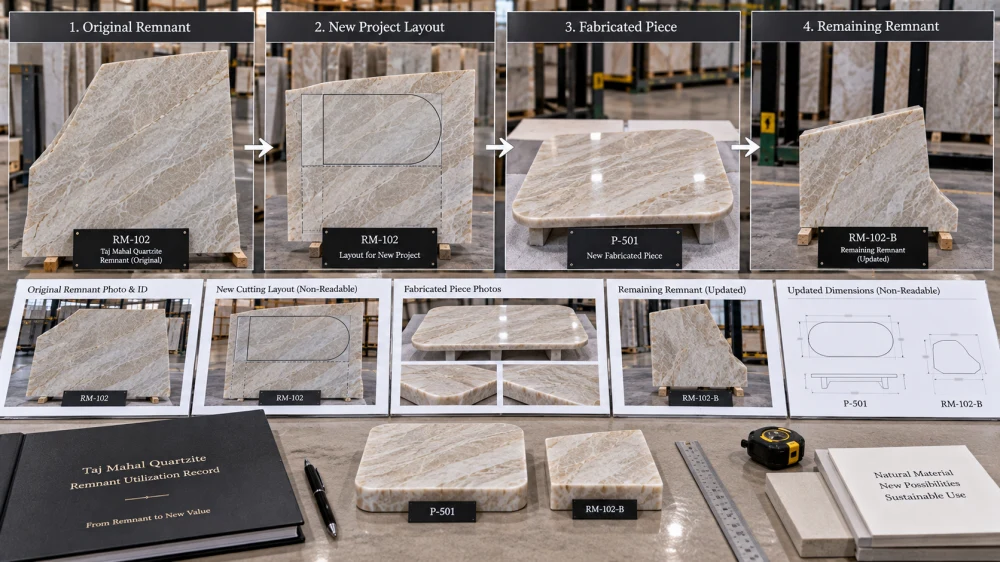
The register should preserve one continuous identity chain:
Source Slab → Original Cutting → Remnant ID → Current Physical Piece → Storage → Reuse Review → New Fabricated Piece
What Counts as a Quartzite Remnant?
A remnant is a physical piece of stone retained after another cutting, fabrication, sampling, replacement, or project activity.
Depending on the project, it might be:
a large unused section of a selected slab;
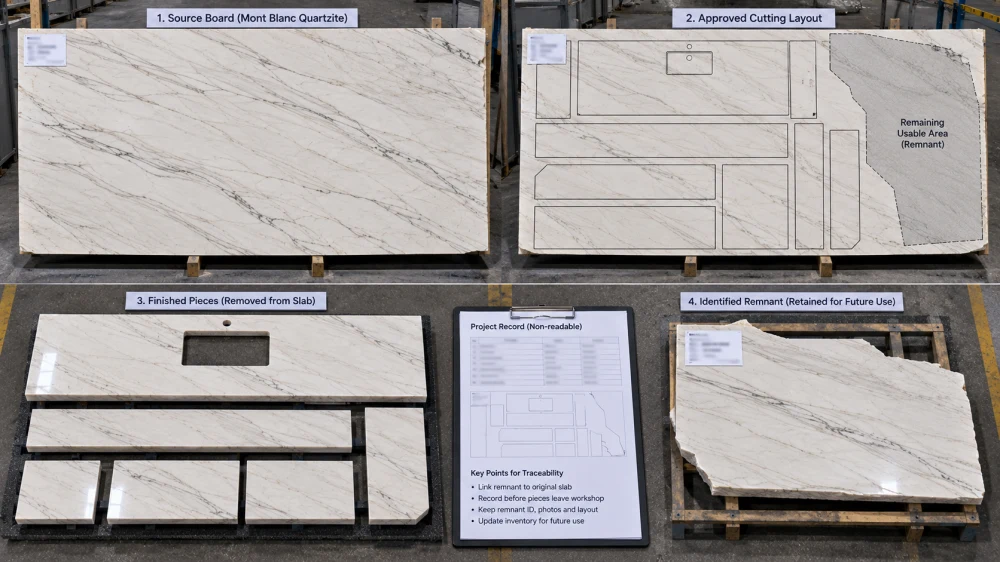
mont-blanc-quartzite-source-slab-remnant-id
a rectangular piece left beside a countertop layout;
a narrow strip;
a piece retained for a possible replacement;
material reserved for a future furniture component;
a finished or partially finished offcut;
a piece containing an approved finish reference; or
another physically identifiable leftover component.
Not every scrap needs to enter a controlled register.
The useful question is whether retaining the piece’s identity could have value for a future project decision.
The Most Important Rule: Do Not Let the Remnant Become Anonymous
Before the original slab identity disappears from the workshop, assign the retained piece a stable remnant ID.
例えば:
Board TM-042 → Original Cutting Plan → Remnant TM-042-R01
If another useful section remains:
Board TM-042 → Remnant TM-042-R02
This is only a conceptual naming structure. A factory can use another system as long as the identifier is unique and remains attached to the physical piece and its records.
Traceability Rule
Create the remnant ID while the relationship to the source slab is still known. Reconstructing that identity months later from colour, pattern, or memory is much less reliable.
What Fields Belong in a Quartzite Remnant Register?
A useful register should answer identification, physical-condition, location, and status questions without pretending to answer fabrication questions that have not yet been reviewed.
Register Field
What It Records
Remnant ID
Unique identity of the current physical piece
素材名
Commercial Natural Quartzite reference used for the project
Source Slab / Board
Original slab identity where known
Original Project
Project or order reference that created the remnant
Current Dimensions
Measured current physical size, not an old theoretical size
厚さ
Current stated or measured thickness where relevant
Face / Orientation
Visible face and orientation reference where useful
表面/仕上げ
Current finish or processing state
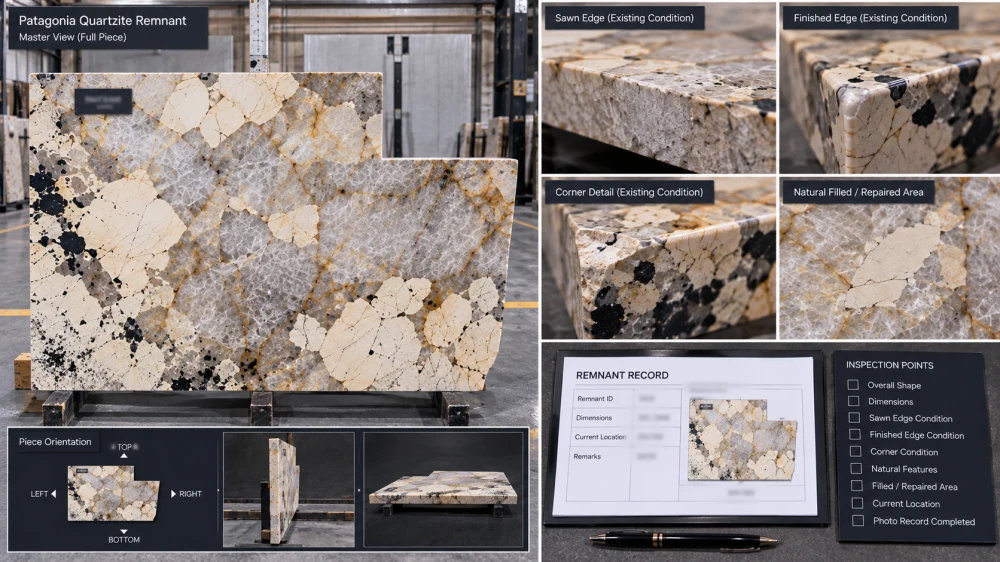
Condition Notes
Observed edges, filled areas, cutouts, damage or other review points
Photo Record
Current dated images linked to the same remnant ID
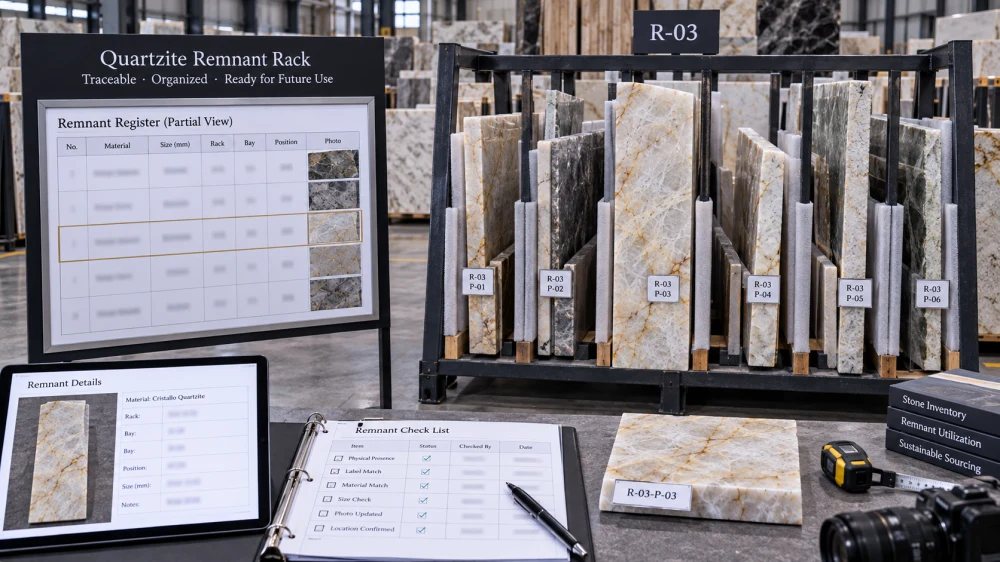
Storage Location
Rack, zone, crate, shelf, pallet or other controlled location
ステータス
Current register status such as available for review, held, allocated, recut or archived
Last Verified
Date the physical piece and record were last reconciled
Keep the Source Slab Number Whenever It Is Known
The commercial material name is useful, but it is not enough for strong traceability.
Two remnants may both be labelled Taj Mahal Quartzite while coming from different slabs with different natural movement.
Where the source is known, retain the relationship:
If the source is genuinely unknown, do not invent it.
Use a status such as:
Source Slab: Unverified
That is more useful than creating false certainty from visual similarity.
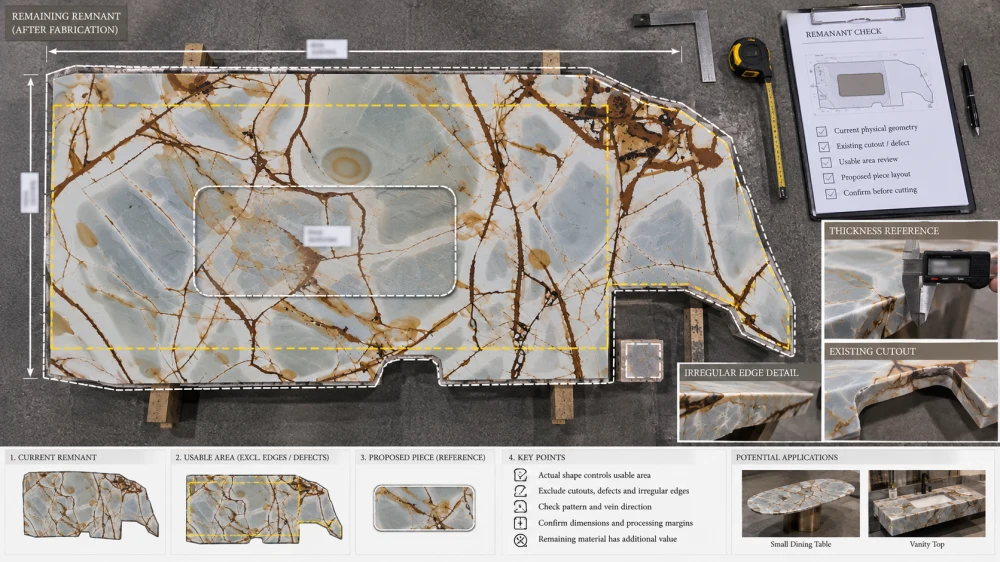
Measure the Current Remnant, Not the Original Empty Space
After cutting, the remnant is its own physical object.
Its register should therefore use its current measured geometry.
Record where relevant:
maximum length;
maximum width;
thickness;
不規則なエッジ;;
existing cutouts;
missing corners;
holes;
仕上げられた端部;;
areas already consumed; and
other geometry that reduces the rectangular envelope.
A 1500 × 800 mm bounding rectangle does not necessarily mean a 1500 × 800 mm finished component can be cut from the piece.
The same distinction between gross dimensions and genuinely usable cutting area applies when evaluating remnants. The site’s usable-area versus gross-slab-area guide explains why actual layout geometry, exclusions and visual priorities matter when judging usable stone.
Add One Photograph That Identifies the Whole Piece
12 Sep — Created from Board TM-042 18 Sep — Measured and photographed 04 Nov — Held for original project replacement 15 Mar — Released from project hold 22 Apr — Recut for vanity piece V-07 22 Apr — Remaining section remeasured and rephotographed
How to Review a Remnant for a New Project
Finding a large enough number in the register is only the beginning.
The new project should compare:
Current Remnant → New Finished-Piece Geometry → Cutting Position → Visible Area → Finish → Edge Requirements → Natural Features → Fabrication Review
For visually sensitive work, place the proposed new piece outline over a current photograph or controlled representation of the actual remnant.
This answers a much better question than:
“Is the remnant bigger than the finished piece?”
Instead ask:
“Can this finished piece be positioned within the currently usable area of this exact remnant?”
Remnants Can Be Valuable for Future Replacement Orders
A retained remnant can be especially useful when a future replacement needs to relate to an existing installation.
If its identity has been preserved, the project may know:
the original material;
the source slab;
the original project;
its current finish;
its natural pattern relationship;
its current dimensions; and
where the physical stone is stored.
That does not guarantee a usable replacement.
But it provides much stronger evidence than searching later for another slab based only on a commercial material name.
Do Not Confuse Remnants with Spare Finished Pieces
These should normally be distinguished.
あ remnant is retained raw or partially processed stone that may support a future fabrication decision.
あ spare finished piece has already been fabricated for a defined geometry or project purpose.
They may belong to the same broader traceability system, but their records answer different questions.
A spare finished component should normally retain its finished-piece ID, drawing relationship, orientation and intended installation location rather than being reduced to a generic remnant number.
1. What should a Quartzite remnant register include?
A practical Quartzite remnant register can include a unique remnant ID, material name, source slab where known, original project reference, current dimensions, thickness, visible face, finish, condition observations, dated photographs, storage location, status, last verification date, and recut history.
2. Should every small Quartzite offcut be registered?
Not necessarily. The level of control should reflect the potential value of retaining the piece. Large remnants, visually important material, replacement stock, special finishes, rare selections, and pieces likely to support future fabrication are stronger candidates for controlled registration than insignificant scrap.
3. Does a Quartzite remnant register prove that a piece is available?
No. Registration proves that a piece has a record. It may still be held, allocated, awaiting verification, reserved for replacement, or otherwise unavailable. Availability should be confirmed separately.
4. Can remnant dimensions prove that a new finished piece will fit?
No. Maximum length and width describe the physical envelope but do not automatically establish usable cutting area. Existing cutouts, irregular edges, natural features, condition, orientation, visual priorities, fabrication allowances, and the proposed finished geometry may all affect whether the new piece can be produced.
5. What should happen when a Quartzite remnant is recut?
Update its dimensions, photographs, condition, location, status, and cutting history. If another useful remnant remains, give that current physical piece a traceable identity rather than continuing to rely on obsolete dimensions.
6. Why keep the original slab number with a Quartzite remnant?
Where known, the source slab number preserves the relationship between the remnant and the original physical stone. This can be useful for project traceability, visual comparison, replacement planning, and reconstructing where the material came from.
7. Can a Quartzite remnant be useful for a future replacement?
Yes, particularly when its source, finish, dimensions, condition, photographs, and storage location have been preserved. However, the actual remnant still needs to be reviewed against the replacement geometry and visible relationship before fabrication is approved.
最終的なトレーサビリティルールA useful Quartzite remnant should not become an anonymous leftover. Preserve the chain Source Slab → Remnant ID → Current Dimensions → Photo Record → Storage Location → Status / Recut History → New Project Review. When the physical piece changes, update the record rather than allowing old dimensions and photographs to continue representing it.
For project-based Natural Quartzite fabrication, HRST STONE can coordinate selected slab references, cutting layouts, CAD/shop drawings, piece identification, fabrication QC, remnant records for agreed retained material, and reinforced export packing around the confirmed project scope. For a remnant review, send Josh the material name, remnant or source-slab reference where available, current photographs, measured dimensions, thickness, finish, intended new piece, drawing, quantity, and delivery destination.
Hi, I am the author of this article. I have been working in the field of Natural Stone for more than 15 years. If you need customized Natural Stone services, please feel free to contact me.