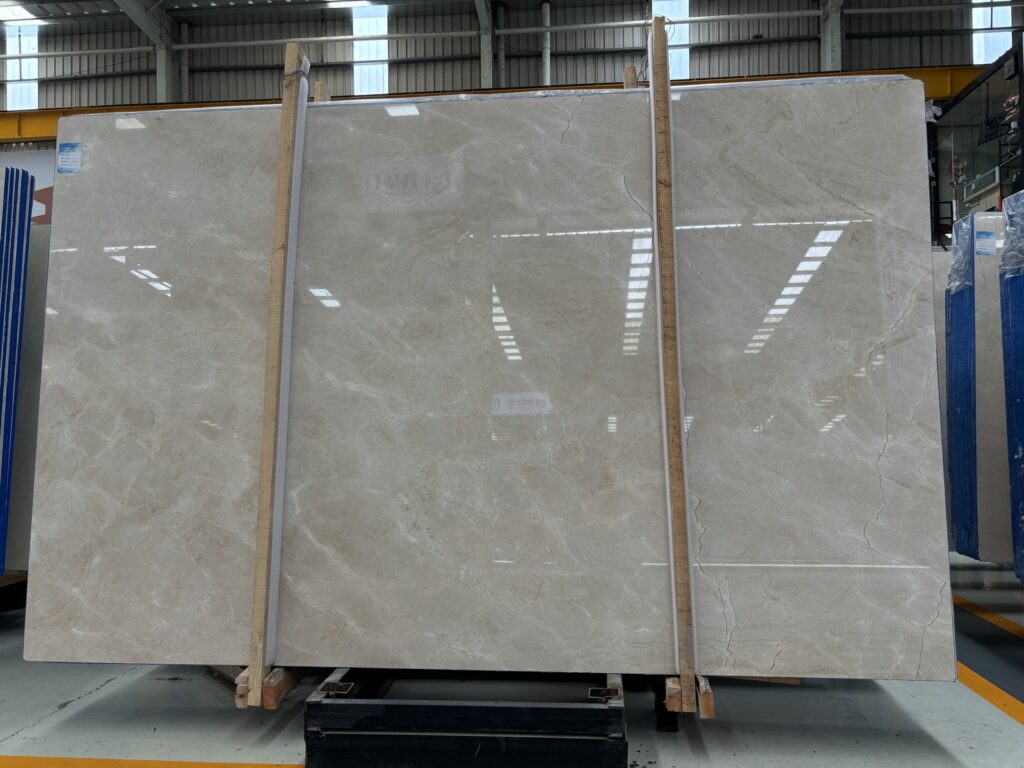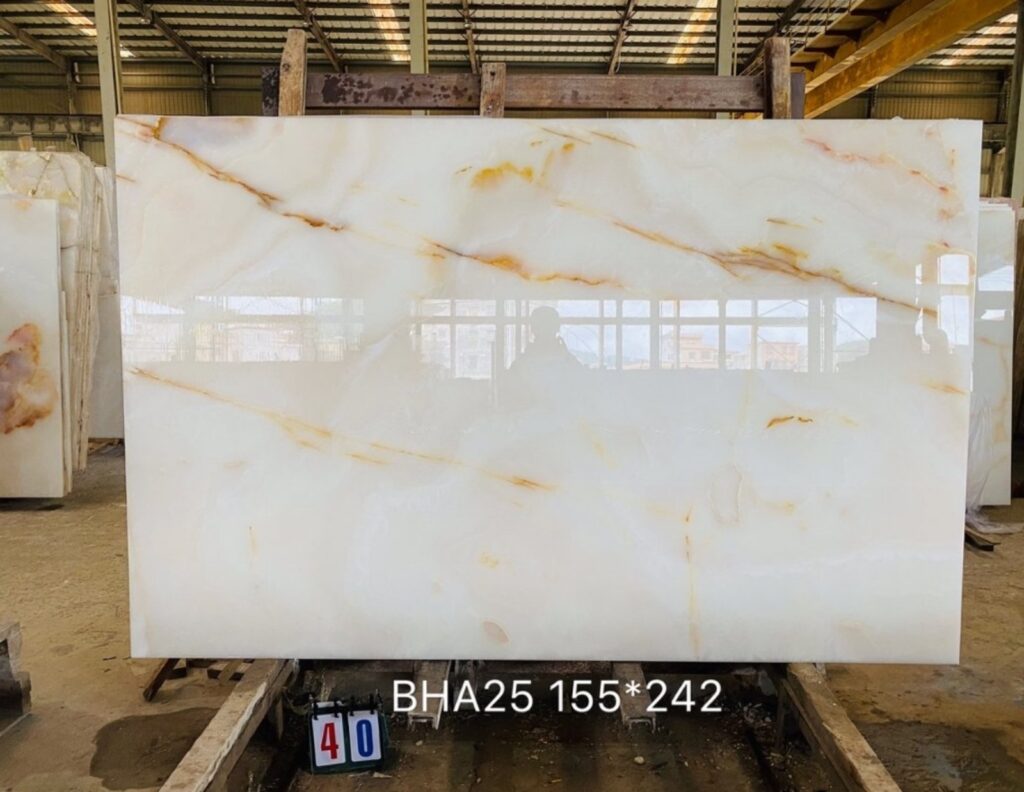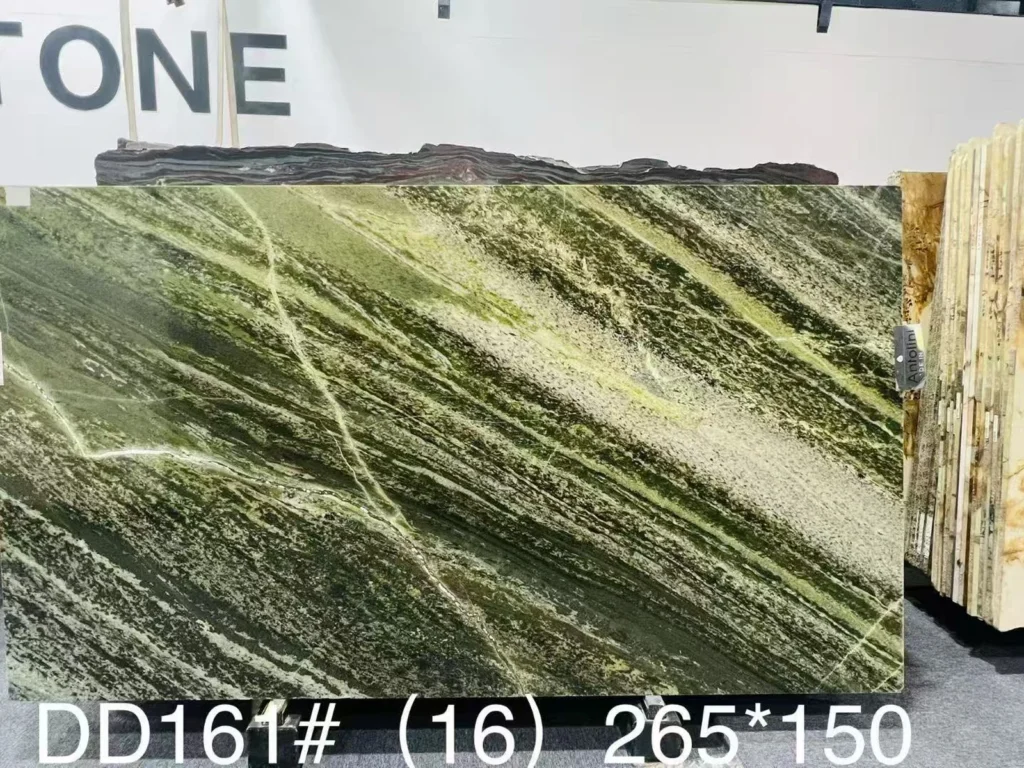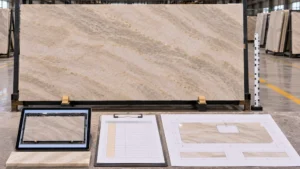
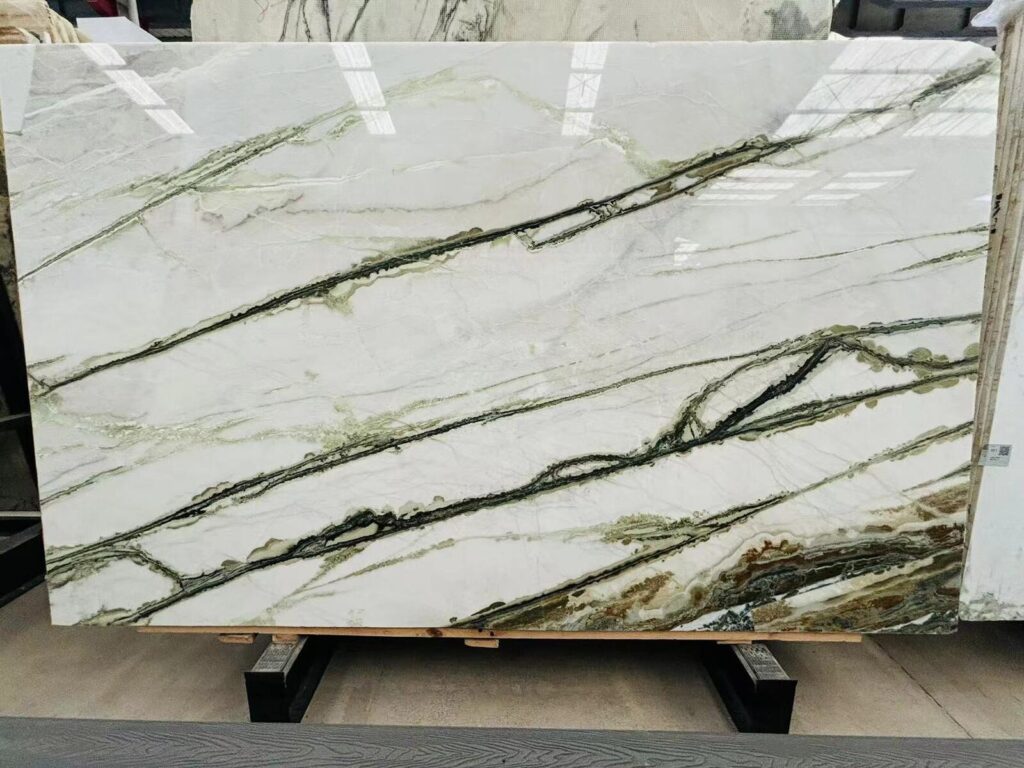
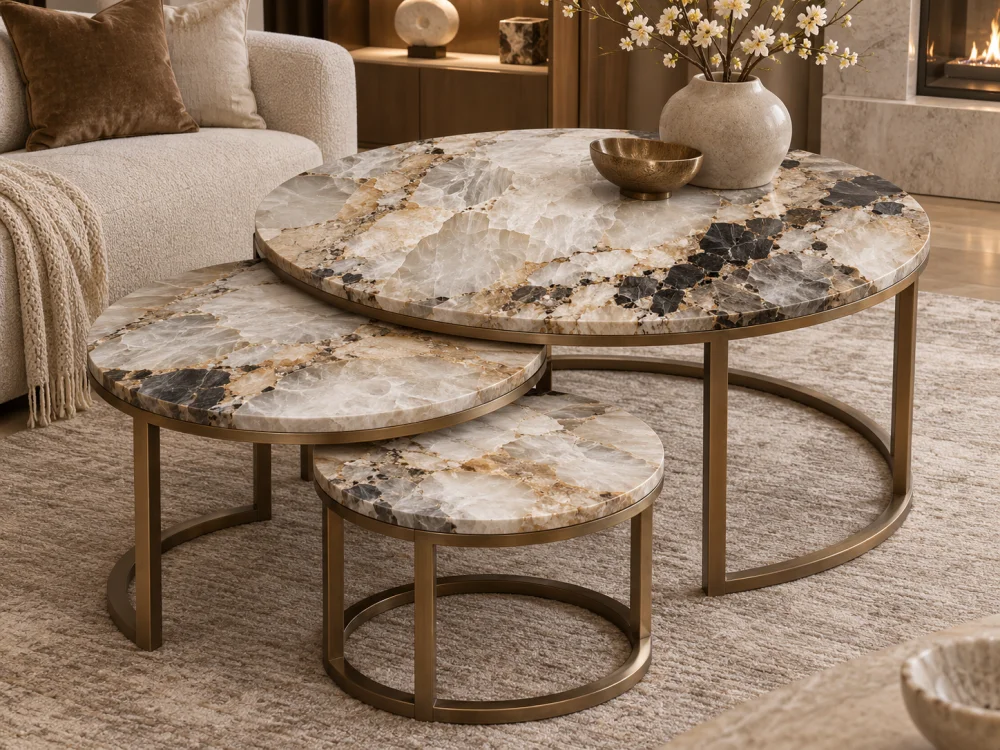
天然クォーツァイトスラブには、一つの卓越した地質学的エリアが含まれています。.
大きな結晶構造、顕著な鉱物の遷移、または一目で注目を集める独特な暗色の特徴が存在します。.
本プロジェクトでは、三つのネスティングテーブルが必要です。.
そのスラブのどの部分をどのテーブルに割り当てるべきでしょうか?
最も大きなものでしょうか?
最も背の高いものでしょうか?
セットをネストした際に一番上に置かれるテーブルでしょうか?
最も小さなテーブルは、頻繁に引き出して単独で使用されるためでしょうか?
それとも、その特徴をセット全体に分散させるべきでしょうか?
これが、 クォーツァイトのネスティングテーブル:主要なパターンをどの天板に配置するかを決める.
ネスティングテーブルは、独立した三つのサイドテーブルとは異なります。.
通常の視覚的状態が複数存在します。.
ネストした状態では、天板同士が重なり合い、一部の領域が見えなくなります。.
分離した状態では、各天板は独立した完全な天然クォーツァイトの構成となります。.
セット全体の構成 + 各テーブル単体の構成。
1. 個々の石製天板ではなく、まず家具セットから始めましょう。.
ネスト状態.

家具の幾何学形状によりますが:.
最大の天板がほぼ完全に見えるままの場合もあります;
多くのネスティングテーブルは、完全にネストした状態や完全に分離した状態でのみ使用されるわけではありません。.
分離状態.
テーブルが部屋中に配置されると、各天板は独立した家具の表面となります。.
ネストした構成の中では小さなアクセントとして見栄えの良いクロップでも、単独で見ると不完全に感じられることがあります。.
有益なプロジェクトレビューでは、次のような状態を特定できます:.
状態A — 完全にネスト.
状態C — 完全に分離
具体的な状態の数は変動しうます。
セット計画のルール
ネスティングテーブルのレイアウトは、部品が一緒の時にも、離れている時にも機能するように設計されるべきです。ある状態で優勢な石材表面が、別の状態では優勢ではない場合があります。
2. この特定のスラブにとって「主要なパターン」とは何を意味するのかを定義しましょう。.
「主要なパターン」は普遍的な地質学用語ではありません。.
それは一つの大規模な鉱物特徴である可能性があります。.
“Main pattern” is not a universal geological term.
It is a project-design description for the slab area carrying the strongest visual importance.
表情豊かな天然クォーツァイトの場合、主な模様は次のいずれかである可能性があります:
スラブで最も魅力的な部分が、必ずしも最も劇的なものとは限りません。.
控えめな家具デザインの場合、主な視覚的価値は特に落ち着きがありバランスの取れたエリアから生まれるかもしれません。.
スラブ全体のごく一部しか占めていない特徴が、小さなテーブルでは際立つことがあります。.
同様に、一つの広い鉱物構造が最大サイズのテーブルには美しく映る一方で、それをはるかに小さな天板に切り取ると混乱を招くこともあります。.
の クォーツァイトの模様スケール:室内距離での板材の読み取り ガイドでは、スラブ全体と仕上げ後の部材の切り取りを別々に検討すべき理由を説明しています。.
提案された各天板について、以下の点を比較してください:
「スラブで最も劇的な部分はどこか?」だけを問うのではなく、「どの仕上げ天板が最も強い視覚的インパクトを担うべきか、そしてそのテーブル単体で使用した際にもそのインパクトが十分に成立するか?」を問うべきです。“
最大サイズの入れ子式テーブルに必ずメイン模様を配置しなければならないという普遍的なルールはありません。.
いくつかの管理された戦略が有効です。.

最大サイズの天板には最も強烈な地質構成を配します。.
小さなテーブルには、より控えめだが関連性のあるスラブ領域を使用します。.
この方法は、最大サイズのテーブルが入れ子状態でも独立状態でも主要な視覚面であり続ける場合に有効です。.
その関係性は次のようになります:
メインテーブル = フォーカル模様
サブテーブル = サポート模様
一部の家具形状では、上部の小さなテーブルが非常に目立つ一方で、下部の大きなテーブルの多くは覆われている場合があります。.
このような配置では、最も露出している表面がより強い模様にふさわしいかもしれません。.
決定は物理的な面積だけでなく、可視性に基づいています。.
デザイナーは、ある特定のテーブルがソファや椅子の脇に頻繁に移動され、独立したサイドテーブルとして使用されることを知っているかもしれません。.
その部材には意図的に最も特徴的なスラブの切り取りを施すことができます。.
他の部材は、その周りに組み込まれてもより控えめな印象を保ちます。.
セットは、一つの地質運動に関連する複数の部分を使用することがあります。.
例えば:
これらの部材を一緒に配置しても、文字通り連続したイメージを作る必要はありません。.
それらは、意図的に関連していると感じられる程度の地質的言語を共有していればよいのです。.
別のアプローチでは、支配的な「ヒーロー」を完全に排除します。.
Each tabletop receives a different but equally controlled composition.
The set remains coordinated through:
| Pattern Strategy | Best Question to Ask | Main Risk to Review |
| Largest Table Leads | Is the largest top visually dominant in normal use? | Main pattern may be partly hidden when nested |
| Most Exposed Surface Leads | Which top remains most visible in the nested arrangement? | That top may become less important when separated |
| Independent Hero | Which table is most often used independently? | Grouped set must still look balanced |
| Progressive Sequence | Can related geological zones connect the set? | Do not promise permanent vein continuity as tables move |
| Balanced Independent Tops | Can every top work alone without one overpowering the group? | Set may lack a clear focal hierarchy if that was intended |
A slab layout becomes much more useful when it knows which parts of each tabletop will actually remain visible.
Using the current furniture drawing, identify where smaller or taller tables overlap other stone surfaces.
For each tabletop, divide the finished top conceptually into:
Always Visible
Sometimes Visible
Normally Hidden When Nested
If one exceptional slab feature will sit almost completely beneath another tabletop in the normal nested arrangement, ask whether that is the best use of the material.
It may still be appropriate if the table is regularly separated.
But that decision should be intentional.
A smaller table pulled halfway out can expose a narrow crescent, rectangle, or irregular zone of its surface.
Make sure the visible section does not accidentally contain only a disconnected fragment of a stronger pattern.
Do not evaluate only from directly overhead.
Nesting furniture is normally read from an oblique room angle.
From that viewpoint:
Pattern allocation should therefore use both top-view layout and normal room-view review.
This is the most important production rule for the article.
Do not approve Table A, cut it, and then try to fit Tables B and C into whatever stone remains.

The slab layout should show:
T01 → Large Table
T02 → Medium Table
T03 → Small Table
or the project’s equivalent controlled piece IDs.
Place every finished outline on the selected Natural Quartzite before irreversible cutting.
A perfect crop for T01 may consume the only slab area that allows T02 and T03 to form a coherent set.
The correct layout should balance:
If the tables are:
use those actual outlines rather than bounding rectangles.
A circle and rectangle with similar net area can require very different parts of the slab.
The complete slab may make a crop appear more coherent because the eye sees geological information outside the finished piece.
Temporarily hide that surrounding stone.
そして次のように問いかけます:
Does T01 work by itself?
Does T02 work by itself?
Does T03 work by itself?
Do they still work as one set?
の 天然クォーツァイトの有効利用可能領域とスラブ全体の領域の違い principle becomes especially important for multi-piece furniture.
The slab may contain enough square metres mathematically while still failing to provide three acceptable finished crops in the required shapes and pattern hierarchy.
Approve T01 + T02 + T03 as one cutting-layout decision. The strongest first tabletop is not a successful layout if it leaves the remaining tables with poor crops or no usable stone.
A natural feature does not have the same visual effect on every tabletop size.
The largest surface can usually preserve more geological context.
含まれる要素としては:
The medium surface may work best with:
The smallest top needs especially careful crop review.
A large dark fragment can become the entire composition.
A broad feature may be reduced to one unexplained edge fragment.
A quieter area may therefore become more successful at this scale.
But this is not a universal rule that small tables require quiet stone.
A compact top can intentionally carry one strong focal feature if that crop appears complete.
The project is selecting real Natural Quartzite.
A smaller table does not receive a proportionally reduced version of the same slab pattern.
It receives a smaller physical crop from the real geology.
This is why actual templates matter.
Nesting tables are movable furniture.
Their relationship is less fixed than a kitchen island and waterfall end.
A grouped arrangement may allow two mineral features to relate beautifully.
Move one table beside a chair and that relationship disappears.
This is normal.
Set-wide coordination should therefore rely more on:
than on one fragile alignment that works only in a single staged position.
If the designer wants the set presented in one preferred arrangement, document it.
This can support:
But it should remain a reference arrangement rather than a promise of permanent stone continuity.
If the Quartzite has strong directional movement, each tabletop can have an approved orientation.
例えば:
T01 Direction → Long Axis
T02 Direction → Related Long Axis
T03 Direction → Project-Specific Orientation
The tables can then be rearranged while each individual top still retains an intentional composition.
The slab layout is only the visible top-surface decision.
The furniture still has to physically nest.
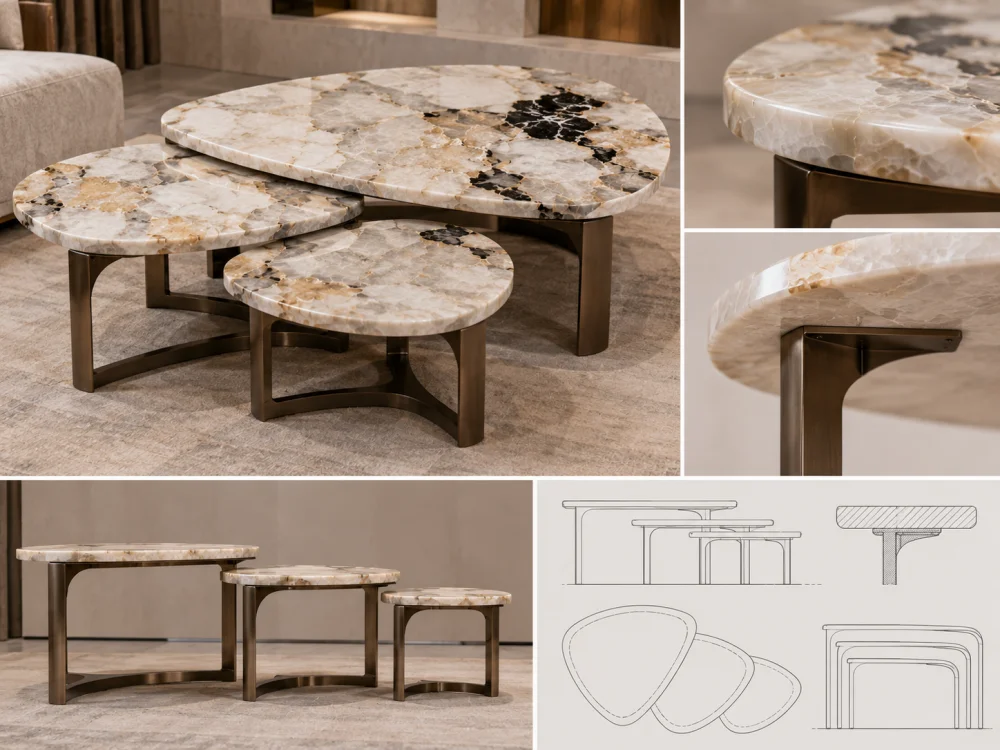
The actual Natural Quartzite thickness and any built-up edge treatment influence:
Do not change the apparent stone thickness late in the project without checking the complete nesting geometry.
Nesting tables are frequently touched and viewed closely.
レビュー:
Confirm the actual furniture-base geometry before cutting.
The responsible furniture designer and fabricator should coordinate:
This article does not prescribe universal nesting clearance, support spacing or stone thickness.
If the furniture system needs:
connect those operations to the current base drawing and approved stone layout.
の ブルーローマクォーツァイトテーブル page follows the same furniture principle: slab selection, top geometry, edge, base, support and fabrication QC should remain coordinated rather than being approved independently.
Nesting tables can be a useful application for retained Natural Quartzite remnants.
Several smaller surfaces may fit into material that cannot accommodate a large countertop.
But this should not become:
“Use whatever offcuts are available.”
Confirm:
If three tops are required, place all three finished outlines on the current remnant before approving any one of them.
関連する 端材から切り出した小型家具用天板における天然クォーツァイトと花崗岩の比較 guide makes this set-planning principle explicit: one attractive first furniture top should not consume the only usable area required for the remaining pieces.
A remnant may be physically present while still being:
Physical existence, usability and commercial availability are separate questions.
If useful stone remains after the nesting-table set is fabricated, update the remaining piece identity, dimensions, photograph and status rather than leaving the previous record unchanged.
The final inspection should not show three stone tops separately and call the set approved.
Confirm:
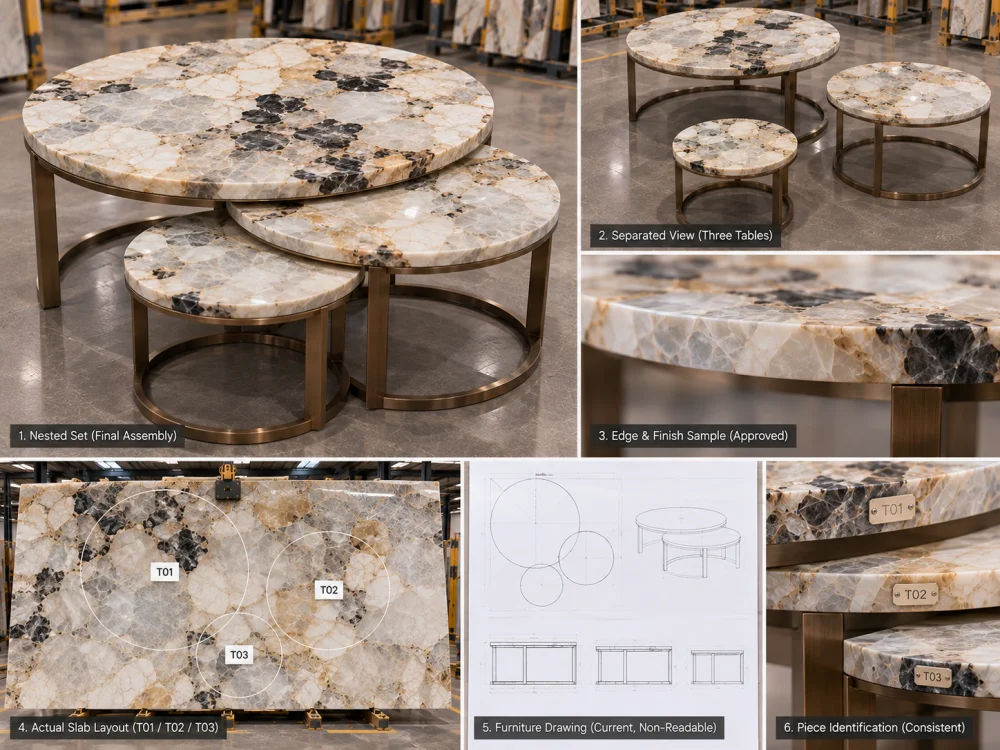
レビュー:
Check whether surfaces that become newly visible still read intentionally.
Each top should also be photographed and inspected as a complete individual composition.
例えば:
T01 — Large Table
T02 — Medium Table
T03 — Small Table
The top, base and packing reference should remain connected so the correct components can be reassembled after shipment.
Packing should respond to:
Do not allow the nesting function itself to cause stone-to-stone impact during transport.
□ Exact Natural Quartzite identified.
□ Actual slab or remnant reference confirmed.
□ Complete nesting-table set drawing confirmed.
□ Large, medium and small tabletop finished shapes confirmed.
□ Fully nested arrangement reviewed.
□ Partially nested arrangement reviewed where relevant.
□ Fully separated condition reviewed.
□ Main-pattern strategy defined.
□ Most-visible surfaces identified in each furniture state.
□ All tabletop templates positioned on the actual stone before the first cut.
□ Each tabletop crop reviewed individually.
□ Complete set reviewed together.
□ Pattern scale reviewed for each different tabletop size.
□ Directional orientation recorded where relevant.
□ Permanent vein continuity is not promised for movable pieces.
□ Surface finish confirmed.
□ Edge profile confirmed.
□ Stone thickness and furniture height coordinated.
□ Base geometry and support reviewed.
□ Nesting clearance confirmed by the responsible furniture design team.
□ Any underside machining or fixing details confirmed before stone machining.
□ Trial assembly completed where required.
□ T01 / T02 / T03 or equivalent piece IDs maintained through QC.
□ Packing keeps the complete set traceable and protects finished stone surfaces and edges.
No. The largest top may be the correct focal surface when it remains visually dominant, but another table may be more exposed when nested or more frequently used independently. Decide the pattern hierarchy from the furniture’s real nested and separated states rather than from surface area alone.
それらは関連する模様の方向や地質的な特徴を持つことがありますが、永久的な鉱脈の連続性は通常、移動可能な家具において優れた採用基準とはなりません。テーブルが離されたり配置を変えられたりすると、その関係性は変化してしまいます。背景色調、模様の濃淡、コントラスト、仕上げ、そして全体的な視覚的重量感を統一的に調整することは、むしろ広範囲にわたって持続性の高い統一感を生み出すための重要な要素です。.
はい、見た目の調和が取れたカスタムセットの場合です。最初の不可逆的な切断を行う前に、必要な仕上げ済み天板形状をすべて並べて配置してください。これにより、メインパターンの位置、サブカット、有効なスラブ領域、向き、および加工スペースをセット全体でバランスよく調整できます。.
はい、仕上がった作物が意図された構図を完全に形成している場合です。小さなテーブルだからといって、必ずしも静かな石が必要なわけではありません。ただし、大きなコントラストの強い要素一つが小さな面積を圧倒してしまう可能性がありますので、その要素が視覚的に縮小されるだろうと決めつけるのではなく、実際の天板の輪郭を確認してください。.
可能性があります。現行の物理的な残材、使用可能な形状、仕上げ、厚み、既存の切り欠きや不規則なエッジ、パターンの位置、および市販の入手可能性を確認してください。最初の部品を承認する前に、実際の残材に完全なネスティングテーブルセットを重ね合わせて確認してください。.
組み立ては、テーブルの高さ、石材の厚さ、ベースの形状、脚やフレームの位置、支持構造、固定方法、およびクリアランスとの関係に依存します。ベースを後から変更すると、以前に承認された石材の形状や下面の加工が不適切になる可能性があります。不可逆的な製造に入る前に、これらを必ず調整してください。.
ジョシュに、提案された天然クォーツァイト素材、可能な場合はスラブまたは端材の参照資料、テーブルの数量、仕上げ済み天板の形状および寸法、ネスティング配置、各テーブルの高さ、仕上げ、エッジプロファイル、優先するパターン階層、家具ベースの図面、確定した範囲内の固定方法または下面加工に関する情報、数量、主要な空間の参照箇所、および納品先を送付してください。スラブレイアウトを承認する前に、セットとして使用するべきものが単一のヒーローパターンか、段階的な地質学的配列か、あるいはバランスの取れた個別構成かを明示してください。.
For custom Natural Quartzite nesting tables, coffee-table sets, side tables and coordinated furniture collections, HRST STONE can coordinate full-slab or remnant photographs, tabletop CAD templates, set-wide pattern allocation, actual-slab cutting layouts, edge samples, base-interface review within the confirmed stone scope, fabrication QC, trial assembly, piece identification, protective packing and export documentation. Send Josh the material, slab or remnant reference, complete furniture-set drawings, tabletop dimensions and shapes, finish, edge design, nesting arrangement, base information, pattern priorities, quantity and destination before final cutting approval.