After visiting Xiamen Stone Fair 2026, many international buyers leave with dozens of supplier contacts, product catalogs, and quotations. However, one of the most important procurement questions often remains unclear: is the supplier a true manufacturer or a trading company? At the exhibition, both may present themselves professionally, both may show attractive slabs, and both may offer competitive pricing. But once production begins, the difference between these two supplier models becomes highly important for project execution.
For buyers managing marble, quartzite, onyx, or engineered stone projects, choosing the wrong supplier structure can lead to delays, inconsistent production, unclear accountability, and communication problems during shipment. This is why experienced buyers first build sourcing logic before comparing prices. If supplier selection is still in the early stage, many procurement teams begin by reviewing the Xiamen Stone Fair exhibitor list and suppliers guide to understand which companies control actual production capacity.
A manufacturer owns or directly manages production lines. A trading company usually coordinates between buyer and factory, often sourcing from multiple workshops depending on material category. Neither model is automatically better in every case, but each creates very different operational risks depending on order size, technical complexity, and project schedule.
What Defines a True Stone Manufacturer
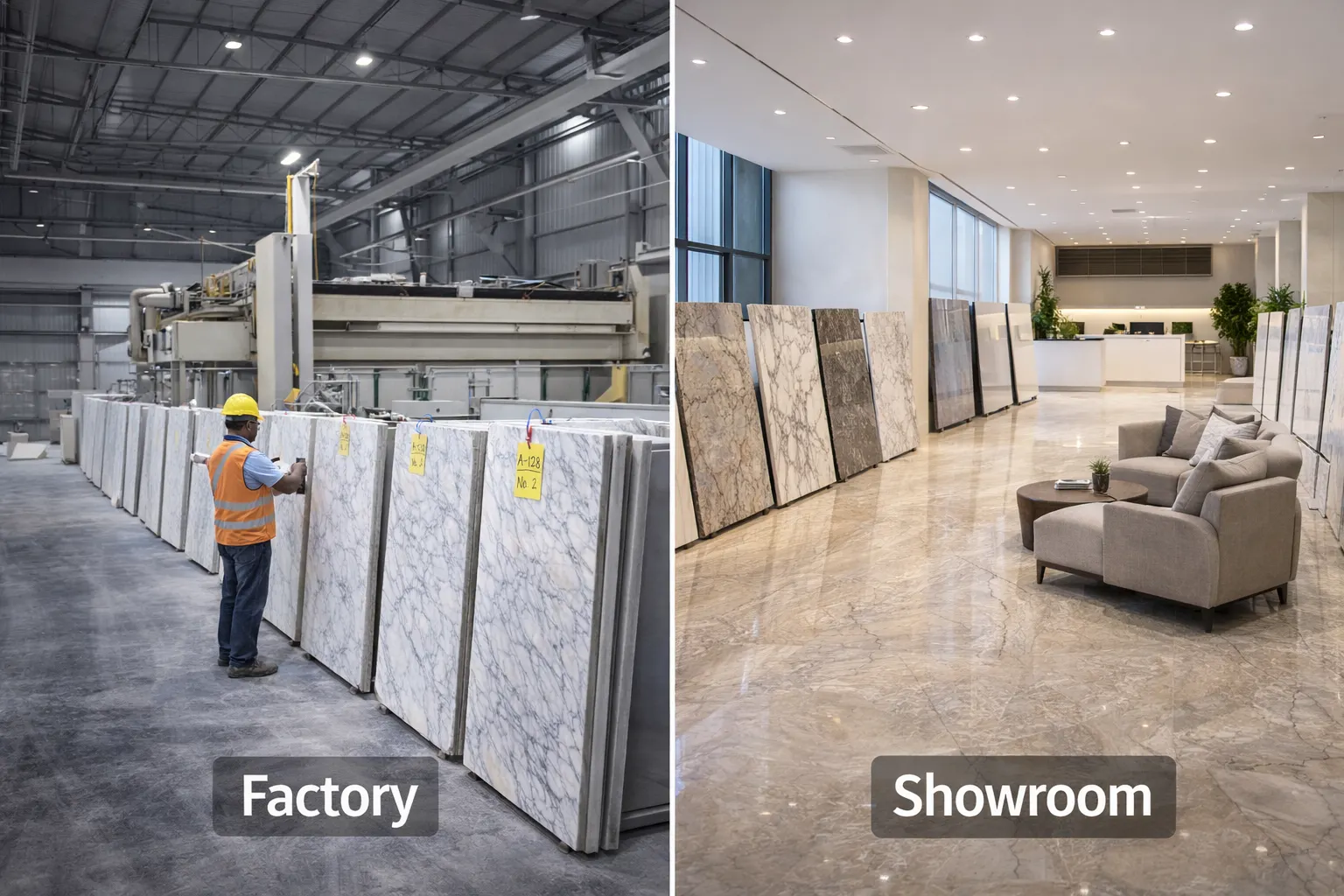
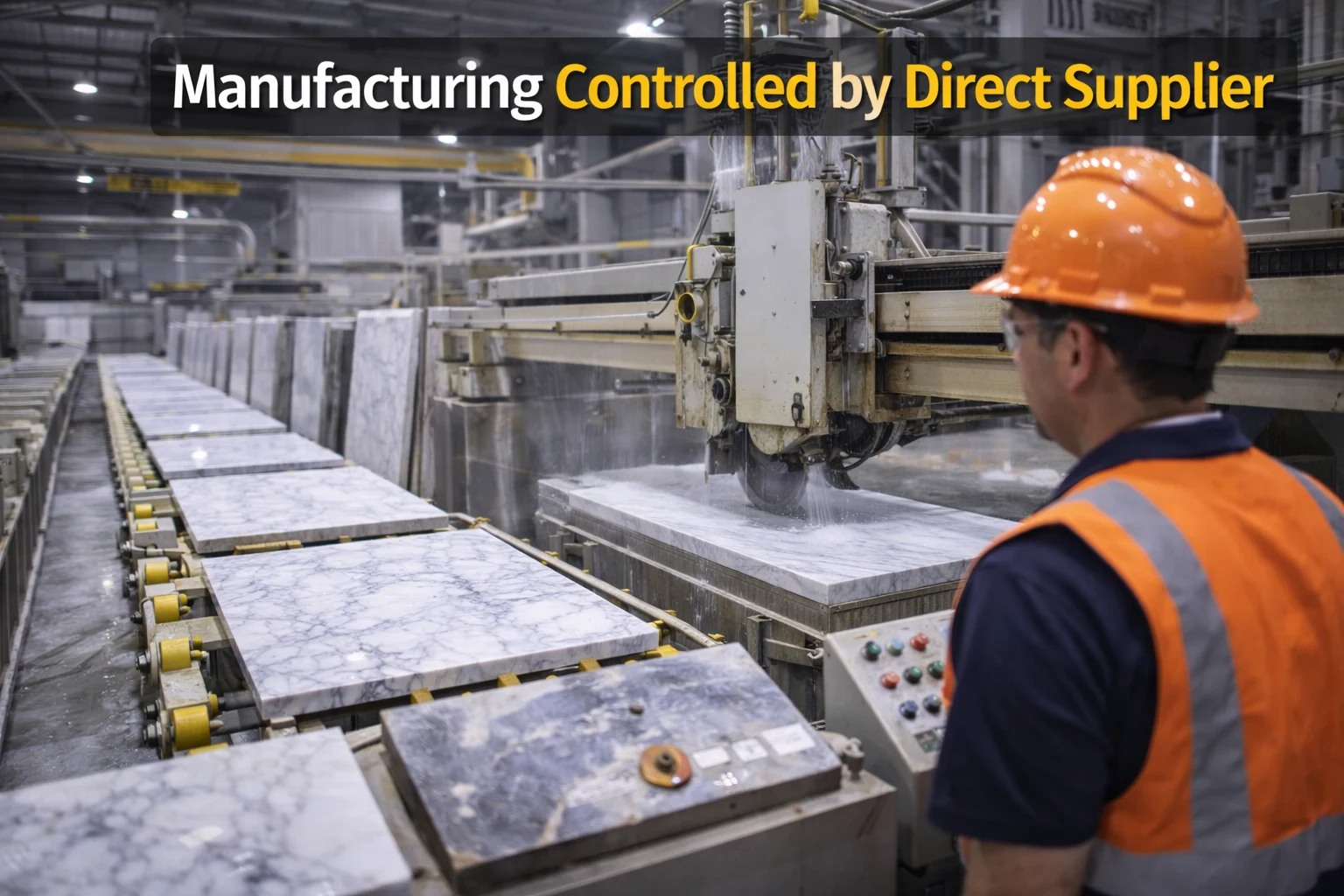
A true manufacturer typically controls cutting equipment, polishing lines, slab storage, packaging operations, and production scheduling. This means the supplier can directly answer technical questions related to thickness calibration, edge processing, resin treatment, and slab sequencing. In large marble projects, this direct control often reduces risk because decisions can be made inside one production system.
Manufacturers are especially important when projects require stable batch allocation. For example, when multiple containers must come from the same quarry block, production scheduling becomes highly sensitive. Buyers handling this type of requirement often also review batch consistency strategy for marble projects before selecting final suppliers.
However, not every manufacturer is equally strong. Some factories own machines but still outsource special processing. Buyers must therefore confirm which steps are internal and which are subcontracted.
What Trading Companies Usually Offer
Trading companies often provide broader product coverage. They may source marble from one factory, quartz from another, terrazzo from another, and furniture products from specialized workshops. This flexibility helps buyers who need mixed material procurement under one communication channel.
For buyers still comparing multiple materials after the fair, trading companies can simplify sourcing because they already understand cross-category coordination. This becomes useful when buyers are evaluating trends similar to those discussed in top materials at Xiamen Stone Fair 2026.
| Supplier Type | Main Advantage | Main Risk |
|---|---|---|
| Manufacturer | Direct production control | Limited material diversity |
| Trading Company | Wide sourcing flexibility | Indirect factory control |
| Manufacturer with Export Team | Balanced control and communication | Higher minimum order expectations |

Pricing Transparency Differences
Many buyers assume manufacturers always offer lower prices. In reality, this is not always true. A trading company may secure better internal pricing from partner factories if it delivers large annual volume. Meanwhile, some manufacturers quote higher because they include stronger QC processes and direct export handling.
The key question is not who is cheaper, but who explains pricing clearly. Buyers should ask whether quotations include slab replacement allowance, packaging upgrade, moisture protection, and export inspection.
This is why experienced teams often first apply supplier screening logic similar to supplier checklist for global buyers before price comparison begins.
Communication During Production
For many international projects, communication quality determines project success more than factory size. A strong trading company with disciplined reporting may outperform a factory that replies slowly and lacks documentation.
Buyers should therefore test communication speed before deposit payment: ask for updated slab photos, revised packing drawings, and production schedule confirmation. Suppliers who answer clearly under pressure usually perform better during shipment.
If uncertainty remains, buyers should always arrange direct factory inspection using the framework described in how to visit a stone factory after Xiamen Stone Fair 2026.
Which Supplier Model Fits Large Marble Projects Best
For large continuous marble projects, direct manufacturers usually reduce technical risk because slab selection, sequencing, and thickness control remain centralized.
For mixed residential projects needing marble, quartz, furniture tops, and decorative products together, experienced trading companies often improve coordination.
The best suppliers increasingly combine both models: factory ownership plus export management plus external partner network.
In practice, buyers should not ask “manufacturer or trader?” as a fixed choice. The better question is: who controls the exact production steps required for my project?

よくある質問
1. Is a manufacturer always better than a trading company?
No. The best choice depends on project type, material diversity, and production complexity.
2. Can trading companies provide factory inspection?
Yes, but buyers should verify whether the factory shown is the actual production source.
3. Are manufacturers cheaper?
Not always. Pricing depends on control level and included services.
4. Which supplier is better for large marble projects?
Manufacturers usually offer stronger batch control for large projects.
5. Which supplier is better for mixed material orders?
Trading companies often coordinate mixed categories more efficiently.
6. Should buyers still visit factories after the fair?
Yes, physical inspection remains essential.
HowTo
Step 1: Identify whether supplier owns production equipment.
Step 2: Ask which processes are subcontracted.
Step 3: Compare quotation transparency.
Step 4: Test communication speed before deposit.
Step 5: Visit factory before final order.