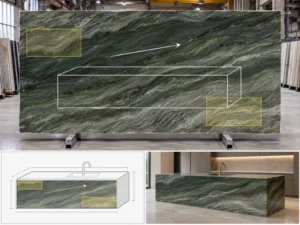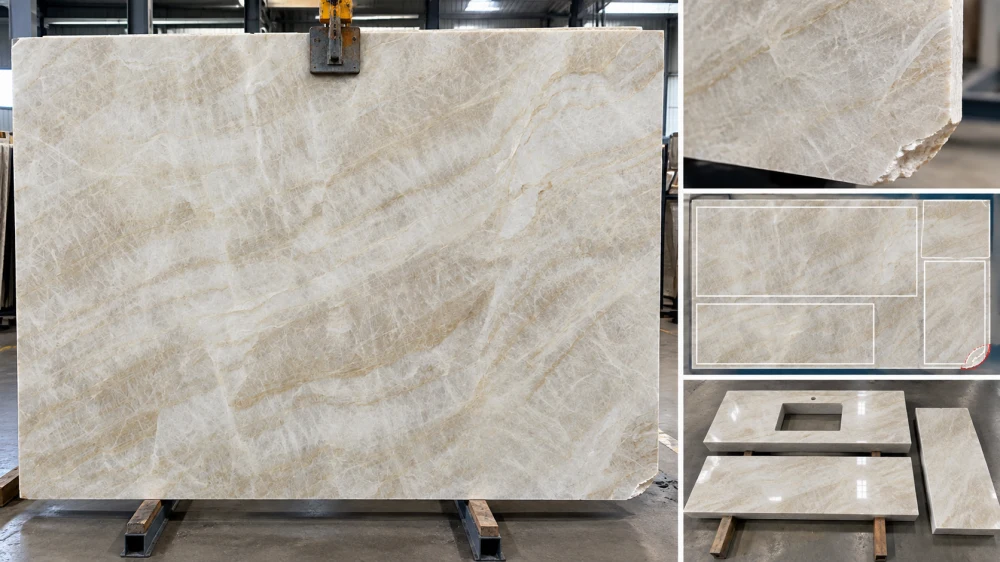
Quartzite edge damage reduces usable yield only when the affected zone interferes with the material required for the approved finished-piece layout. A chipped corner outside all planned components may have little or no effect, while damage extending into a long island, visible finished edge, waterfall, seam zone, or other required piece can force additional trimming, repositioning, a new seam, or another slab. Evaluate the actual slab condition against the cutting plan before deciding how much usable material has been lost.
A buyer receives photographs of a Natural Quartzite slab before cutting and notices a chipped edge or broken corner.
しばしば直面する疑問は次のとおりです。
“How much usable area have we lost?”
That question cannot be answered reliably from the chip alone.
A 100 mm damaged area at one corner does not automatically mean that the entire slab must be reduced by 100 mm on both dimensions. Conversely, a relatively small edge condition can matter significantly if it falls directly inside the only workable position for a large island, waterfall panel, long vanity, or another critical finished component.
The correct approach is to connect quartzite edge damage to the actual cutting layout.
Gross slab dimensions describe the physical envelope of the slab.
Usable yield describes how much of that particular slab can actually satisfy the project cutting plan.
The difference may be influenced by:
This is why a slab should not be judged only by multiplying its overall length by its overall width.
Damage outside all planned pieces
May have little or no effect on project yield.
Damage inside an area already intended for trimming
May be absorbed without changing the finished-piece layout.
Damage intersects a planned piece but the piece can move
May require layout optimization rather than another slab.
Damage enters a critical piece that cannot move
May reduce usable yield and require a seam, redesign, or additional material.
Damage reaches a required visible finished edge
Requires specific visual and fabrication review even if the gross piece still fits.
Before deciding whether quartzite edge damage affects the order, create a simple condition record for the actual slab.
記録内容:
The condition should be identifiable on the complete slab image. A close-up alone can make a small edge chip appear much more important than it is in relation to the whole board.
Damage sits beyond every required finished piece. Yield may remain unchanged.
The affected material would already have been removed during squaring or fabrication.
One or more pieces can be repositioned while maintaining the required project result.
Damage enters a required component or visible edge and the layout cannot simply move away.
This is the simplest situation.
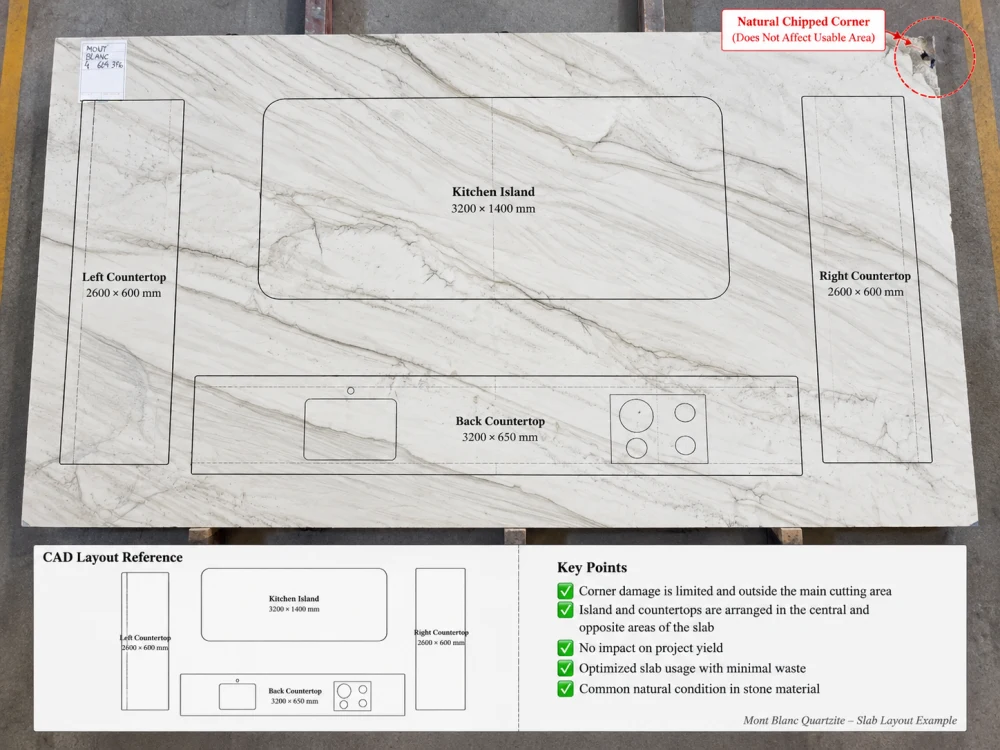
Suppose the slab has an irregular chipped corner, but the cutting plan places:
If none of those components requires the damaged area, the chip may not reduce project yield at all.
The gross slab remains visually damaged at its perimeter, but the project-usable area may be unchanged.
Natural stone slabs do not always have perfectly straight production-ready edges.
A cutting plan may already assume that part of the perimeter will be removed before finished components are produced.
If an edge chip lies completely inside material that was already going to be trimmed away, it may not create an additional yield loss.
Do not create a universal “standard trimming allowance” for every Quartzite slab. The required trimming depends on the actual slab edge, cutting method, finished-piece geometry, fabrication process, and project requirements.
Sometimes the damage enters the first proposed position of a component but does not make the slab unusable.
The fabricator may be able to reposition the pieces.
However, moving a piece should trigger another question:
What else changes when the piece moves?
確認事項:
Solving an edge conflict should not accidentally create a worse visual or fabrication problem elsewhere.
ここが quartzite edge damage can genuinely reduce usable yield.
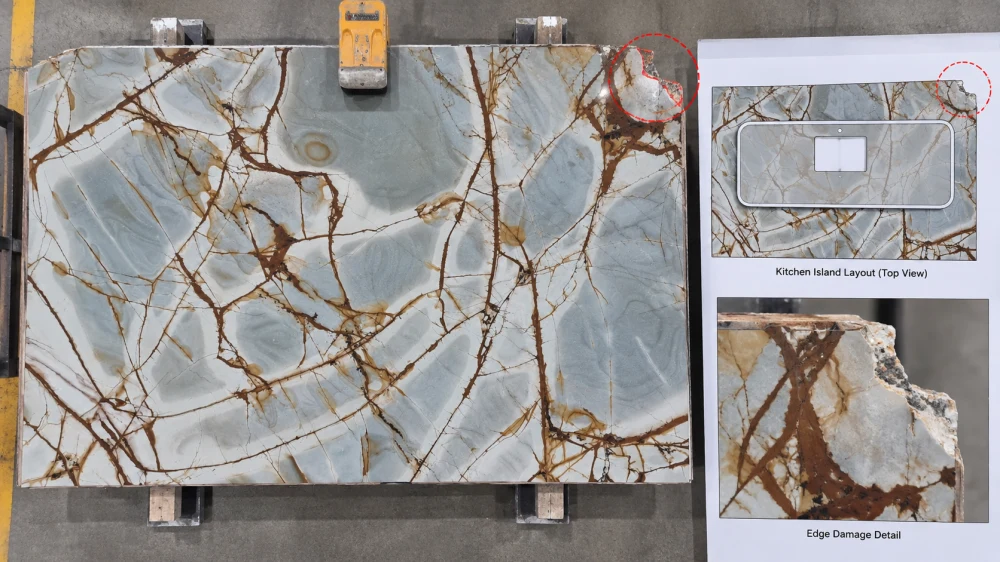
For example, the project requires a long one-piece island and only one position on the selected slab provides enough usable length.
If the damaged edge extends into that required envelope, possible consequences may include:
The correct solution depends on the actual slab and project. The edge condition itself does not determine which option should be selected.
Yield is not only about whether a rectangle physically fits.
Suppose a countertop piece fits inside the slab dimensions, but the affected area becomes part of an exposed finished edge.
The project must then consider:

A piece can therefore “fit” geometrically while still requiring visual review.
This is an important procurement distinction.
If a small damaged corner forces a 3,000 mm-long finished component to move to another slab, the commercial effect may be much larger than the physical area of the chip.
Conversely, a visibly larger edge condition may have almost no project effect if that entire perimeter lies outside all required components.
Physical damage area and project yield loss are not the same measurement. Yield loss should be evaluated through the cutting plan.
The most useful review is visual.
Place the proposed finished-piece outlines over the actual slab image and show the edge condition in the same record.
This allows the buyer and fabricator to see:
Actual Slab → Edge Condition → Piece Envelope → Trim Zone → Cutouts → Visible Edges → Remaining Material
サイトの クォーツァイトスラブ予約ガイド similarly recommends checking actual slabs against the project cut list rather than relying on gross dimensions alone. It specifically identifies edge trimming, orientation, natural features, openings, waterfall returns, and cutting layout as factors that can change usable yield.
When several slabs from the same bundle are available, a condition report without a board number can quickly become ambiguous.
The yield review should connect:
Board Number → Full-Slab Photo → Edge Condition → Cutting Plan → Finished Pieces
If the cutting layout is revised, retain the same slab identity so the buyer knows which physical board is being reassessed.
For projects where several slabs feed multiple finished components, the クォーツァイト切断計画ガイド explains how board numbers and finished-piece IDs can maintain this traceability through fabrication.
A damaged perimeter can become more significant when the planned component also contains a large opening.
For example, moving an island away from an edge chip may shift the sink cutout closer to:
This is why layout optimization should consider the whole finished component rather than only avoiding the damaged perimeter.
の パタゴニア ブラウンクォーツァイト キッチンアイランド page likewise treats usable slab yield as a combination of visual selection, fissures, repairs, cutout position, waterfall matching, edge requirements, spare material, and other risk areas rather than gross slab area alone.
Do not make repair the first question.
First determine whether the affected material is even needed.
If the edge condition changes the cutting plan, record both versions.
| レビュー項目 | Original Layout | Revised Layout |
| Slab / Board | Same identified slab | Same or replacement slab |
| Main Piece Position | Original position | Moved if required |
| Edge Condition | Conflicts / no conflict | Excluded, trimmed, or still relevant |
| Secondary Pieces | Original allocation | Reallocated where necessary |
| Additional Material | Original assumption | Confirm after revised layout |
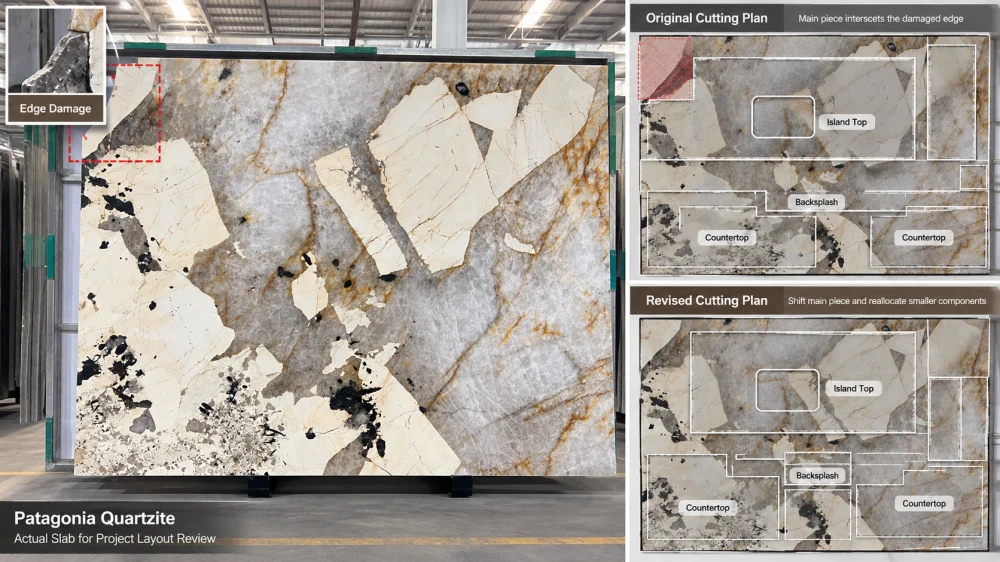
The practical answer is:
When avoiding, trimming, or accommodating the affected edge prevents the approved finished-piece set from being produced from the slab in the intended layout.
This may happen when:
It may have no meaningful effect when:
The decision still needs to be tied to the actual slab and current cutting plan rather than assumed from these examples.
Before cutting a slab with a recorded edge condition, confirm:
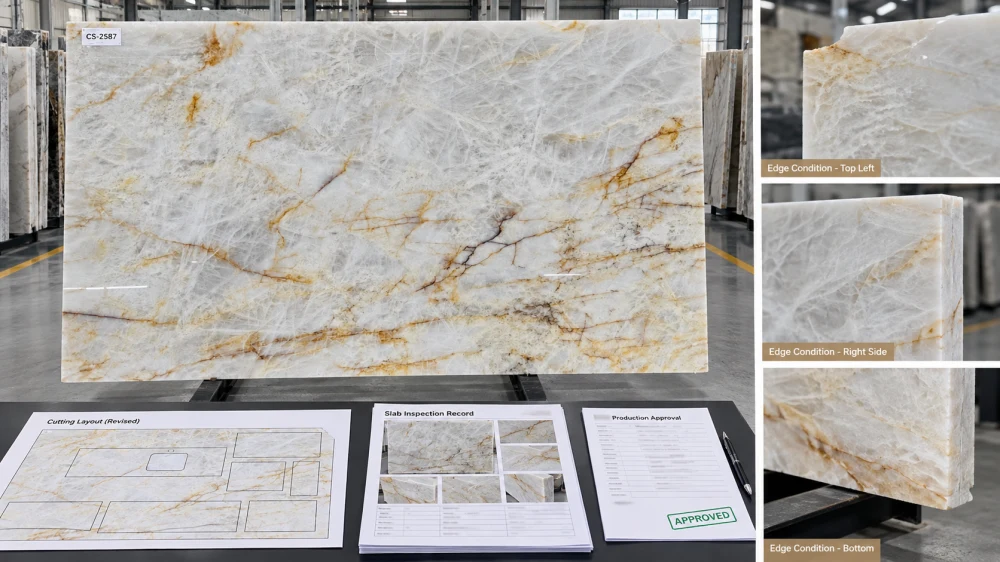
□ Correct slab / board number identified
□ Full-slab photograph retained
□ Edge condition shown in context
□ Current slab dimensions confirmed
□ Latest cutting-plan revision used
□ Finished pieces overlaid on actual slab
□ Visible edges checked
□ Cutouts and seams reviewed
□ Original vs revised yield recorded if layout changed
□ Additional material requirement confirmed if applicable
□ Buyer / designated reviewer approval recorded
いいえ。欠けた端部は、要求される仕上げ面のすべてから外れている場合もあれば、既に切り落とされる予定の材料の内部にある場合もあります。その影響は、実際のスラブおよび切断計画に基づいて評価する必要があります。.
実際のスラブの寸法と状態、ならびに仕上げ部材の配置図を確認してください。影響を受ける領域が、部材の配置位置、目地、視覚的関係、切り欠き、または必要となるスラブ枚数に変化を及ぼすかどうかを判断します。歩留まりの損失は、物理的なチップ面積のみから算出してはなりません。.
可能性はあります。回答は、損傷部位の位置、使用可能なスラブの寸法、アイランドのサイズ、切り欠きの有無、視覚的優先順位、エッジ部の要件、および承認済みのレイアウトを維持したまま、アイランドを影響を受けたエリアから離れた位置に配置できるかどうかによって異なります。.
まず、該当部位が切断計画上必要とされるものかどうかを確認してください。損傷した材料が除去される場合や、完成部材のすべての範囲外にある場合は、修復は該当しない可能性があります。完成部材内に残存する材料に対する修復については、当該プロジェクトにおいて具体的に検討する必要があります。.
場合によっては、部品の配置を見直すことでエッジ条件を回避できますが、改訂後のレイアウトについても、ベインの方向、視覚的優先順位、継ぎ目、切り欠き、ウォーターフォール関係、および他の部品が占有する余剰スペースの確保状況を確認する必要があります。.
縁部の状態やその他のレイアウト上の要件を考慮したうえで、選定した材料の有効利用面積内に承認済みの仕上がり部材セットが収まらなくなった場合、追加の板材が必要となることがあります。この点は、縁部の写真だけではなく、修正後の切断計画により確認してください。.
材料名、スラブまたはボードの番号、スラブ全体の写真、影響を受けた端部のクローズアップ画像、スラブの寸法、現行図面、仕上げ品のサイズ、切り欠き、見える端部の要件、レイアウトの優先順位、および現在の切断計画の改訂版を送付してください。.
For project-based Natural Quartzite fabrication, HRST STONE can coordinate actual slab photographs, board identification, CAD cutting layouts, finished-piece positioning, visual review, fabrication QC, and export packing around the approved project scope. Send Josh the slab reference, condition photographs, drawings, required piece sizes, finish, cutouts, edge requirements, and destination when an edge condition needs to be reviewed before cutting.
© HRST STONE/XIAMEN HRST STONE CO., LTD. 無断転載を禁じます。.