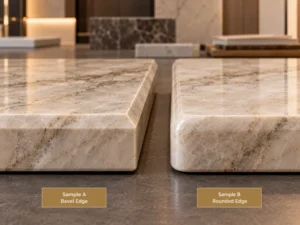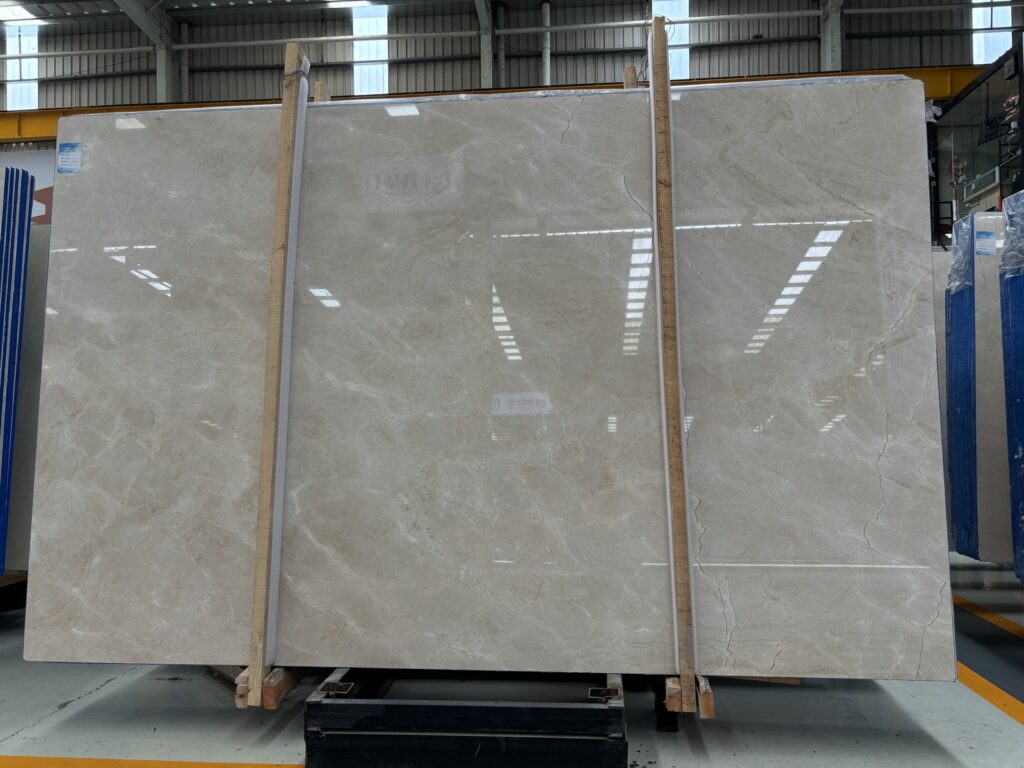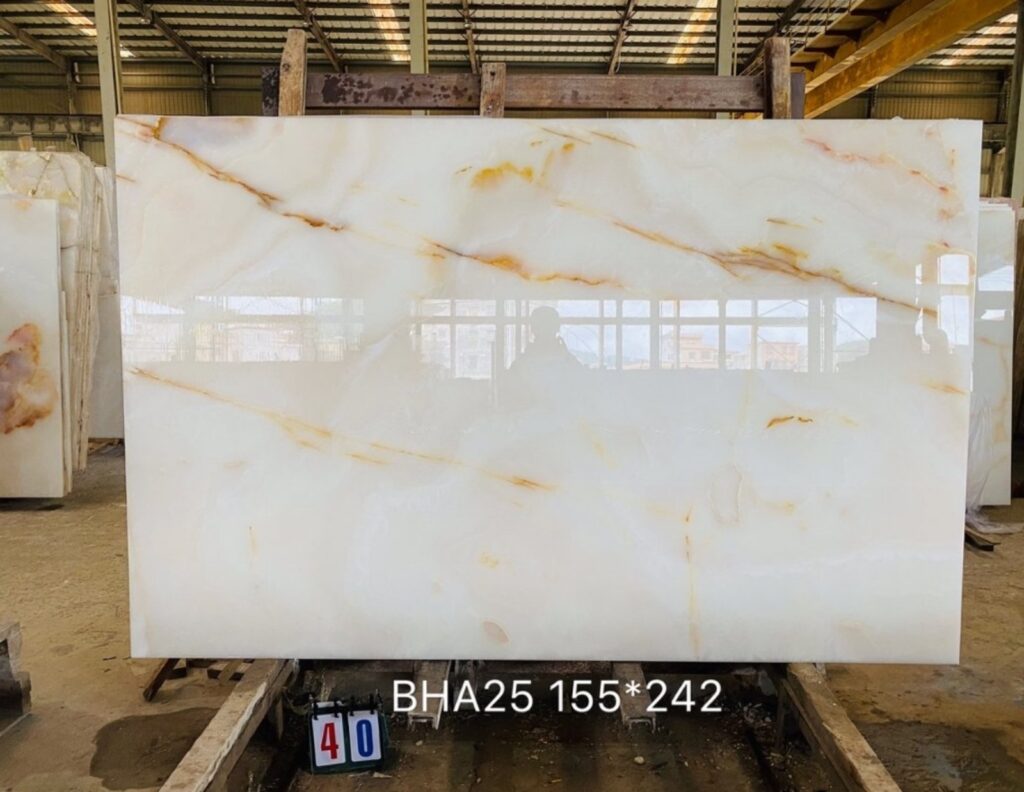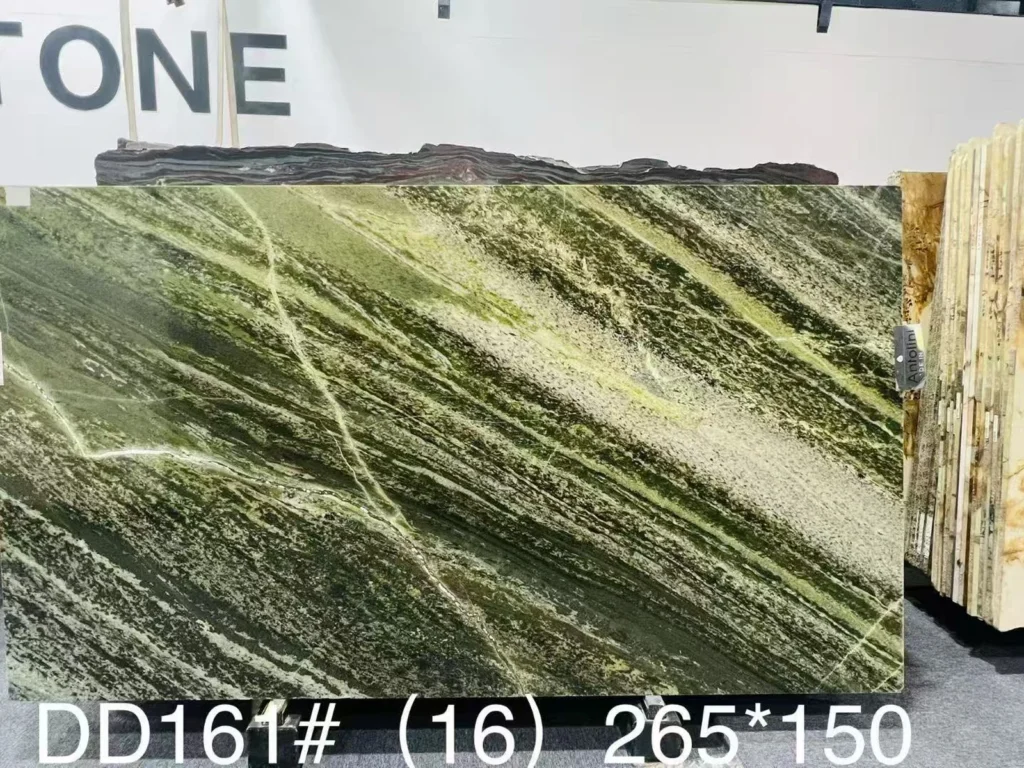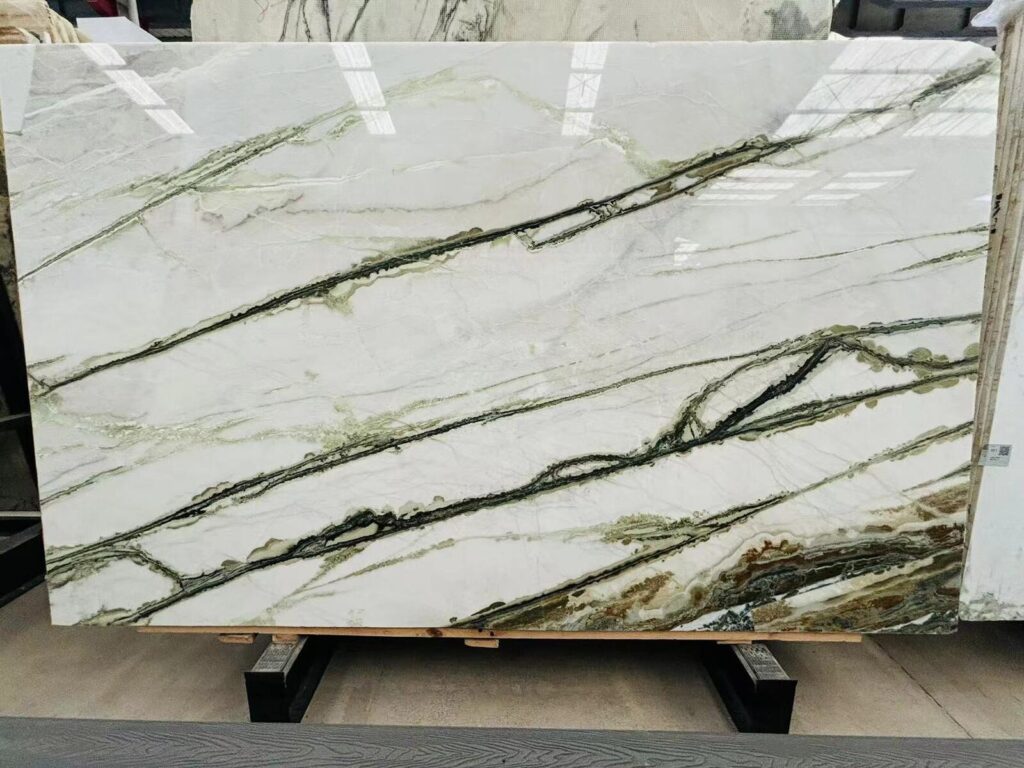

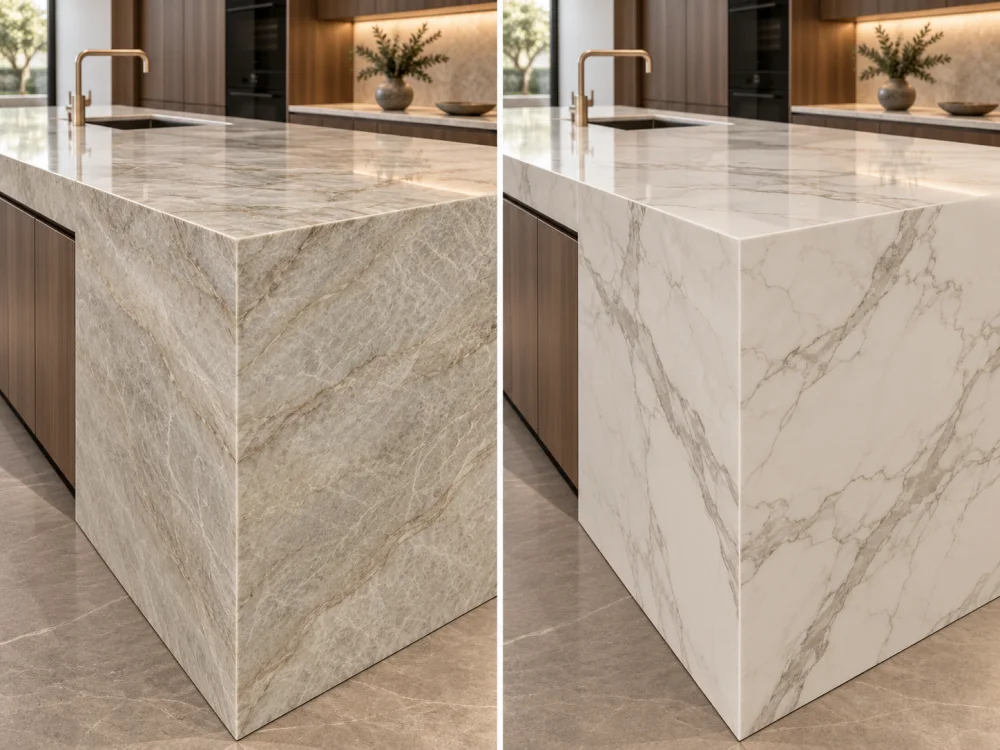
A large kitchen island can look almost monolithic when its horizontal top turns downward into a waterfall panel through a clean mitred corner.
The same principle appears in reception counters, stone furniture, vanity boxes, fireplace surrounds, pedestals, shelving, and other architectural elements where two visible surfaces meet at an outside corner.
From several metres away, the detail may look simple:
Horizontal Face → Sharp Architectural Turn → Vertical Face.
But the corner is not created by physically folding one slab.
Two fabricated pieces—or two fabricated faces within a coordinated assembly—must be cut, prepared, fitted, supported, joined, finished, protected, transported, and installed.
C’est pourquoi Quartzite naturel vs pierre frittée pour les angles mitrés apparents should not be reduced to a general question about which material is stronger or more premium.
La question plus pertinente est :
Which actual material and fabrication approach can create the approved visible corner for this design, with realistic expectations for pattern continuity, edge appearance, joint visibility, and handling?

The word “mitre” describes only part of the detail.
The project should first identify what people will actually see after installation.
For a kitchen island, this is normally the large worktop surface.
It may contain the strongest part of the stone or surface design and is usually viewed from several directions.
This face may be highly visible from the kitchen entrance, dining area, living room, or seating side.
For some designs, it is almost as important visually as the top.
The mitre line forms the visual hinge between the two surfaces.
Its appearance depends on cutting accuracy, joint preparation, adhesive or joining system, final refinement, product characteristics, and installation.
A rendering may make this line disappear completely. The fabricated corner should instead be reviewed as a real joint between real pieces.
Some designs expose more than two surfaces.
A boxed island, reception desk, table base, or thickened stone structure may include side returns, recesses, undersides, seating-side faces, or additional corners.
Each important visible surface should be identified before material allocation begins.
Primary Face → Secondary Face → Mitre Line → Adjacent Returns → Main Viewing Direction. Define these first, then decide what “matching” around the corner actually means.
The finished architectural form can be similar while the material logic behind it is different.
Natural Quartzite contains slab-specific geological movement.
If the designer wants the top and vertical face to relate around the mitred corner, both pieces should be positioned on the actual selected slab or coordinated slab sequence.
The review can consider:
Two pieces from visually related slab areas can create a convincing transition.
However, natural geological movement should not be promised to meet line-for-line around every corner.
Sintered Stone is a manufactured surface category.
The project should identify the exact selected product, finish, thickness, slab format, graphic or face reference where applicable, and the current fabrication guidance supplied for that product.
Do not assume that every Sintered Stone product has identical through-body appearance or that the design on the broad face will automatically appear the same on a cut or worked edge.
Some products use surface decoration or other product-specific visual technologies. The relationship between the face, body, mitred edge, and joint therefore needs to be checked on the actual selected material.
A small face sample is useful for color and local appearance, but it may not answer what a fabricated mitred corner will look like.
Natural Quartzite should not be expected to repeat with manufactured consistency.
Sintered Stone should not automatically be described as having the geological depth or slab-specific mineral movement of Natural Quartzite.
The comparison should focus on the finished corner the project wants to achieve.
| Review Area | Quartzite naturel | Pierre frittée |
| Visual source | Actual natural slab | Exact selected manufactured product / face |
| Pattern continuity | Develop from real slab positions and natural movement | Develop from available product graphics and fabrication layout |
| Cut-edge appearance | Natural material visible through the worked edge | Confirm against exact product construction and worked sample |
| Fabrication basis | Actual slab + fabricator review + project detail | Exact product + current manufacturer / fabricator guidance + project detail |
This distinction is particularly important for a visible mitred corner.
A designer may look at a digital slab layout and see one vein ending at the top-piece edge and apparently beginning at exactly the same point on the vertical return.
The CAD relationship can communicate design intent, but fabrication changes the physical material between those two visible faces.
For Natural Quartzite, the top and return are separate fabricated faces.

Material can be consumed through:
This means two mineral lines that appear to touch perfectly in a conceptual flat layout may show a small visual displacement after fabrication.
Le relatif Mitraques pour cascade en quartzite : pourquoi l’ordre de coupe est-il important ? guide explains this developed-corner principle in greater detail.
Instead of requiring every mineral line to meet exactly, define which visual relationships matter.
Par exemple :
These criteria can be reviewed before cutting and again during a trial fit.
A Sintered Stone product with a large stone-inspired graphic may also require face sequencing and corner-layout planning.
However, the available pattern relationships depend on the exact product, slab face, design repeat, and manufacturer’s product system.
Do not assume that a pattern can be repositioned indefinitely or that every available slab face provides the same graphic relationship.
Review the actual product information before approving the corner.
One of the clearest ways to review a mitred corner is to temporarily convert the three-dimensional corner into two flat visible faces.
Imagine:
A1 — Horizontal Top
↓
M1 — Mitred Transition
↓
A2 — Vertical Return
Now place A1 and A2 onto the actual slab or product layout.
Show:
Direction arrows can help, but they do not prove pattern continuity.
Le Symboles de direction des veines de quartzite pour les plans d’exécution guide explains why direction should remain connected to piece IDs, visible faces, seams, and actual slab positions.
Show the equivalent top and return pieces using the exact selected slab face or graphic reference where available.
Confirm whether the product has multiple faces, directional graphics, or manufacturer-specific layout considerations.
The project should not mirror, rotate, or substitute a product graphic without confirming that the resulting visible relationship is acceptable.
A mitred corner can look different from the long side of an island than from its waterfall end.
If one viewpoint has priority, identify it.
For example, the dining-room approach may be more important than the working side of the kitchen.
The slab or product allocation can then prioritize the corner relationship seen from that direction.
A broad face sample does not answer every question about the finished corner.

Natural Quartzite exposes the actual stone material at the worked edge.
The edge may pass through different minerals, crystal areas, or veins than the broad face.
Where the corner is highly visible, review how the actual stone reads through the mitred transition and any final edge refinement.
For Sintered Stone, inspect the exact selected product in a fabricated condition.
The face graphic, slab body, cut edge, adhesive line, and final corner may not have identical visual character.
A worked mitred sample is therefore more useful than assuming the face sample tells the whole story.
Even a carefully fabricated mitred corner contains a physical joint.
Its final visibility can be affected by:
Do not promise an “invisible mitre” from a concept image alone.
A more useful approval is a representative worked corner viewed under the intended lighting.
Face Color → Cut Edge → Mitre Preparation → Joint → Corner Refinement → Finished Viewing Condition. Approve the conditions that remain visible in the completed project.
Architectural renderings often show an extremely sharp ninety-degree outside corner.
Real fabrication needs a more controlled discussion.
The responsible fabricator should establish the final corner treatment according to the material, selected product, thickness, fabrication method, design intent, handling, and installation requirements.
A small edge refinement, easing, or other project-specific treatment may affect both appearance and practical handling.
Do not invent one universal dimension for every Natural Quartzite or Sintered Stone project.
Manufactured surface suppliers may provide specific instructions for mitred edges, machining, reinforcement, corner treatment, transport, or installation.
Those instructions should be checked for the exact product being fabricated.
Do not apply one brand’s fabrication rule automatically to another Sintered Stone product.
For Natural Quartzite, the fabricator should review the specific slab, edge location, natural features near the mitre, piece dimensions, support, handling, and proposed assembly.
A dramatic mineral transition located directly at the mitred edge may warrant a different slab position or additional fabrication review.
A perfect corner leaving the fabrication bench still has to survive internal handling, QC, packing, transport, unloading, and installation.

Mitred pieces should be packed and handled according to the applicable material and fabrication requirements.
Exposed corners and finished edges should not be allowed to strike adjacent pieces or hard crate components.
For Sintered Stone, follow the current manufacturer and fabricator guidance for edge and corner protection.
For visually related Natural Quartzite pieces, a top and waterfall panel may have similar dimensions but completely different installed orientations.
Use stable piece IDs.
Par exemple :
A1 — Island Top
A2 — Left Waterfall
A3 — Right Waterfall
The same piece IDs should remain connected to the slab layout, shop drawing, fabrication record, QC photographs, packing list, and installation handover.
A waterfall panel may be packed horizontally even though it will be installed vertically.
Transport labels such as “This Side Up” do not replace project-defined TOP, VISIBLE FACE, LEFT, RIGHT, or other installation-orientation references.
Orientation control becomes especially important when the design depends on a specific pattern relationship around the corner.
A visible mitred corner deserves more than a flat sample when the project places high visual importance on the detail.
The mock-up can evaluate:
It does not need to reproduce the entire island.
It needs to reproduce the condition that could change the material decision.
If Natural Quartzite and Sintered Stone are being compared, make the corner samples physically comparable where practical.
Use equivalent viewing geometry and representative finishes.
Do not compare a carefully fabricated Natural Quartzite mitre with an unworked Sintered Stone face chip and then conclude that one material creates a better corner.
From room distance, judge the overall architectural line and pattern transition.
At close range, inspect the joint, corner refinement, cut-edge appearance, and any change in pattern at the mitre.
Both viewing distances matter because a statement island or reception counter may be experienced from across the room and directly beside the corner.
A designer may approve the appearance of a corner while technical fabrication questions remain open.
These decisions should not be merged into one vague “approved” message.
| Approbation | What It Confirms | What It Does Not Automatically Confirm |
| Face sample approved | Color, finish and local appearance | Mitred joint or corner appearance |
| Slab / product layout approved | Top and return visual relationship | Final fabricated joint |
| Worked corner approved | Defined edge, joint and corner appearance | Every later slab, product batch or changed geometry |
| Fabrication release | Current pieces, drawing revision and defined technical scope can proceed | Unresolved site or installation conditions outside the agreed scope |
A change in island length, waterfall height, return depth, overhang, cabinet position, or another relevant dimension can move the mitre line into a different part of a Natural Quartzite slab.
For Sintered Stone, it may also change the product layout, graphic position, joint arrangement, or fabrication strategy.
If the geometry changes materially after approval, review the affected corner again before cutting.
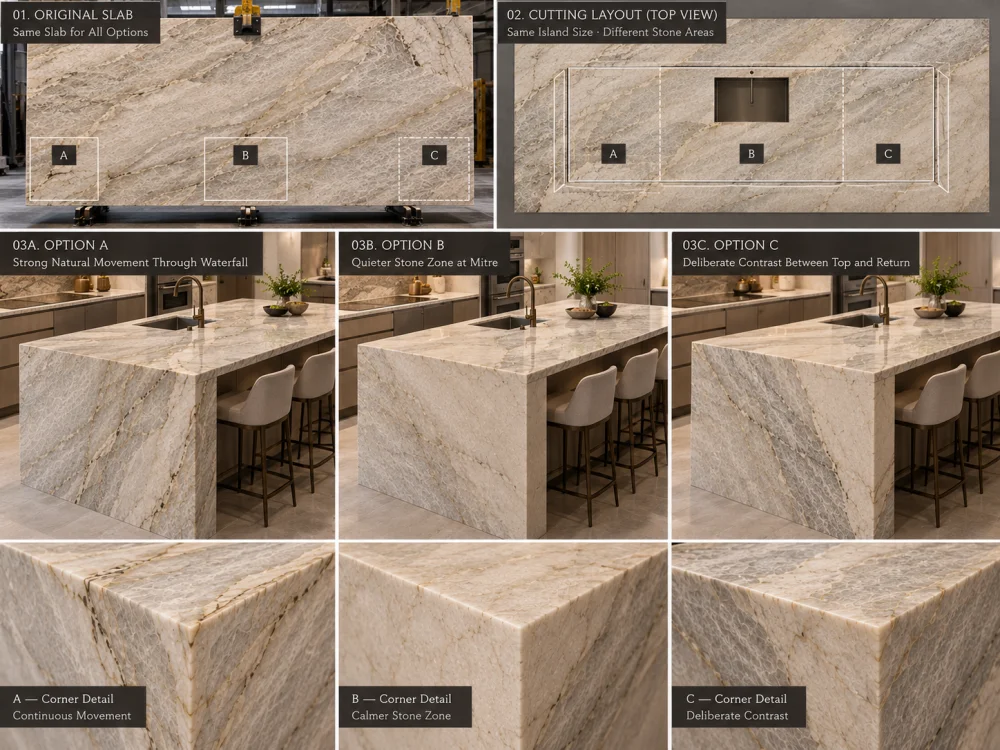
Le Îles cascade en quartzite Roma bleu : choisir la meilleure orientation des dalles guide illustrates why one slab can produce a strong-pattern corner, a quiet transition, or deliberately contrasting faces depending on where the pieces are positioned.
The same principle applies to other directional Natural Quartzites.
Natural Quartzite may be preferred when the designer wants authentic geological movement to remain visible across the top and return, and the selected slab provides an attractive relationship around the mitre.
Sintered Stone may be preferred when the specific manufactured product, available graphic, thickness, finish, and fabrication system support the intended architectural detail.
Neither material should be selected from the category name alone.
For an important visible corner, compare:

A convincing corner is the result of coordinated material, layout, fabrication, and installation—not a property guaranteed by the words “Quartzite” or “Sintered Stone.”
Il n’existe pas de gagnant universel. Le quartzite naturel présente des mouvements géologiques propres à chaque dalle, tandis que la pierre frittée reflète les caractéristiques du produit manufacturé exact. Comparez les matériaux réels, la relation des motifs, les bords taillés, l’aspect des joints, les consignes de fabrication, les exigences de manutention et les conditions d’utilisation prévues.
Il ne convient pas de supposer une correspondance parfaite, ligne à ligne. Les entailles de scie, la découpe, le rognage, la préparation des mitres, l’ajustement et les finitions peuvent entraîner une perte ou une modification de matière entre les deux faces visibles prévues. Un objectif plus réaliste consiste à obtenir une relation visuelle conforme aux prescriptions, fondée sur la disposition réelle des dalles.
Ne présumez pas cela pour chaque produit. Les produits en pierre frittée peuvent varier en termes de structure du corps, de décoration de surface, de motifs graphiques, d’épaisseur et d’aspect des bords. Vérifiez le produit exact sélectionné et, lorsque l’angle revêt une importance esthétique, inspectez un joint d’onglet travaillé représentatif.
No universal corner refinement should be specified for every material and project. The responsible fabricator should confirm the appropriate final geometry according to the selected material or product, fabrication method, handling, installation, and design intent.
No. A face sample can support color and finish approval, but it does not fully demonstrate the cut edge, joint line, corner refinement, adhesive relationship, or pattern transition. A worked sample or project-specific mock-up can provide stronger evidence when the mitre is a major design feature.
The two pieces create one visible architectural corner. Planning them independently can place unrelated pattern areas at the mitre or lose the intended movement. For Natural Quartzite, review both pieces on the actual slab; for Sintered Stone, review the exact product faces and layout information.
Send Josh the proposed Natural Quartzite material, current slab references where available, project plan and elevations, finished dimensions, top and return piece sizes, required finish, visible faces, preferred pattern relationship, mitre locations, openings, support information within the confirmed project scope, quantities, and delivery destination. If Sintered Stone is being compared, also provide the exact product reference and applicable technical information.
For project-based Natural Quartzite mitred edges, waterfall islands, reception counters, and custom stone furniture, HRST STONE can coordinate available slab photographs, board references, CAD/shop drawings, developed-corner layouts, piece IDs, visible-face notation, vein direction, cutting layouts, trial-fit photographs, edge-detail QC, packing identification, and export documentation according to the confirmed stone scope. Send Josh the current drawings, dimensions, material references, quantities, finish, visible-corner priorities, and delivery destination before cutting release.