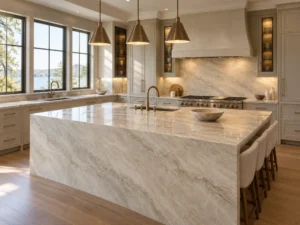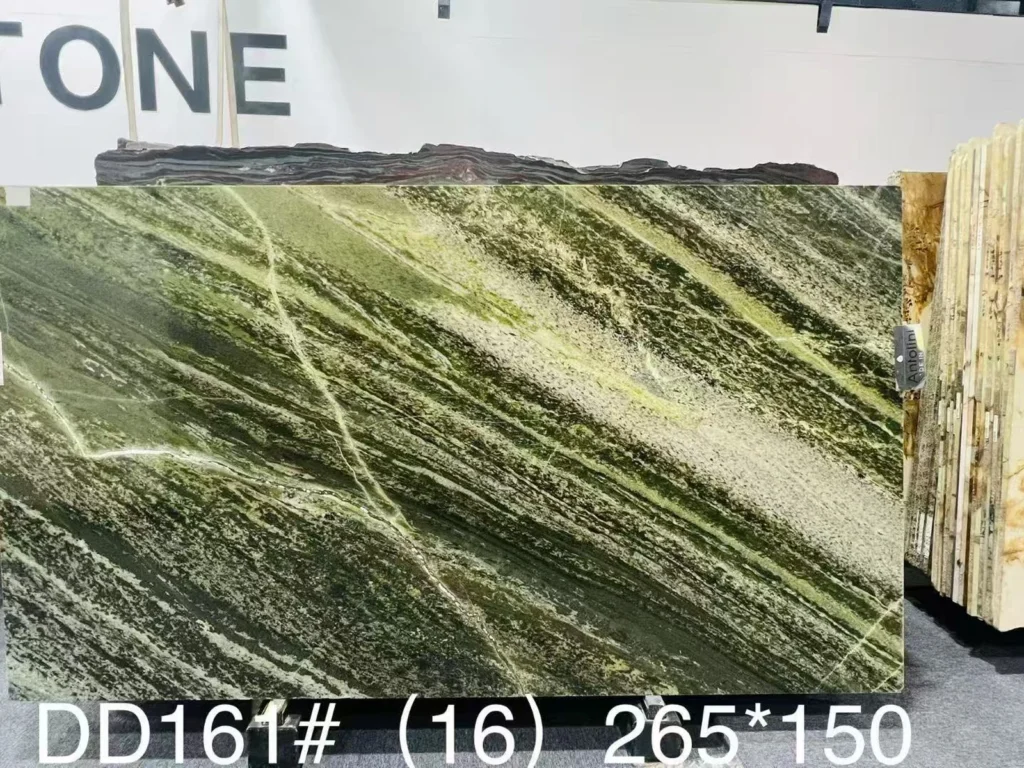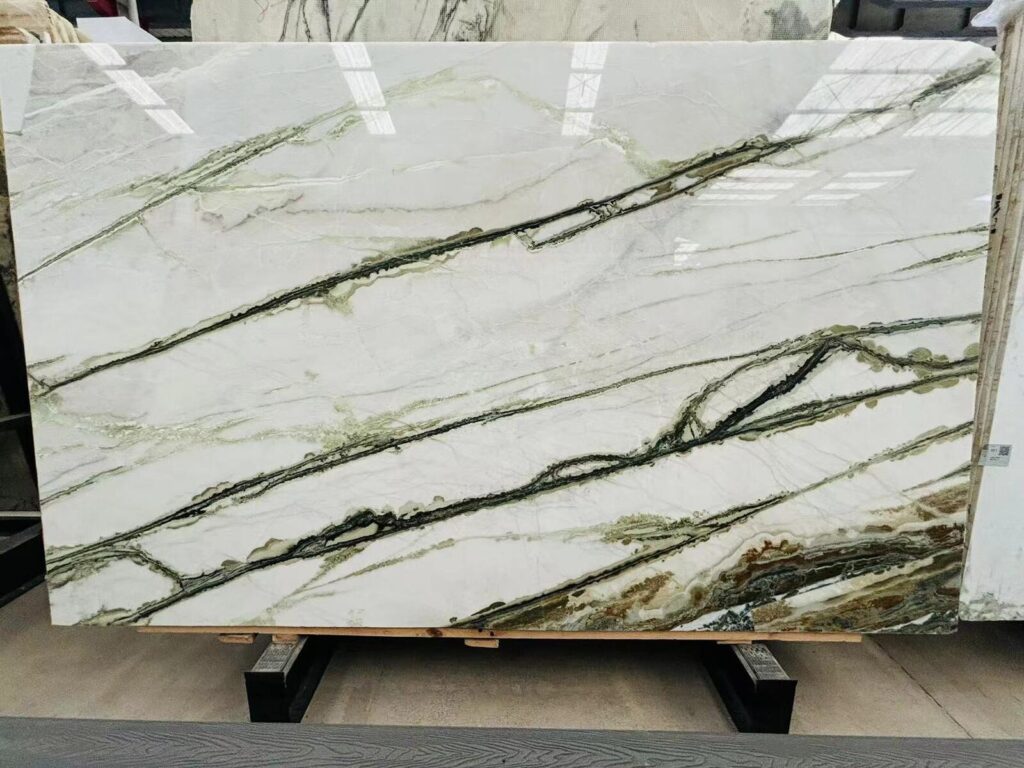


A kitchen project is completed.
The main island, perimeter countertops, and backsplash pieces have already been cut from the selected natural stone slabs.
Several pieces remain in the factory.
One may be a broad rectangular section beside the original island layout. Another may have an irregular edge. A third may already contain one finished edge from the original fabrication.
Months later, the designer asks:
“Could we use one of those pieces for two bedside tables?”
Or:
“Can this Quartzite remnant become a round side table instead of ordering another slab?”
C’est ici que Natural Quartzite vs Granite for Small Furniture Tops Cut from Remnants becomes a much more specific question than a conventional material comparison.
Both materials are natural stone. Both can contain valuable leftover sections after another project has been cut. Both can create distinctive furniture tops.
But the useful decision is based on the exact physical remnant:
Can this identified leftover piece actually produce the required furniture top, in the desired orientation, with an acceptable visible area, edge, base interface, and fabrication result?
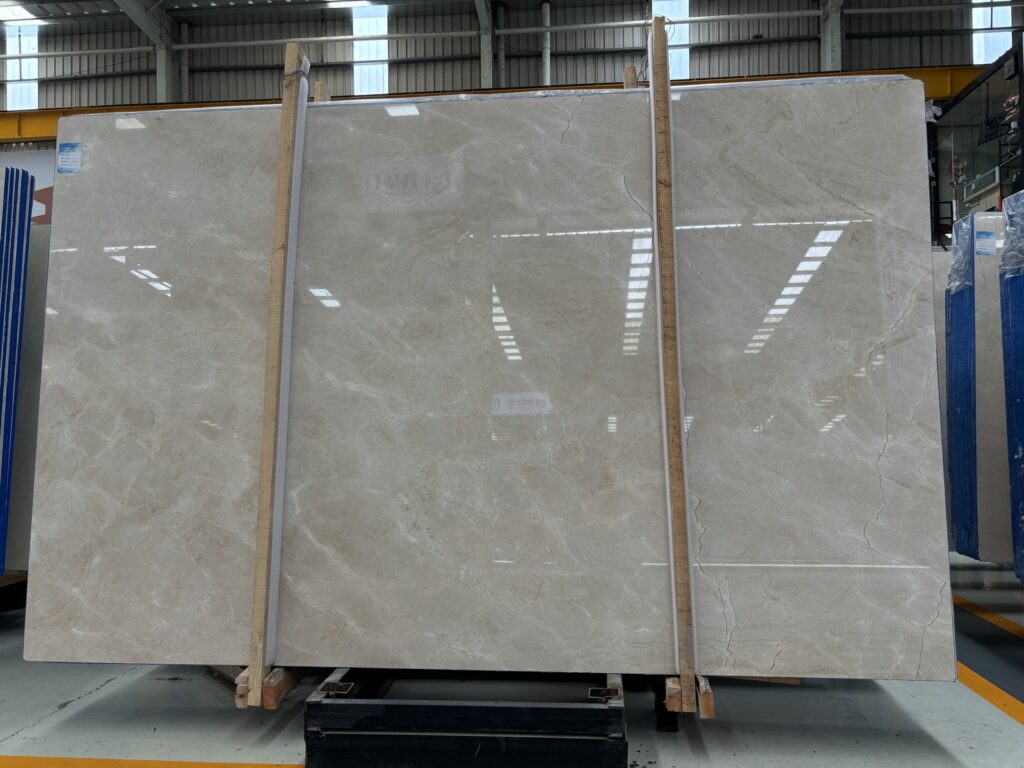
The word “remnant” can make a leftover stone piece sound simpler than it really is.
A full slab normally begins as one identifiable board with known overall dimensions and a large continuous face.
A remnant has already been affected by another cutting decision.
It may now contain:
This means the first question should not be:
“How many square metres are left?”
Demandez plutôt :
“What physical stone exists now, and what usable finished-piece geometry can fit inside it?”
Where a remnant-management system exists, review the current piece identity rather than relying on an old cutting-plan screenshot.
A useful record can connect:
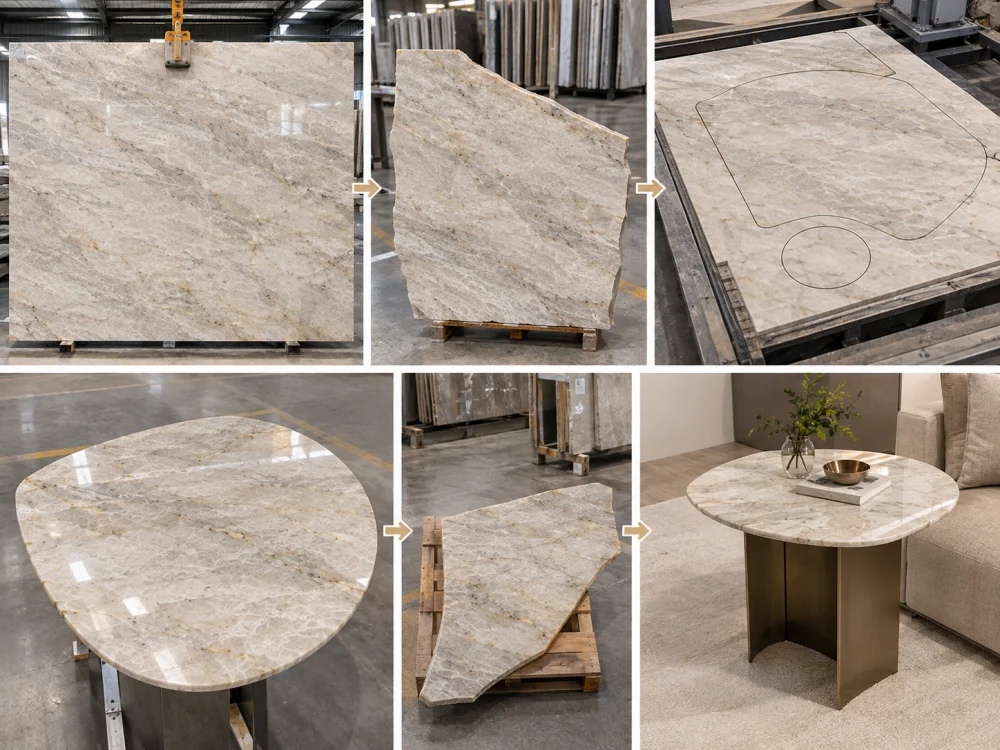
Original Material → Source Slab → Original Cutting Layout → Remnant ID → Current Photograph → Current Dimensions → Storage Location → New Furniture Review.
Le relatif Propriété et stockage des dalles de quartzite : que se passe-t-il après la réservation ? guide explains why intentionally retained remnants should remain connected to their source board and storage record where that information is known.
Do not assume that dimensions recorded immediately after the original project are still current.
The remnant may have been:
Before planning the furniture, locate and recheck the actual physical piece.
Recorded Remnant → Physical Piece Located → Current Dimensions → Current Condition → Visible Face / Finish → Usable Cutting Area → Availability → Furniture Layout. Do not skip from an old inventory entry directly to fabrication.
Natural Quartzite and Granite can both produce successful small furniture tops.
For remnant work, however, category-wide claims are usually less useful than the individual piece.
A Natural Quartzite remnant can contain a concentrated section of the original slab’s geological movement.
A small tabletop may capture:
This can make furniture an interesting secondary use for visually valuable stone that remained outside the original finished components.
Granite remnants can also vary substantially.
Some commercial Granites present relatively consistent granular fields. Others contain strong bands, movement, contrasting mineral zones, or large-scale structures.
A small Granite furniture top can therefore be either visually restrained or highly expressive depending on the exact retained piece.
Imagine that the warehouse contains:
Remnant A — a Natural Quartzite piece large enough for one table but with the most attractive mineral area close to an irregular corner.
Remnant B — a Granite piece that comfortably accommodates two coordinated bedside-table tops with clean edge access.
For a pair of bedside tables, Remnant B may provide the more practical design solution even if the designer originally preferred Quartzite.
Now imagine the project needs only one sculptural side table and Remnant A contains a striking natural feature that fits perfectly inside the proposed top.
The decision may reverse.
This is why the useful comparison is:
Exact Remnant + Exact Furniture Geometry + Exact Visual Intent.
This is one of the most important points for small custom furniture.
A warehouse record may describe a remnant as:
1200 × 700 mm.
That does not automatically mean every finished shape smaller than those dimensions will fit.
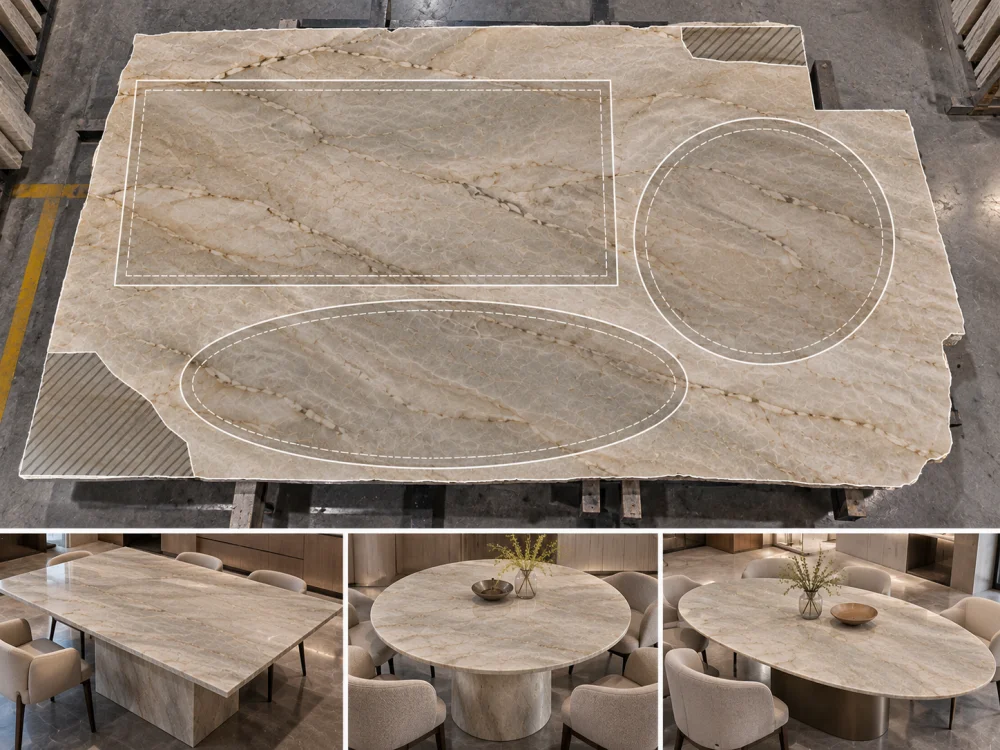
The 1200 × 700 mm figure may describe the maximum bounding dimensions.
One corner may be missing. One side may taper. Part of the piece may already have an opening.
The actual usable area can therefore be significantly different from the nominal rectangle.
A round table cannot be approved by checking only maximum remnant width and length.
The complete circular outline must sit within the usable stone.
An irregular corner that does not affect a small rectangular tabletop may prevent a larger circle from fitting.
For an oval, organic, racetrack, triangular, or custom freeform top, place the real finished outline onto the current remnant photograph or CAD geometry.
This is much more reliable than calculating only net square metres.
The finished component may also require trimming, profiling, polishing, mitring, or other processing around the perimeter.
The fabricator should review the actual cutting and finishing allowance rather than placing the finished outline directly against an unusable remnant edge.
Le Natural Quartzite Usable Area vs Gross Slab Area guide explains the broader principle: overall physical area, practical usable cutting area, and finished-piece area are different quantities.
| Remnant Information | What It Tells You | What It Does Not Prove |
| Maximum length × width | Overall physical envelope | That a rectangular piece of that size is usable |
| Gross remnant area | Approximate amount of physical stone | Finished-piece yield |
| Current photograph | Shape, pattern and visible conditions | Exact fabrication suitability without dimensional review |
| Furniture-top overlay | Proposed finished-piece position | Final fabrication release until remaining technical issues are reviewed |
A large kitchen island may consume a major portion of one slab.
A side table, nightstand top, pedestal top, or small console insert can be much more selective.
This can turn remnant planning into a design opportunity.
Instead of centering the tabletop automatically within the remnant, examine the complete face.

Demander :
Then position the furniture outline accordingly.
A directional stone used for a rectangular desk or console has an obvious long axis.
A circular table does not.
This gives the designer more freedom to rotate the finished shape over the remnant until the natural movement feels balanced.
However, the approved orientation should still be recorded before cutting if one direction has been selected intentionally.
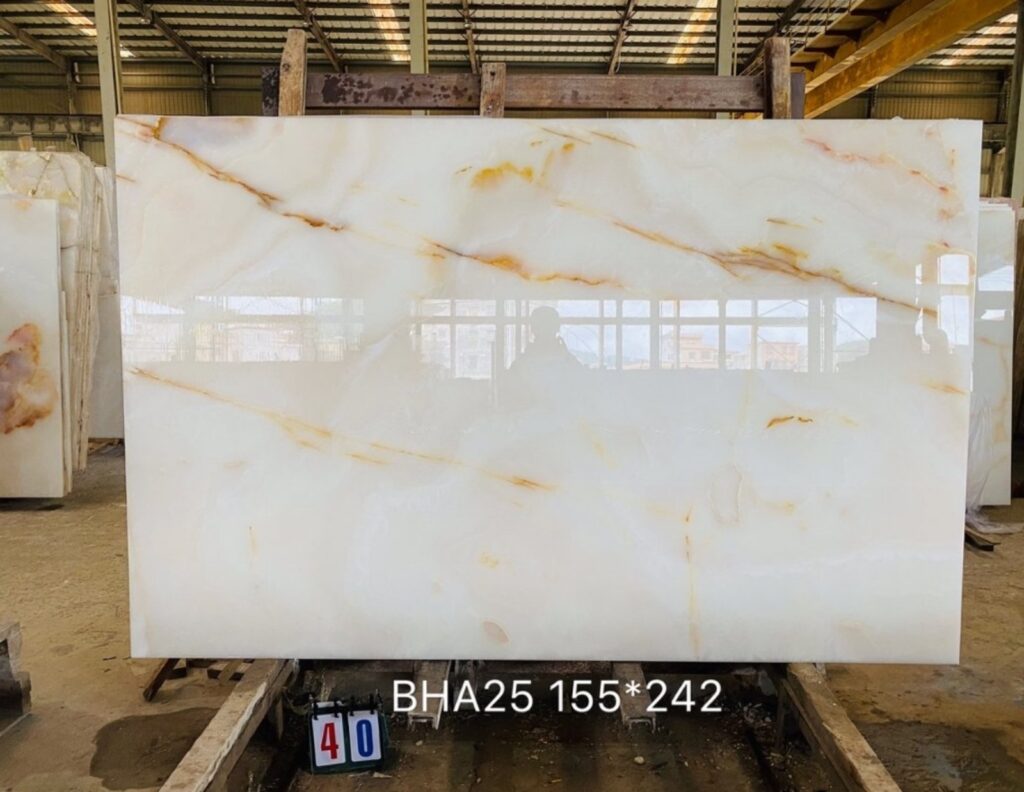
On a full slab, a dramatic mineral feature may occupy only a small percentage of the surface.
On a 450 mm or 600 mm side-table top, the same feature can become the entire composition.
This is one reason small furniture can make visually interesting use of retained natural stone.
The goal should be deliberate selection rather than treating the furniture as a place to use whichever offcut is easiest to cut.
Small furniture is often ordered in groups.
Parmi les exemples figurent :

This changes remnant planning.
Before cutting, define the visual relationship.
The project may want:
Matched Pair — both tops have similar tone and movement.
Related Pair — both clearly come from the same natural material but show different sections of the remnant.
Individual Pieces — natural variation is intentionally celebrated and each top may be different.
If two bedside tops must coordinate, overlay both finished outlines onto the remnant at the same time.
A visually perfect first crop may consume the only area that would have allowed the second top to match.
Three nesting tables may have different diameters or shapes.
The layout should consider:
For a pair or set, approve the complete group layout before cutting the first piece. One attractive furniture top should not accidentally consume the only usable area needed for the remaining pieces.
The stone top does not exist independently from the furniture below it.
A 20 mm slab top, a thicker natural-stone piece, a built-up edge, or another fabricated appearance can create very different proportions on the same metal or timber base.
A retained remnant normally carries the thickness of its original slab or fabricated component.
Confirm that thickness physically where relevant rather than assuming it from the material name.
If a thicker-looking furniture edge is required, the fabricator should review the proposed construction and visible edge treatment for the actual remnant.
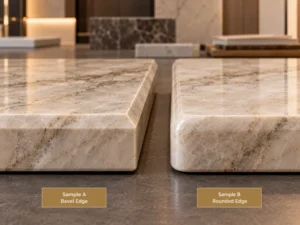
A small side-table top may use:
Do not select the profile only from a countertop catalogue.

The edge should relate to the thickness, table size, design language, material, handling, and fabrication capability.
A stone top may sit on:
The support and fixing arrangement should be designed for the actual top size, weight, geometry, center of gravity, intended use, and base construction.
Do not assume that because the stone piece is small, every base geometry is automatically adequate.
If mechanical fixing, inserts, holes, or another attachment detail is proposed, coordinate it with the responsible furniture designer and stone fabricator before machining the stone.
Natural features, edge distances, thickness, hole location, and base hardware can all affect the final detail.
A remnant can exist physically without being available for a new furniture order.
This distinction is particularly important when leftover material came from another client’s project.
A physical remnant may be:
Availability should therefore be confirmed separately from physical existence.
A stone piece sitting in a supplier’s factory does not by itself establish who owns it or whether it can be used for another project.
Ownership, commercial allocation, storage, permission to recut, and similar questions should follow the applicable quotation, purchase order, invoice, contract, or other governing project records.
Le site Quartzite Slab Ownership and Storage guide makes the same distinction between physical location, commercial status, storage, and fabrication release.
The project should also avoid assuming:
“It is leftover stone, so we only pay for the exact finished area.”
A supplier may quote a remnant, fabricated component, minimum fabrication charge, handling, edge processing, packing, freight, or other scope according to the actual commercial arrangement.
Le relatif Commandes minimales pour le quartzite naturel : questions relatives aux achats de dalles mixtes guide explains why finished net area, material purchase quantity, MOQ, and minimum charge should not be treated as the same concept.
Once a retained stone piece is cut again, its physical geometry changes.
The old record should not continue to describe the remaining stone as though nothing happened.
A useful traceability chain might look like:
Board TM-042 → Remnant TM-042-R01 → Side Table ST-01.
If another useful section remains after ST-01 is cut, assign or update its identity according to the factory’s controlled system.
The exact numbering format can differ.
The important point is that the history remains reconstructable.
Where another useful remnant is intentionally retained, update:
A raw or partially processed remnant may support many possible future cutting decisions.
A spare finished furniture top has already been fabricated for a defined geometry and should retain its own finished-piece identity, dimensions, orientation, edge profile, and intended use.
Keeping these records separate makes future replacement or repeat orders easier to understand.
For a small furniture top, Natural Quartzite may be the preferred choice when an available remnant contains a particularly attractive geological feature that fits the finished shape.
Granite may be the better choice when its actual remnant provides the right dimensions, visual character, edge condition, or enough usable material for a coordinated furniture set.
Neither category wins automatically.
| Furniture-Top Decision | Natural Quartzite Remnant | Granite Remnant |
| Identité du matériau | Confirm actual remnant and source slab where known | Confirm actual remnant and source slab where known |
| Usable size | Overlay actual furniture geometry | Overlay actual furniture geometry |
| Sélection visuelle | Choose the preferred natural geological crop | Choose the preferred mineral / pattern crop |
| Pair / set | Confirm all required tops fit before first cut | Confirm all required tops fit before first cut |
| Edge / base | Coordinate actual thickness, edge and support | Coordinate actual thickness, edge and support |
| Commercial status | Confirm availability and allocation separately | Confirm availability and allocation separately |
A practical final review can follow this sequence:
Locate Remnant → Verify Identity → Remeasure → Map Usable Area → Overlay Furniture Shapes → Select Visual Crop → Confirm Pair / Set → Confirm Edge and Base → Confirm Commercial Availability → Release Fabrication → Update Remaining Remnant.
This approach turns leftover natural stone into a controlled furniture material rather than an anonymous workshop offcut.
Not universally. For a remnant project, the exact physical piece is usually more important than the material category. Compare current usable dimensions, natural pattern, finish, thickness, edge condition, furniture geometry, base design, availability, and the number of tops required.
Do not rely only on maximum length and width. Irregular edges, missing corners, existing cutouts, natural conditions, required trimming, edge fabrication, and the actual tabletop shape can reduce the usable cutting area. Overlay the finished outline onto the current remnant before approval.
Potentially. Round, oval, and freeform tops can work well with remnants, but their complete outline must fit within the usable stone. A remnant that accommodates a rectangular piece of similar net area may not necessarily accommodate a large circle or oval.
It may, but both finished outlines should be planned together before the first piece is cut. Confirm that the remnant provides sufficient usable area and that the two selected crops meet the project’s definition of matched, related, or intentionally varied natural-stone tops.
No. A physical record does not automatically establish commercial availability. The piece may be held for the original project, reserved for replacement, allocated elsewhere, pending inspection, or subject to another commercial arrangement. Confirm availability separately.
The stone-top geometry and furniture-base interface should be coordinated before final fabrication. Confirm the top dimensions, thickness, support area, fixing concept, edge profile, weight and intended use with the responsible furniture designer and stone fabricator before drilling or other irreversible machining.
Send Josh the preferred Natural Quartzite material or available remnant reference, furniture-top drawing, quantity, finished shape and dimensions, required thickness where relevant, surface finish, edge profile, furniture-base information, whether the pieces need to form a matched set, visual priorities, and delivery destination. If a specific remnant is proposed, include its current ID and photograph where available.
For project-based Natural Quartzite furniture tops, side tables, coffee tables, bedside tables, shelves, and other small fabricated components, HRST STONE can coordinate available remnant references, current photographs, source-board information where known, CAD layouts, pattern-crop review, edge details, fabrication QC, piece identification, packing, and export documentation according to the confirmed project scope. Send Josh the furniture drawings, quantities, dimensions, stone preference, finish, edge requirement, base information, visual priorities, and destination for review.