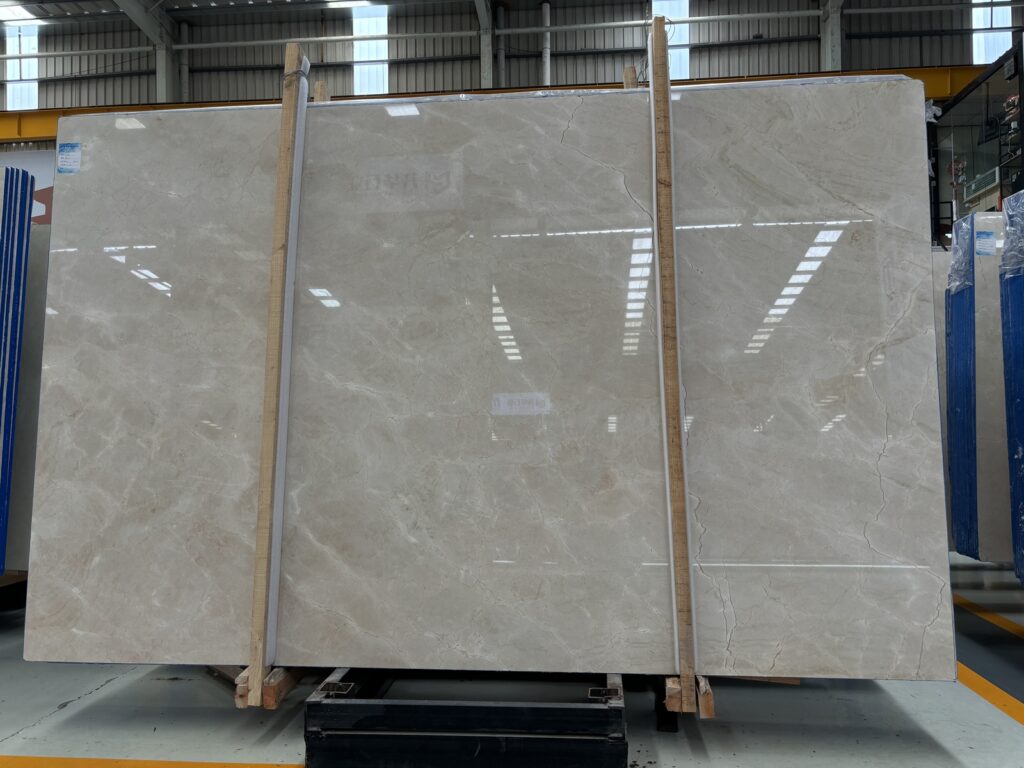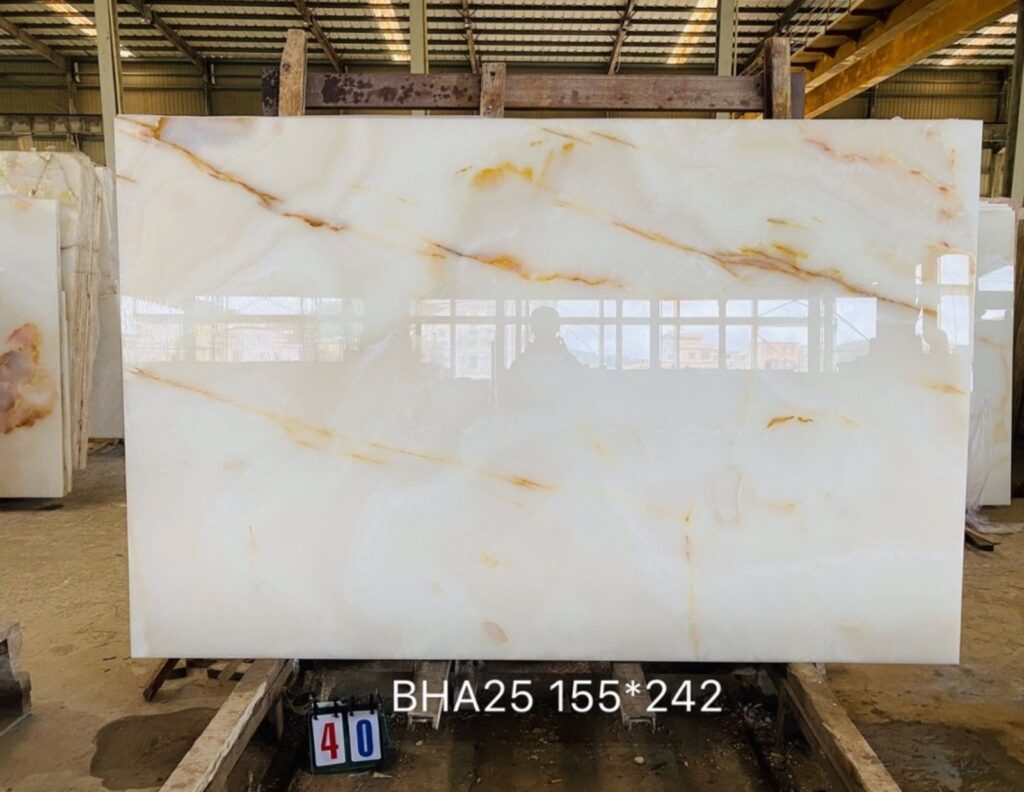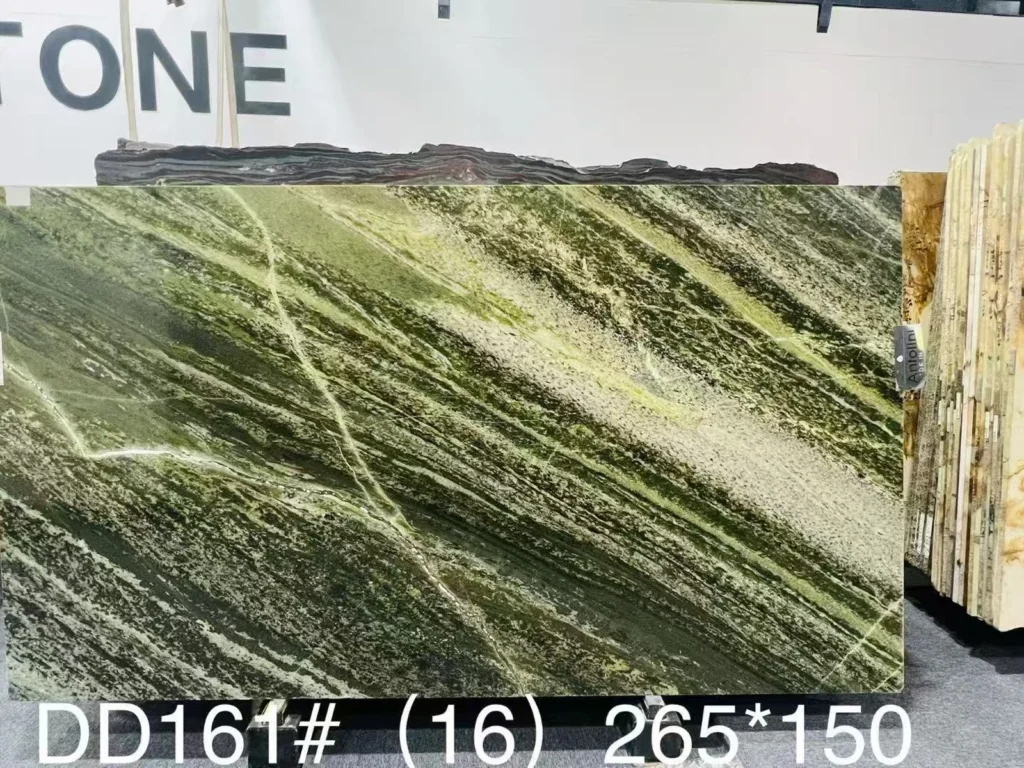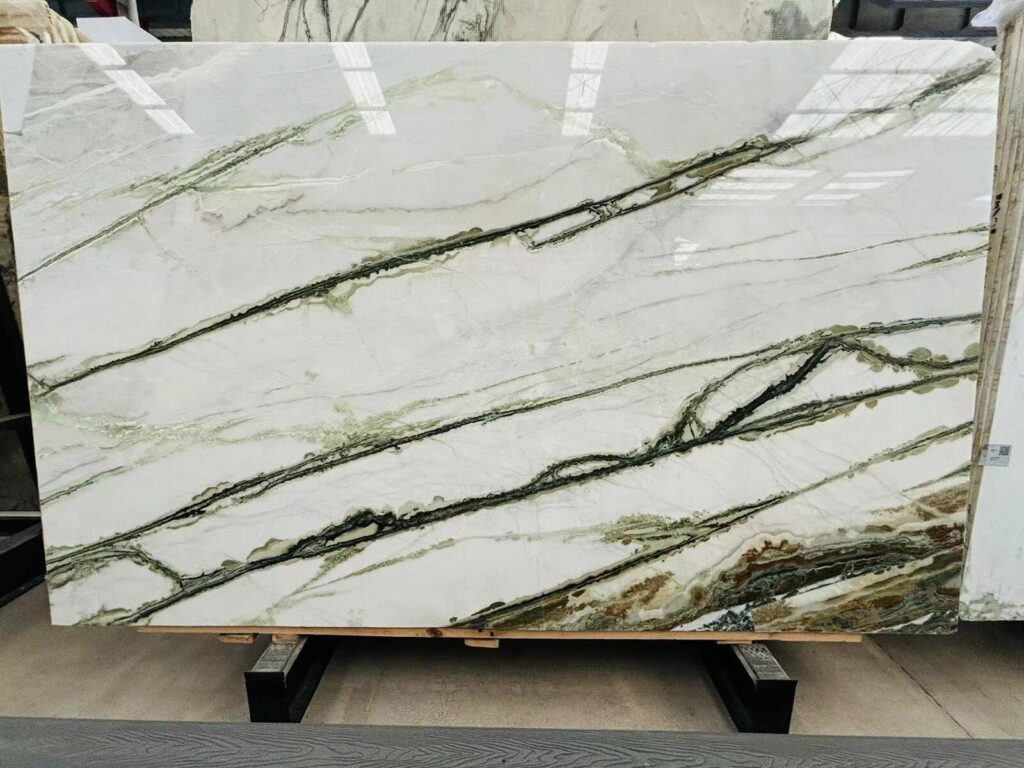


Best Thickness and Edge Details for Quartzite Kitchen Countertops is a practical decision guide for homeowners, designers, fabricators, contractors, and import buyers. The objective is to select a slab thickness and edge profile that suit the design while remaining practical to fabricate, transport, support, and install. Natural stone is inherently variable, so the advice below emphasizes the actual material, documented approvals, qualified fabrication, and project-specific judgment rather than absolute promises.
Dans tout ce guide, “ quartzite ” désigne la pierre naturelle, et non le quartz d’ingénierie. Les appellations commerciales peuvent varier selon les fournisseurs et les marchés. Lorsque l’identité géologique, le comportement structurel, l’absorption, la réaction chimique ou toute autre caractéristique de performance est essentielle, précisez clairement l’exigence et organisez une évaluation représentative appropriée, plutôt que de vous fier uniquement à l’appellation commerciale.
Thickness is not an isolated style choice. Cabinet rigidity, overhangs, appliance openings, sink type, joint positions, access routes, and installation equipment all affect the workable specification. A strong decision begins with drawings and the actual slabs, not a generic rule copied from another project.
For homeowners, designers, fabricators, contractors, and import buyers, the useful question is not whether start with the whole countertop system is generally recommended, but what evidence will make the choice defensible for this order. Record the assumption, the person responsible for confirming it, the approval format, and the stage after which a change becomes costly. This turns a broad preference into a controlled project decision.
At the approval stage, ask four practical questions: what exactly is being accepted, what evidence supports it, who owns the next action, and how will a deviation be handled? For select a slab thickness and edge profile that suit the design while remaining practical to fabricate, transport, support, and install, these questions create a repeatable trail from selection through installation. They also make it easier to compare proposals without assuming that similar names or photographs represent identical material and service.
Slabs are commonly described by nominal thickness, while calibration, surface finishing, and local tolerances can affect the measured result. Buyers should record actual measurements at several points and confirm which dimension the fabricator uses for shop drawings, edge build-ups, reinforcement, and final elevations.
Appliquez ce principe aux plans de travail en quartzite naturelle réels, et non à un échantillon idéalisé. Comparez l’apparence à grande échelle, les mesures, les plans et les contraintes pratiques de manipulation. En cas d’incertitude persistante, recourez à un test représentatif, à une maquette, à un examen par le fabricant ou à une inspection tierce, adaptés aux conséquences d’un éventuel échec. Évitez d’inventer des seuils numériques d’acceptation, sauf si le contrat spécifie une méthode et une tolérance.
At the approval stage, ask four practical questions: what exactly is being accepted, what evidence supports it, who owns the next action, and how will a deviation be handled? For select a slab thickness and edge profile that suit the design while remaining practical to fabricate, transport, support, and install, these questions create a repeatable trail from selection through installation. They also make it easier to compare proposals without assuming that similar names or photographs represent identical material and service.

A thinner format can support a restrained visual language and may reduce weight, but it requires disciplined handling and a support strategy suited to the layout. Narrow rails around sinks, long cutouts, large overhangs, and difficult site access deserve particular review because they concentrate risk.
The commercial documents should support the technical decision. Quotations, approvals, shop drawings, piece labels, packing records, and change notices need consistent terminology. If when a thinner slab can work changes after approval, document the effect on price, yield, timing, appearance, and responsibility before work continues.
At the approval stage, ask four practical questions: what exactly is being accepted, what evidence supports it, who owns the next action, and how will a deviation be handled? For select a slab thickness and edge profile that suit the design while remaining practical to fabricate, transport, support, and install, these questions create a repeatable trail from selection through installation. They also make it easier to compare proposals without assuming that similar names or photographs represent identical material and service.
A thicker slab can create a substantial appearance and may simplify some exposed edges, yet it is heavier and is not automatically safer in every geometry. Transport frames, lifting, cabinet loading, internal defects, and the direction of natural movement still require evaluation.
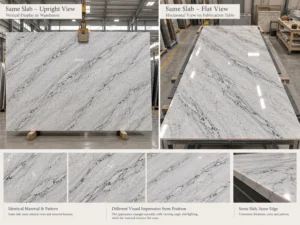
La communication visuelle est primordiale, car la pierre naturelle est variable et que les appareils photo, les écrans, l’éclairage et les surfaces humides peuvent fausser la perception. Utilisez des repères d’identification et d’échelle, présentez à la fois des vues d’ensemble et des détails pertinents, et conservez les fichiers originaux. Les preuves doivent aider l’équipe à comprendre la gamme et l’emplacement, plutôt que de créer une promesse irréaliste d’une uniformité parfaite.
At the approval stage, ask four practical questions: what exactly is being accepted, what evidence supports it, who owns the next action, and how will a deviation be handled? For select a slab thickness and edge profile that suit the design while remaining practical to fabricate, transport, support, and install, these questions create a repeatable trail from selection through installation. They also make it easier to compare proposals without assuming that similar names or photographs represent identical material and service.
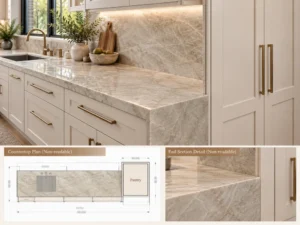
A built-up edge can create the appearance of greater thickness without using a full-thickness mass. The result depends on a clean return, compatible pattern selection, controlled adhesive color, accurate miters, and thoughtful placement where the joined pieces will be visible.
Risk should be allocated to the party able to control it. The stone supplier can document the selected material; the fabricator controls cutting methods and shop execution; the installer controls site placement; designers coordinate intent; and the buyer confirms commercial acceptance. Clear interfaces reduce gaps where every party assumed someone else had checked understanding laminated and mitered build-ups.
At the approval stage, ask four practical questions: what exactly is being accepted, what evidence supports it, who owns the next action, and how will a deviation be handled? For select a slab thickness and edge profile that suit the design while remaining practical to fabricate, transport, support, and install, these questions create a repeatable trail from selection through installation. They also make it easier to compare proposals without assuming that similar names or photographs represent identical material and service.

A simple eased edge usually keeps attention on the stone and is comparatively straightforward to maintain. Bevels, pencil rounds, bullnoses, ogees, and other profiles alter highlight, shadow, tactile feel, and the amount of material removed. Intricate profiles should be mocked up when the quartzite is strongly directional.
For homeowners, designers, fabricators, contractors, and import buyers, the useful question is not whether choosing an edge profile is generally recommended, but what evidence will make the choice defensible for this order. Record the assumption, the person responsible for confirming it, the approval format, and the stage after which a change becomes costly. This turns a broad preference into a controlled project decision.
At the approval stage, ask four practical questions: what exactly is being accepted, what evidence supports it, who owns the next action, and how will a deviation be handled? For select a slab thickness and edge profile that suit the design while remaining practical to fabricate, transport, support, and install, these questions create a repeatable trail from selection through installation. They also make it easier to compare proposals without assuming that similar names or photographs represent identical material and service.
Rules of thumb cannot replace an engineering or fabricator assessment. Stone properties, thickness, cutouts, support spacing, bracket design, substrate, seam positions, and how people may load the surface all matter. Show every unsupported zone on the drawings and obtain written approval of the support concept.
Appliquez ce principe aux plans de travail en quartzite naturelle réels, et non à un échantillon idéalisé. Comparez l’apparence à grande échelle, les mesures, les plans et les contraintes pratiques de manipulation. En cas d’incertitude persistante, recourez à un test représentatif, à une maquette, à un examen par le fabricant ou à une inspection tierce, adaptés aux conséquences d’un éventuel échec. Évitez d’inventer des seuils numériques d’acceptation, sauf si le contrat spécifie une méthode et une tolérance.
At the approval stage, ask four practical questions: what exactly is being accepted, what evidence supports it, who owns the next action, and how will a deviation be handled? For select a slab thickness and edge profile that suit the design while remaining practical to fabricate, transport, support, and install, these questions create a repeatable trail from selection through installation. They also make it easier to compare proposals without assuming that similar names or photographs represent identical material and service.

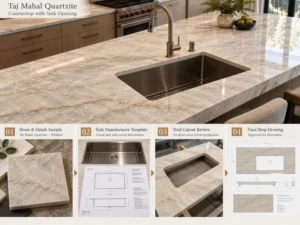
Sink rails and cooktop corners are vulnerable because cutouts interrupt the slab. Corner radii, reinforcement methods, sink support, faucet holes, and polishing access should be settled before cutting. The sink should be independently supported where the system requires it rather than relying on adhesive alone.
The commercial documents should support the technical decision. Quotations, approvals, shop drawings, piece labels, packing records, and change notices need consistent terminology. If sink and cooktop details changes after approval, document the effect on price, yield, timing, appearance, and responsibility before work continues.
At the approval stage, ask four practical questions: what exactly is being accepted, what evidence supports it, who owns the next action, and how will a deviation be handled? For select a slab thickness and edge profile that suit the design while remaining practical to fabricate, transport, support, and install, these questions create a repeatable trail from selection through installation. They also make it easier to compare proposals without assuming that similar names or photographs represent identical material and service.
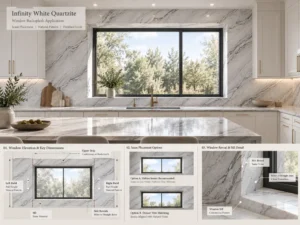
Quartzite with bold movement can look discontinuous when a return piece is taken from an unrelated area. Digital layout or physical templates help the team choose where veins continue, turn, or intentionally stop. Photograph the approved arrangement and connect it to piece labels.
La communication visuelle est primordiale, car la pierre naturelle est variable et que les appareils photo, les écrans, l’éclairage et les surfaces humides peuvent fausser la perception. Utilisez des repères d’identification et d’échelle, présentez à la fois des vues d’ensemble et des détails pertinents, et conservez les fichiers originaux. Les preuves doivent aider l’équipe à comprendre la gamme et l’emplacement, plutôt que de créer une promesse irréaliste d’une uniformité parfaite.
At the approval stage, ask four practical questions: what exactly is being accepted, what evidence supports it, who owns the next action, and how will a deviation be handled? For select a slab thickness and edge profile that suit the design while remaining practical to fabricate, transport, support, and install, these questions create a repeatable trail from selection through installation. They also make it easier to compare proposals without assuming that similar names or photographs represent identical material and service.
Approve actual thickness measurements, slab orientation, edge samples, seam map, overhang supports, cutout radii, reinforcement, finish, and acceptable visual tolerances. Keep approvals together so purchasing, fabrication, and installation teams work from the same revision.
Risk should be allocated to the party able to control it. The stone supplier can document the selected material; the fabricator controls cutting methods and shop execution; the installer controls site placement; designers coordinate intent; and the buyer confirms commercial acceptance. Clear interfaces reduce gaps where every party assumed someone else had checked approval and quality-control checklist.
At the approval stage, ask four practical questions: what exactly is being accepted, what evidence supports it, who owns the next action, and how will a deviation be handled? For select a slab thickness and edge profile that suit the design while remaining practical to fabricate, transport, support, and install, these questions create a repeatable trail from selection through installation. They also make it easier to compare proposals without assuming that similar names or photographs represent identical material and service.
| Zone de décision | Ce qu’il faut confirmer | Principal levier de contrôle |
|---|---|---|
| Simple eased edge | Quiet, contemporary, easy to understand | Corner softness and polish consistency |
| Rounded profile | Softer touch and reduced sharpness | Profile radius and visual thickness |
| Decorative profile | Traditional or expressive detailing | Mock-up, tooling, vein behavior |
| Mitered or laminated build-up | Creates a thicker visual edge | Joint visibility, pattern match, adhesive color |
Ce flux de travail est volontairement fondé sur des preuves. Il n’élimine ni les variations naturelles ni tous les risques liés au projet, mais il met en lumière les hypothèses dès le début, lorsque l’équipe dispose encore de plusieurs options. L’approbation la plus précieuse est celle que quelqu’un d’autre pourra comprendre ultérieurement, sans avoir à reconstituer des conversations informelles.
Non. L’épaisseur n’est qu’un facteur parmi d’autres. La structure naturelle, la géométrie des découpes, le support, l’emplacement des joints, la manutention et la qualité de la réalisation peuvent être tout aussi déterminants. Demandez au fabricant d’examiner les dalles réelles ainsi que l’ensemble du plan d’implantation avant de considérer une épaisseur comme suffisante.
Cela peut être possible lorsque le substrat, le cadre, les débords, les découpes, le plan de manutention et les méthodes locales sont adaptés. Les îlots de grande taille augmentent les risques liés au transport et à l’installation ; la décision finale doit donc s’appuyer sur l’examen des plans d’atelier et des dispositifs de support.
Une arête simple, légèrement arrondie ou modérément cintrée est souvent facile à entretenir, car elle comporte moins de creux et de détails fins. L’entretien dépend toutefois de la qualité de la finition, de la stratégie d’imprégnation lorsque cela s’applique, des pratiques de nettoyage, ainsi que de l’évitement des chocs aux angles exposés.
Un joint bien réalisé peut être discret, mais il ne doit pas être présenté comme invisible. Le mouvement de la pierre, la géométrie des bords, l’éclairage, la teinte de l’adhésif et la distance de visionnement influencent le résultat. Approuvez un échantillon ainsi qu’une tolérance réaliste avant la fabrication.
The project designer, cabinet or support provider, fabricator, installer, and any required engineer should coordinate the decision. The supplier can provide slab information, but site-specific structural and fabrication responsibility belongs with qualified project professionals.
Chaque projet impliquant du quartzite naturel ou du marbre doit être évalué en tenant compte de la pierre réelle, de la finition, des plans ainsi que des conditions locales de fabrication et d’installation. Cet article constitue un guide général d’achat et de spécification, et ne remplace en aucun cas les conseils professionnels en géologie, ingénierie, droit, douane ou spécifiques au chantier.
Pour la sélection des dalles, les discussions de projet et la coordination des exportations, veuillez contacter Josh chez XIAMEN HRST STONE CO., LTD. Partagez l’application, les dimensions approximatives, la finition, la quantité, la destination et la direction visuelle souhaitée afin que la conversation puisse démarrer sur la base d’un brief clair.
© 2026 XIAMEN HRST STONE CO., LTD. Tous droits réservés.