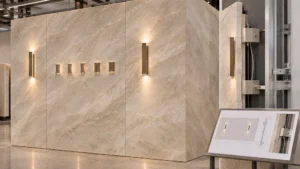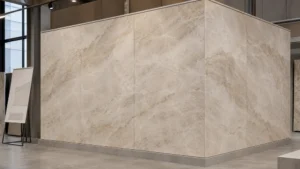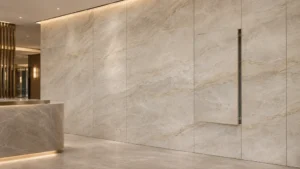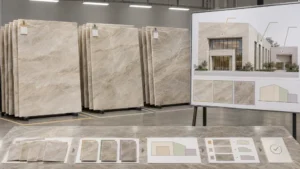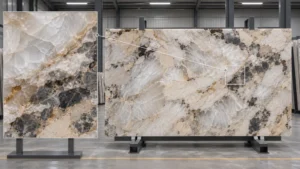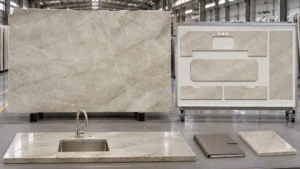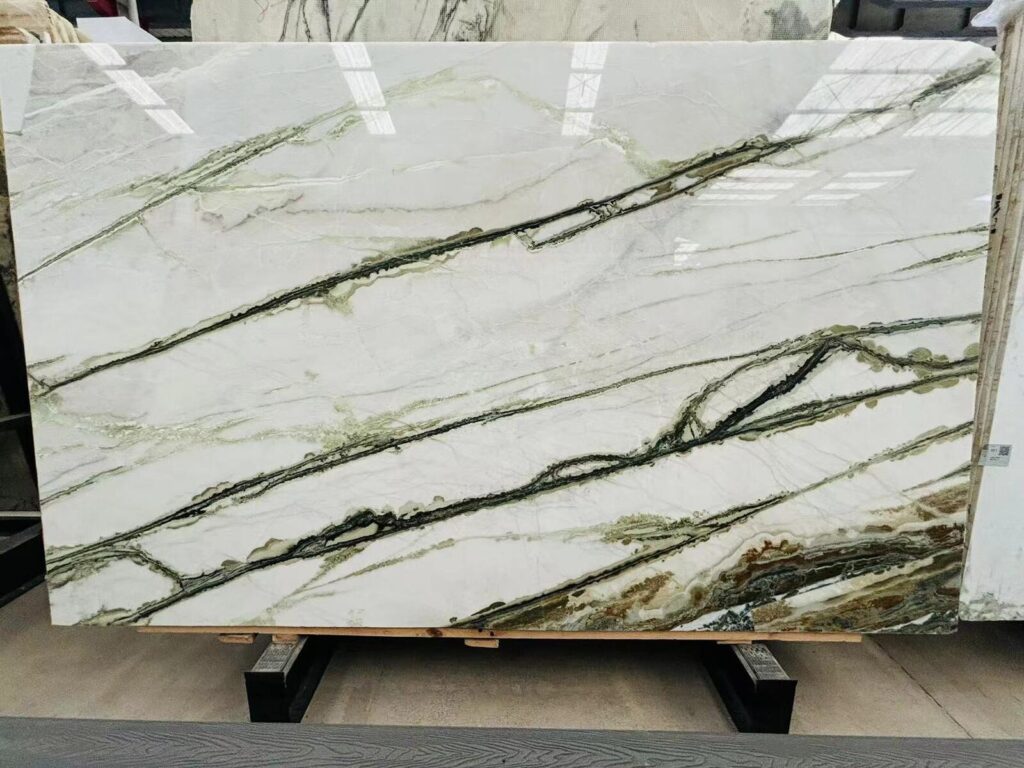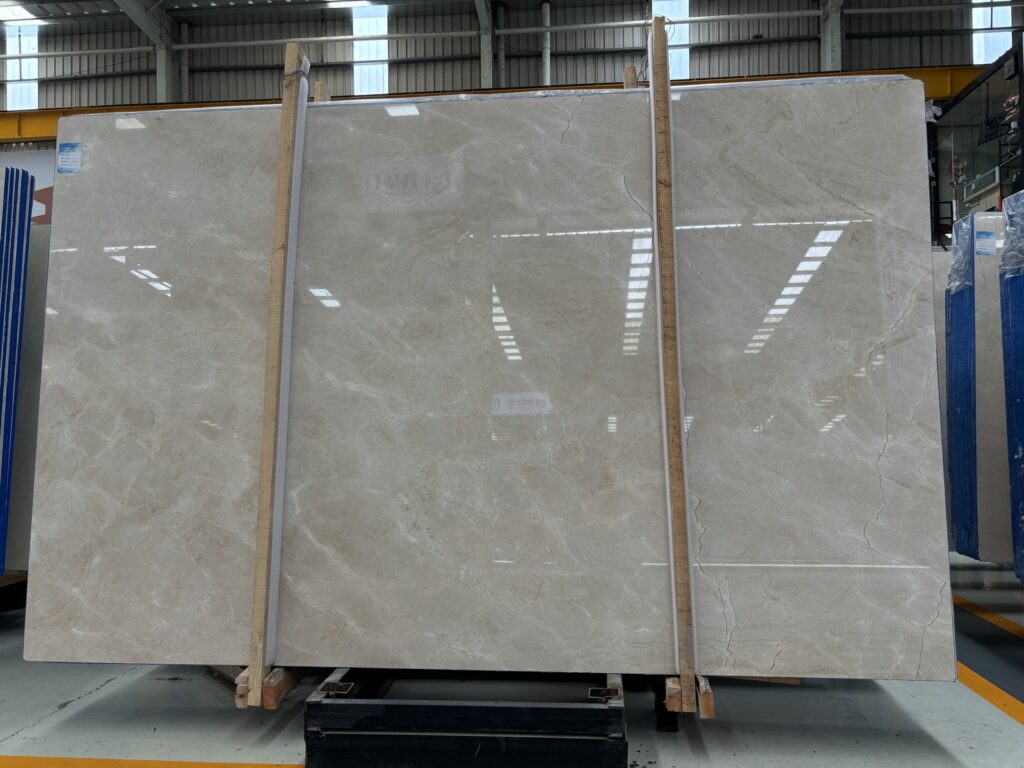


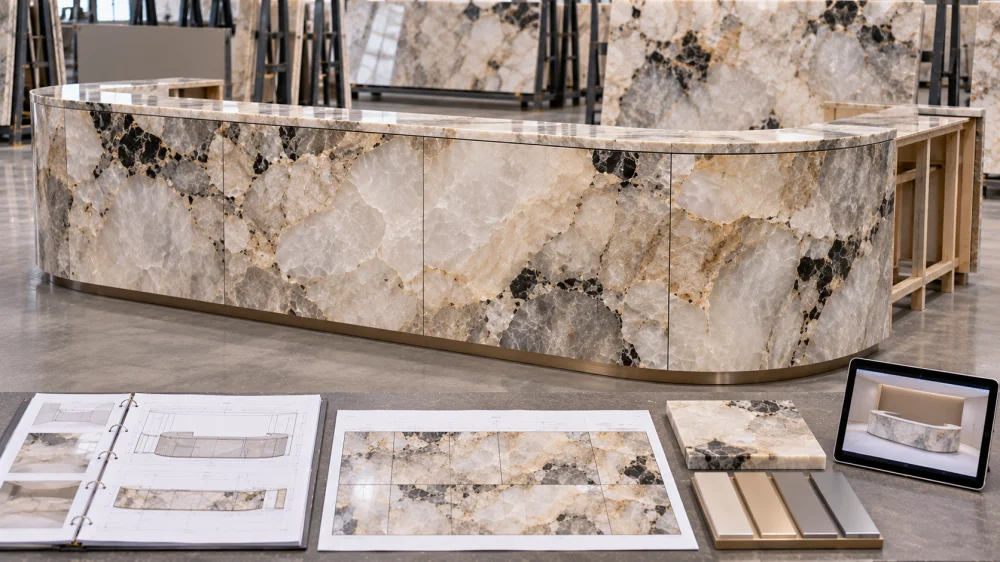
A curved Quartzite reception front can be built as a sequence of flat faceted panels or as a more specialized curved stone assembly, but those are different fabrication strategies rather than two interchangeable appearances. Faceted panels use controlled straight stone faces to approximate the curve and make panel geometry, joints and replacement more explicit. A smoother continuous-looking curve can demand more specialized stone shaping, backing, attachment, templating and installation. The correct choice depends on radius, viewing distance, joint visibility, stone thickness, slab pattern, substrate design, transport and the fabricator’s verified capability.
Specialist Curved Fabrication: the project requires a much more continuous curved reading, so the stone, substrate, machining, panelization or assembly method must be developed specifically for the geometry.
Do not choose between them from a rendering alone. Freeze the actual radius, height, visible approach, backing concept and intended joint language first.
A curved Quartzite reception front is an architectural stone assembly in which the visible reception face follows a curved or compound plan rather than one continuous flat elevation.
La palabra curved does not define how that surface is fabricated.
A rendering may show one perfectly smooth arc.
The finished stone could actually be:
The construction logic should therefore be chosen before the project treats the rendering as fabrication information.
A faceted reception front uses flat stone panels arranged around an arc.
Instead of asking each stone component to become physically curved, the design creates the overall curvature through a sequence of straight faces.
This approach can work especially well when:
A faceted front should not be treated as a cheaper imitation of a “real” curve.
It can be an intentional architectural decision.
The critical question is whether the facet rhythm looks deliberate.
If the project attempts to hide every panel division while using only a few broad flat faces on a tight curve, the completed surface may look like an accidental polygon rather than a resolved reception desk.
Specialist fabrication should be considered when the architectural intent depends on a much more continuous curved reading than practical flat panelization can provide.
That may happen when:

Natural stone should not simply be assumed to bend like sheet metal.
A continuous-looking stone curve may require specially shaped pieces, CNC or multi-axis machining, controlled assembly over a defined substrate, thin-stone or engineered panel strategies where appropriate, hand finishing or another specialist solution.
The actual method should be established by the responsible stone fabricator and project designer for the selected material and geometry.
Before slab allocation, confirm that the proposed fabricator can actually execute the intended radius, panel geometry, edge condition, backing interface and finish using an agreed fabrication route.
A drawing that says only:
“Curved reception desk.”
is not enough fabrication information.
The project may need to establish:
A compound front may not even have one constant radius.
It may contain:
Straight Zone → Transition → Main Arc → Tighter End Return
or another changing geometry.
The more the curvature changes, the less useful a simplified elevation becomes.
A full-size template, CNC-derived geometry, coordinated 3D model or another controlled fabrication reference may become necessary.
El sitio’s Quartzite rounded-island template guide uses the same principle for curved countertop geometry: full-size finished outlines can reveal transitions, support relationships and fabrication questions that are easy to miss in a small drawing.
The panel width determines much of the visual character.
On the same radius:
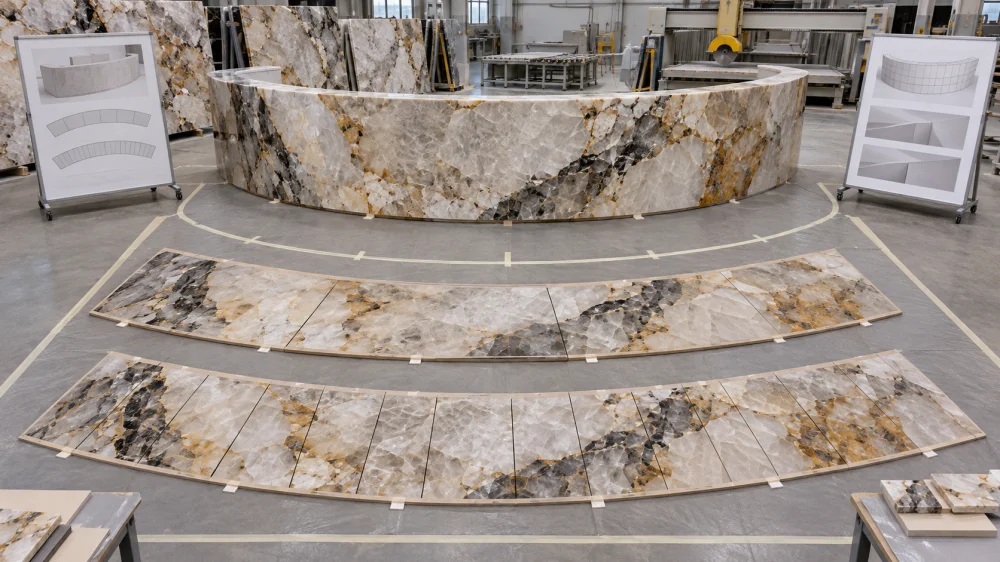
Fewer, wider panels
produce fewer joints but stronger changes of plane.
More, narrower panels
produce a smoother perceived arc but increase:
There is therefore no universal “best” facet width.
| Design Variable | Wider Facets | Narrower Facets |
| Perceived Curve | More visibly polygonal | Smoother perceived arc |
| Joint Count | Lower | Higher |
| Pattern per Panel | Larger natural-stone field | More fragmented visual sequence |
| Instalación | Fewer larger pieces | More smaller pieces and alignment points |
| Replacement | Larger replacement component | Componentes individuales más pequeños |
The correct panelization should therefore be reviewed at the actual project scale.
A straight reception front can often be understood from one elevation.
A curved front changes continuously as the visitor moves.
A panel joint hidden from a straight-on view may become prominent from the lobby entrance.
A mineral feature positioned at the center of the elevation may appear only after the visitor has already walked halfway toward the desk.
El sitio’s Patagonia Quartzite reception-front planning guide recommends reviewing reception stone from the actual approach sequence rather than only from a flat elevation.
For a curved front, that approach sequence becomes even more important.
A useful review can identify:
Entrance View
Which panels are visible first?
Approach View
How do the joints reveal themselves as the viewer moves?
Primary Reception Position
Which stone zone becomes the focal field?
Side / Departure View
How do the end returns and final facets resolve?
Review the panel rhythm, pattern and joints from the directions where visitors will actually see the reception desk.
Faceted geometry introduces a deliberate break at every panel joint.
The stone layout should decide whether those joints:

With Patagonia Quartzite, for example, one panel may contain a large pale crystalline mass while the adjacent panel contains a strong dark mineral fragment.
That can be dramatic and intentional.
Or it can look like unrelated pieces were installed next to each other.
The difference is layout control.
For directional stones, panel rotation must also be controlled.
A sequence should not be visually approved while each panel is shown in one orientation and then cut in another.
A useful chain is:
Actual Slabs → Reception Elevation → Panel Sequence → Main Viewing Path → Joint Relationships → Piece IDs → Cutting Approval
Trying to make every joint disappear is not always the strongest design strategy.
A curved reception front may work better when the panelization is treated honestly.
Joint strategy can include:
The correct detail depends on the overall architectural design and stone attachment system.
For faceted panels, a visible but consistent joint rhythm can often make the segmentation feel intentional.
For a specialist curved solution, the design may aim to minimize segmentation, but fabrication and installation joints may still be required.
Do not promise “seamless curved natural stone” until the actual fabrication and assembly strategy has been reviewed.
The stone is only the visible layer of the reception assembly.
The curved-front decision also depends on what supports it.
The project may need coordination between:
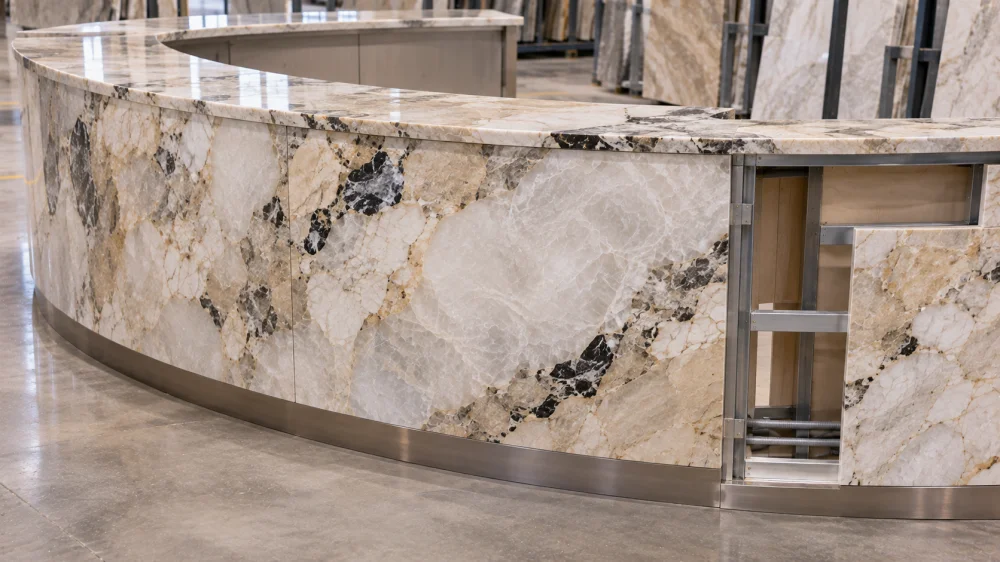
Do not design the front stone independently and assume the backing system can be invented later.
The Natural Stone Institute’s current Dimension Stone Design Manual includes dedicated guidance for interior vertical stone systems, including mechanically anchored, adhesively attached and preassembled panelized approaches. The exact assembly for a reception front remains project-specific and should be developed by the responsible design and fabrication team.
A reception desk often contains:
An apparently perfect stone curve is not useful if future access requires dismantling an uncontrolled sequence of panels.
Where removable access is necessary, panel boundaries may need to respond to that requirement from the beginning.
A generic flat stone sample is not enough to approve a curved reception assembly.
The mock-up should reproduce the variables that could change the decision.
Depending on the design, that may include:
This article should not require a full-size complete reception desk for every project.
The mock-up only needs to be large enough to answer the uncertain question.
| Uncertainty | Useful Mock-Up |
| Facet visibility | Several adjacent panels at intended angles |
| Joint appearance | Two-panel joint with proposed gap / separator |
| Curved edge quality | Worked specialist edge sample at representative radius |
| Iluminación | Representative panel geometry under project light direction |
| Backing / fixing interface | Partial assembly section or approved prototype |
“Does this mock-up look good?”
Preguntar:
“Does this mock-up prove the radius, facet rhythm, joint, edge, finish or backing condition that remains uncertain?”
A reception front is fabricated in a factory but completed on site.
The largest theoretically possible component is not automatically the most practical component.
Revisión:
Faceted panels may create more pieces but can make transportation and replacement more manageable.
A specialist shaped component may create a smoother surface but demand more controlled handling and installation.
The answer depends on the actual geometry.
A rendering is not enough.
The fabricator should receive a controlled package that explains geometry, stone and interfaces together.
A useful hierarchy is:
1. Architectural Intent
Overall reception plan, elevations and key visual approach.
2. Controlled Geometry
Radius, panel boundaries, returns, countertop relationship and relevant sections.
3. Actual Quartzite
Selected slabs, pattern orientation and panel allocation.
4. Fabrication Detail
Edges, joints, returns, access panels and specialist curved conditions.
5. Support / Backing Interface
Current responsible-design information.
6. Mock-Up / Sample Approval
Which physical detail has already been accepted.
7. Installation Information
Delivery route, sequence and site interfaces.
El sitio’s annotated-photo fabrication guide is useful here: photographs and markups should translate design intent, but current drawings, verified dimensions and fabrication documents remain the controlling technical information.
For a curved reception front, fabrication release should not happen simply because the slabs look good.
Freeze the decision chain.
Geometry: current radius / panelization / returns confirmed.
Fabrication Strategy: faceted or specialist curved approach confirmed.
Actual Stone: slab set and panel allocation reviewed.
Joint Strategy: panel boundaries and visible joint language confirmed.
Backing: stone-to-substrate / frame interface assigned to the responsible design team.
Edge Conditions: visible edges, countertop junctions and end returns reviewed.
Mock-Up: unresolved high-risk detail tested where required.
Logistics: transport and installation sequence reviewed.
Revision: superseded geometry removed from production use.
Only then does the actual slab cutting layout become meaningful.
No. Ordinary natural-stone slabs should not be assumed to bend like flexible sheet material. A curved-looking Quartzite front normally requires faceted flat panels, specially shaped stone components, a specialist panel or backing strategy, or another engineered fabrication solution developed for the project.
Yes when the panel rhythm is intentional and coordinated with the architecture, stone pattern, joints and viewing distance. Faceting can be a deliberate design language rather than a compromise, particularly when controlled joints and manageable panel sizes suit the project.
There is no universal number. Panel count depends on radius, arc length, desired visual smoothness, stone pattern, joint strategy, fabrication capability, handling and installation. Review proposed panel widths at project scale rather than selecting a standard number.
Consider it when a tight radius, close viewing distance, continuous curved appearance, complex edge geometry or other architectural requirement makes broad flat facets visually unacceptable. The fabricator should confirm the actual material, machining, backing and assembly method before approval.
If the decision depends on stone pattern, finish, joint appearance, edge processing or a specialist fabricated stone detail, using representative actual Quartzite can make the mock-up much more useful. A geometric substrate prototype may be enough for early radius studies, but it does not approve the final stone appearance.
Review the actual slabs against the complete panel sequence and the visitor approach. Decide which panels carry the main visual features, how movement transitions across joints and whether panel orientation remains consistent with the intended composition. Do not judge each panel independently.
Yes. Directional or grazing light can emphasize each change of plane and panel joint, while softer frontal lighting may reduce that effect. Review representative lighting with the proposed panel geometry when the lighting design is visually important.
Send the current plan and elevations, radius or controlled curve geometry, overall dimensions, proposed panel divisions, countertop and return details, selected Quartzite or slab references, finish, visible joint intent, backing or support information available from the responsible designer, site access information and any mock-up requirement. Also identify whether the design is intended to read as intentionally faceted or as a continuous specialist curve.
It is what physical construction logic will create the intended curve.
Choose the faceted or specialist route, resolve the geometry and backing, test the uncertain joint or curved detail, then allocate the actual Quartzite around the visitor’s viewing path.
Buyer Next Step: Ask the fabricator to show the proposed reception front as a panelized fabrication model or controlled mock-up before approving the slab cutting layout.