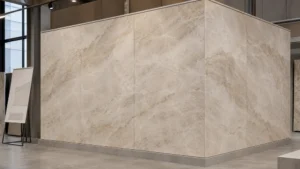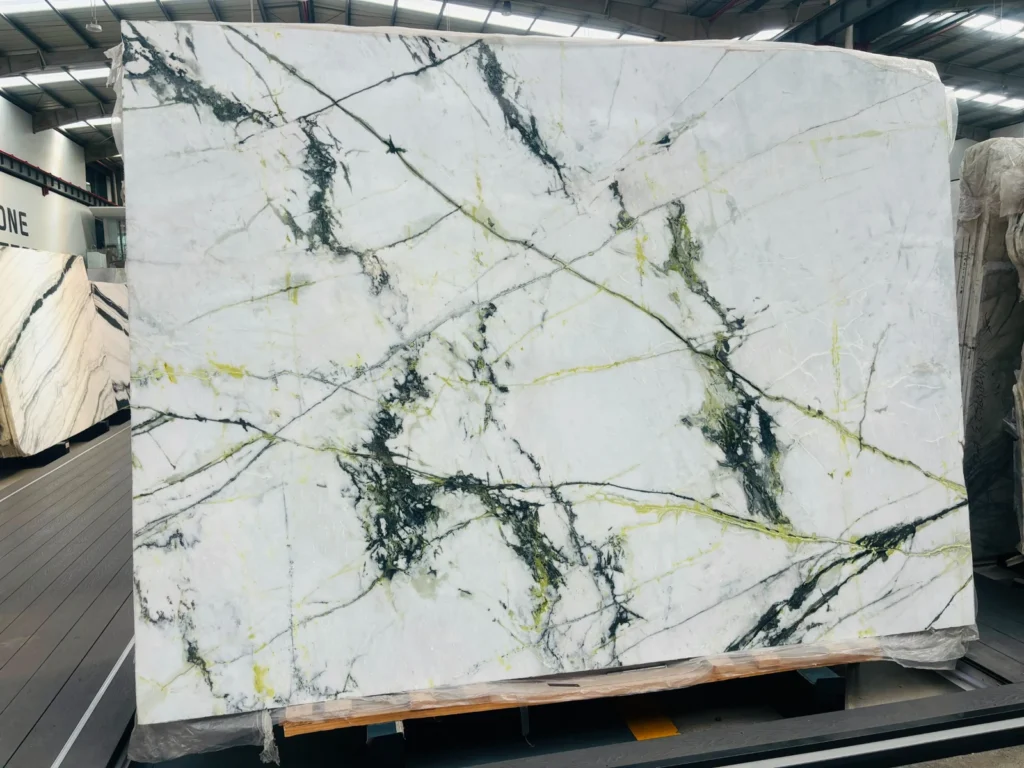


A quartzite cleaning trial should be documented as a controlled test, not as an informal wipe-and-look check. Identify the exact stone and finish, preserve an untreated comparison area, record the cleaner or treatment actually used, document dilution and method where applicable, photograph the surface before and after the trial, and review the result after the stone has returned to a stable condition. Approval should state exactly what was tested and where; it should not automatically become permission to use the same process on every Quartzite slab, finish or project area.
The purpose of the record is not simply to prove that the surface looked better immediately after cleaning. It should make the trial repeatable enough that another reviewer can understand what changed, what did not change, and what conditions were actually approved.
Una approved Quartzite cleaning test area is a defined part of an identified natural-stone surface where a specific cleaning product or procedure has been trialled, documented and accepted for a limited project purpose.
That approval should answer four questions:
If one of those questions cannot be answered, the test may still be useful evidence, but it is not yet a strong controlled cleaning reference.
A cleaning trial should begin by describing what the project is trying to change.
Do not begin with:
“We have Cleaner X. Can we use it?”
Comience con:
“What visible condition are we trying to remove or improve?”
For example, the surface may show:
This distinction matters because cleaning should respond to the actual surface condition rather than to a generic assumption that every visible mark is the same type of contamination.
El sitio’s Grabado frente a manchas en una muestra de cuarcita guide follows the same principle: document whether the surface appears darker, lighter, duller, glossier, cloudy or otherwise changed before assigning a cause.
A sequence of uncontrolled treatments can make the original problem harder to reconstruct and can create a second surface change that gets confused with the first.
The strongest cleaning comparison is usually not:
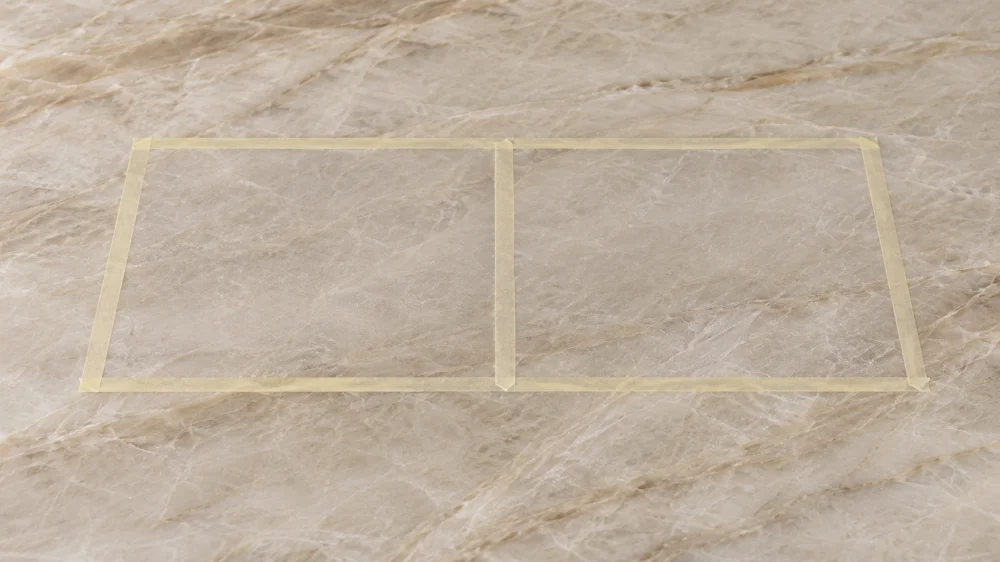
Before photo on Monday → After photo on Wednesday.
Sino:
Tested Area ↔ Adjacent Untreated Control
reviewed under comparable conditions.
An untreated control helps answer whether the apparent improvement comes from the cleaning trial rather than from:
Where practical, the control and trial zones should be close enough that they represent similar material and finish conditions.
Natural Quartzite can contain different mineral zones in one slab, so comparing a cleaned pale crystalline area with an untreated dark mineral zone may introduce unrelated differences.
A project can document:
Zone C — Untreated Control
Zone T1 — Cleaning Trial 1
Zone T2 — Revised Trial, only if a second controlled method is genuinely needed
These identifiers do not need to remain physically written on the installed stone.
They can be shown on photographs, removable masking references or a simple test-area diagram.
Record the baseline before the cleaner touches the surface.
| Baseline Field | Qué registrar |
| Stone Identity | Material name and slab / piece relationship where known |
| Project Location | Room, piece ID or defined surface area |
| Finalizar | Polished, honed, leathered or other confirmed finish |
| Condición de la superficie | Dry / wet / recently wiped / unknown |
| Visible Issue | Colour, sheen, residue, film, mark or other observable condition |
| Previous Treatment | Known cleaner, sealer, polish or treatment history where available |
| Control Area | Adjacent untreated comparison area |
| Baseline Photos | Overview + test-zone view + detail where useful |
The baseline photographs matter because once the test starts, the original appearance may no longer be recoverable.
The statement:
“Test cleaned successfully.”
is not enough.
The record should identify the method actually tested.
Where known and relevant, record:
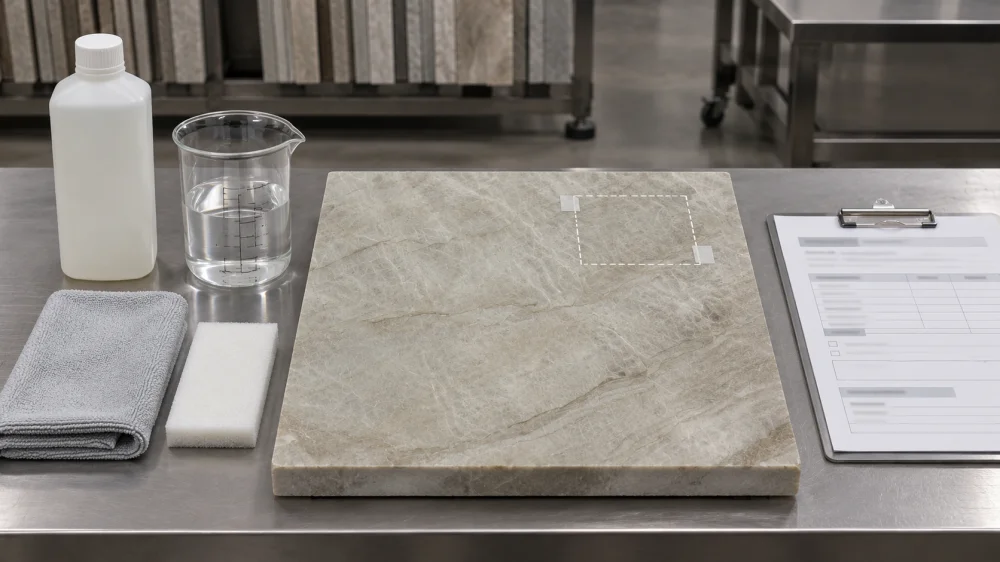
Do not reconstruct missing process details later and present them as known facts.
If nobody recorded the dilution, write:
“Dilution not recorded.”
That is more useful than inventing a value.
Where practical, change one meaningful variable at a time and preserve the process history.
Natural Quartzite is generally classified as a siliceous stone, but that does not justify treating every cleaning chemical as universally safe for every Quartzite surface.
The selected stone may contain mineral constituents, treatments, fillers, resins, sealers or finish conditions that respond differently.
The Natural Stone Institute recommends using appropriate stone-cleaning products, following manufacturer recommendations and avoiding indiscriminate use of products that can damage natural stone.
Product labels, technical data and safety information should therefore be reviewed before the trial.
Do not combine cleaning chemicals unless their manufacturers explicitly allow that procedure.
Where the condition requires aggressive chemical treatment, restoration, polishing or another specialist procedure, the responsible product manufacturer, stone fabricator, installer or qualified restoration professional should review the actual condition.
The photography should make the trial easier to audit rather than more dramatic.
A strong sequence can contain four views.
Shows where the test area is located on the actual countertop, vanity, wall or sample.
Shows the control and proposed test zones together.
Documents what the surface looked like immediately after the process.
This is useful process evidence but should not automatically be treated as final approval.
Shows the test area after the relevant rinse, drying and stabilization period for the actual procedure.
Where sheen is important, include both:
straight-on neutral view
y
controlled low-angle reflected-light view.
El actual Quartzite Sample Rejection Notes guide uses the same distinction: colour, sheen and texture should be described separately because one lighting angle rarely communicates all three accurately.
Moisture can change the apparent colour, depth and contrast of natural stone.
A surface may look darker immediately after cleaning and become lighter as it dries.
Residue may also become more visible only after water evaporates.
For this reason:

Immediate appearance ≠ final stabilized appearance.
The trial record should identify whether the review occurred while the surface was:
The correct observation period depends on the cleaner, stone condition, finish, environment and treatment being tested.
Do not invent one universal drying time for every Quartzite cleaning trial.
Where the appearance can change during drying, return to the same identified test area and compare it with the untreated control after the surface has reached the agreed review condition.
Cleaning success should not be reduced to:
“Mark gone: yes / no.”
Review at least the characteristics relevant to the project.
| Review Field | Question After Cleaning |
| Target Residue / Mark | Was the original visible condition reduced, removed or unchanged? |
| Colour | Does the test area appear darker, lighter, warmer, cooler or cloudier than the control? |
| Sheen | Is the reflection sharper, duller or uneven compared with the adjacent surface? |
| Textura | Is there any visible or tactile surface change? |
| Residue | Did the cleaner leave film, streaking or deposits after drying? |
| Boundary | Is the tested area visibly different from the untreated surrounding stone? |
| Repeatability | Is the method documented well enough to repeat under comparable conditions? |
A trial has limited value if it removes the original residue but creates an unacceptable sheen change.

Likewise, a surface that looks acceptable straight-on may show a dull patch only under low-angle light.
The approval record should be specific enough that a later contractor or site team understands what was accepted.
A concise record can contain:
Project: [Project Reference]
Stone: [Natural Quartzite Reference]
Piece / Location: [ID / Room / Surface]
Finish: [Finish]
Test Area ID: [T1]
Control Area: [C1]
Observed Surface Condition Before Test: [Description]
Cleaner / Product: [Confirmed Product]
Product Manufacturer: [If Known]
Preparation / Dilution: [Recorded Condition / Unknown]
Application Tool / Method: [Recorded Method]
Contact / Working Period: [Recorded / Approximate / Unknown]
Rinse Method: [Method]
Surface Condition at Final Review: [Dry / Other Defined Condition]
Before Photos: [References]
After Photos: [References]
Colour Result: [Observation]
Sheen Result: [Observation]
Texture Result: [Observation]
Residue Result: [Observation]
Decisión: [Accepted / Rejected / Revise / Further Review]
Approval Scope: [Exact area / stone / finish / condition]
Approved By: [Responsible Party]
Date / Revision: [Record]
This is the most important boundary in the article.
If a cleaning method works on:
one polished Taj Mahal Quartzite test area with one known surface condition
the approval does not automatically prove that the same method is suitable for:
The approval scope should follow the evidence.
Change a material variable, process variable or surface condition and confirm whether another test is required before extending the method.
Once the defined test area is accepted, the next decision is whether the process can be extended to the larger surface.
Before scaling up, confirm:
For a large area, the first extended section can itself become a production verification point.
The process can therefore be:
Small Trial → Approval → Limited Production Area → Verification → Wider Cleaning Release
This approach is more controlled than moving directly from one small corner test to hundreds of square metres of stone.
If the target mark becomes less visible but the tested area becomes duller, glossier, rougher or visibly different from the control, the trial has created a second decision.
Do not hide this by describing the surface simply as “clean.”
Document:
Cleaning Result
y
Finish Result
separately.
If the finish difference is unacceptable, the next step may be:
El Quartzite finish rejection guide provides a useful structure for describing sheen, texture, colour and edge changes without relying on vague labels such as “looks wrong.”
For project work, the cleaning record should not disappear after the site team moves on.
Where useful, retain:

For higher-value or complex projects, this can become part of the Quartzite Project Completion Records so a future maintenance team does not have to reconstruct the cleaning decision from memory.
What was cleaned? With what? How? On which finish? What was the result? What limitations were recorded?
For a new product, uncertain surface condition or visually sensitive project, a limited test area is a useful control step. Identify the stone and finish, preserve an untreated comparison area where practical, follow applicable product guidance and review the result before extending the process to the larger surface.
Use an area that is representative enough to answer the project question while limiting unnecessary risk. An inconspicuous location may be appropriate for compatibility testing, while a representative visible zone may be needed when the project must evaluate the final appearance. Record the exact test location either way.
Not when moisture or drying can change the stone’s appearance. Record the immediate post-cleaning condition, then review the identified test area again after it reaches the defined final review condition appropriate to the method.
Photograph the complete surface context, the control and test areas before cleaning, the process where useful, the immediate post-cleaning condition and the final stabilized result. Where sheen is relevant, include a low-angle reflected-light view as well as a normal overall view.
No. The result remains tied to the stone, finish, surface condition, product and cleaning method actually tested. Do not automatically extend one approved trial to another slab, finish, treatment, residue type or project without reviewing whether the conditions remain comparable.
Record those as two separate results: the target residue may have been reduced while the finish changed. The cleaning trial should not be approved as fully successful unless the resulting surface condition is also acceptable within the defined project scope.
Avoid stacking multiple uncontrolled treatments on one area when the project needs to understand which method produced the result. Where another trial is necessary, use a separately identified zone where practical and document the new product and method independently.
Send the stone and piece reference, finish, exact test location, baseline photographs, visible surface issue, cleaner and product information, recorded preparation and application method, rinse and drying information, untreated comparison area where available, final photographs and the specific decision that needs approval. Where specialist chemical treatment or restoration is required, the relevant product manufacturer or qualified stone professional should review the actual condition.
Preserve the untreated reference, record the actual product and process, wait until the surface reaches the agreed review condition, and compare colour, sheen, texture and residue before scaling up.
Buyer Next Step: Ask the site or factory team to return one controlled cleaning-trial record containing the baseline, method, before-and-after photographs, final observation and exact approval scope before the procedure is applied more widely.