

Kurze ZusammenfassungQuarzit-Musterbibliotheken sollten aktuelle Auswahlreferenzen von abgelaufenen, veralteten, beschädigten und historischen Stücken unterscheiden. Ein physisches Naturquarzit-Muster kann über Jahre hinweg attraktiv bleiben, gleichzeitig jedoch für eine aktuelle Kaufentscheidung unzuverlässig werden, weil die ursprünglichen Platten nicht mehr vorhanden sind, ein neueres Muster diese ersetzt hat, die beabsichtigte Oberflächenbearbeitung sich geändert hat, die Herkunftsbeziehung unbekannt ist oder das Muster selbst durch Abnutzung, Nachbearbeitung, Fleckenbildung oder Handhabung verändert wurde. Weisen Sie jedem kontrollierten Muster eine stabile Kennung zu und dokumentieren Sie Materialname, Oberflächenbearbeitung, Herkunftsbeziehung (sofern bekannt), Verwendungszweck, Status, Datum, physischen Standort, Genehmigungsumfang sowie etwaige Ersatzreferenzen. Entsorgen Sie nützliche historische Belege nicht automatisch, sondern halten Sie veraltete Muster physisch und digital klar von aktiven Referenzen getrennt. Vor allem dürfen Sie nicht zulassen, dass ein altes Muster zur automatischen Genehmigung aktueller Naturquarzit-Platten wird; slabenspezifische Projekte erfordern weiterhin die Überprüfung der derzeit verfügbaren physischen Proben.
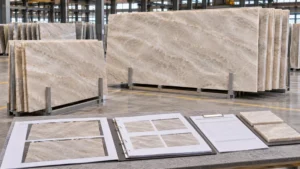
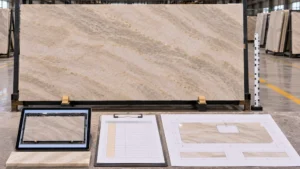
Ein Designer öffnet eine Quarzit-Musterbibliothek.
Es gibt mehrere hellcremefarbene Stücke, die mit bekannten Steinnamen gekennzeichnet sind.
Ein Muster wurde letzten Monat erhalten.
Ein anderes befindet sich seit drei Jahren in der Bibliothek.
Ein drittes stammt aus einer Plattengruppe, die bereits verarbeitet und verkauft wurde.
Ein viertes wurde kürzlich ersetzt, weil die aktuelle Materialauswahl optisch anders ist.
Alle vier Stücke sehen noch wie brauchbare Steinstücke aus.
Doch sie besitzen nicht denselben Status.
Dies ist das eigentliche Problem hinter Quarzit-Musterbibliotheken: Kennzeichnung abgelaufener und veralteter Stücke.
Das Problem besteht nicht darin, dass ein altes physisches Muster plötzlich aufhört, Naturquarzit zu sein.
Das Problem ist vielmehr, dass seine Bedeutung veraltet sein kann, während der Stein selbst physisch intakt bleibt.
Eine kontrollierte Musterbibliothek muss daher folgende Fragen beantworten:
Was repräsentiert dieses Muster derzeit, welche Entscheidung kann es unterstützen, und wurde es durch eine neuere oder relevantere Referenz ersetzt?
Naturquarzit besitzt kein universelles physisches “Verfallsdatum” wie ein verderbliches Produkt.
Die Ablaufkennzeichnung in Musterbibliotheken ist ein Kontrollkonzept.
Sie bedeutet, dass das Muster nicht länger als aktuelle Referenz für die Entscheidung behandelt werden sollte, die es einst unterstützte.
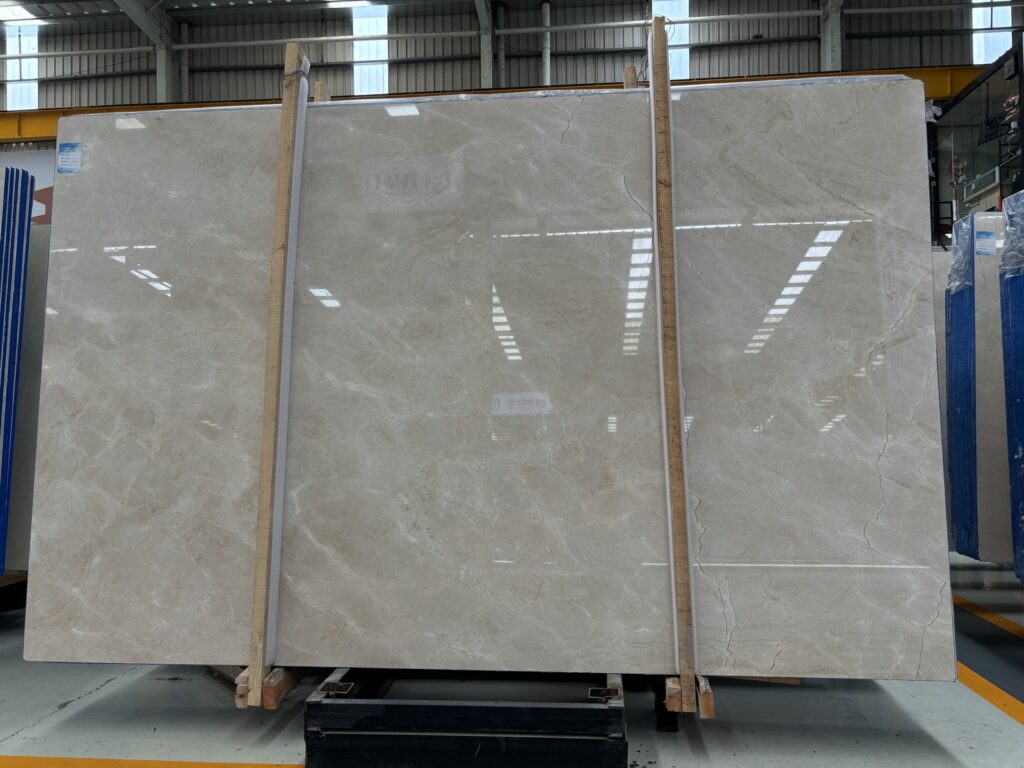
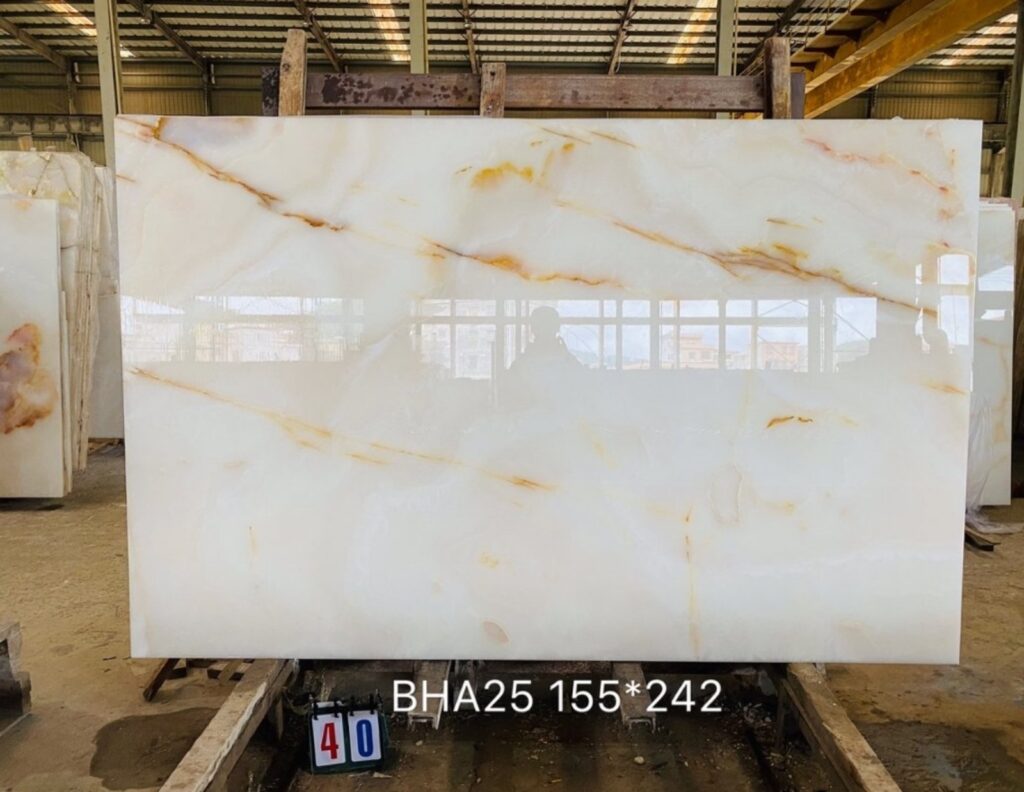
Ein Muster könnte aus einer identifizierbaren Platte oder Plattengruppe geschnitten worden sein.
Wenn diese Platten bereits:
kann das Muster dennoch als historischer Beleg oder allgemeine Materialorientierung nützlich sein.
Es sollte nicht stillschweigend unterstellen, dass entsprechende Platten weiterhin verfügbar sind.
Ein kommerzieller Naturquarzit-Name kann fortbestehen, während sich das physische Inventar ändert.
Eine neuere Gruppe kann sich unterscheiden in:
Wenn dieser Unterschied relevant ist, sollte ein neues Muster eine eigene Identität erhalten, anstatt automatisch die Autorität des alten zu erben.
Ein poliertes Muster ist nicht automatisch eine aktuelle Referenz für geschliffene Oberflächen.
Wenn sich der Projekt- oder Bibliotheksstandard bezüglich der Oberflächenbearbeitung ändert, dokumentieren Sie den Ersatz, anstatt die Historie des alten Musters so lange zu bearbeiten, bis der Unterschied verschwindet.
Wiederholte Handhabung kann ein physisches Muster verändern.
Beispiele hierfür sind:
A changed sample may no longer represent the condition originally approved.
Status Principle
Physical Sample Exists ≠ Current Reference Is Valid. Control what the piece represents, not only whether the piece is still on the shelf.
A sample library becomes easier to use when the status language is defined before problems occur.
An active sample is currently approved for a defined library or project purpose.
Zum Beispiel:
Current general colour-direction reference for Taj Mahal Quartzite.

oder:
Current honed-finish sample for Project K.
Active does not mean that every slab sold under that material name is automatically approved.
A superseded sample has been intentionally replaced by another identified reference.
Zum Beispiel:
Sample TH-018 superseded by TH-026.
The old sample may remain useful for comparison or history.
It should no longer appear to be the current selection standard.
An expired sample is no longer valid for its former active purpose because a defined condition has ended.
Possible triggers can include:
Do not invent one universal number of months for every Natural Quartzite sample.
A historical sample may be intentionally retained because it documents:
Historical does not mean suitable for new purchasing approval.
A sample may still be associated with current material but be unsuitable for visual review because its own physical condition has changed.
This deserves its own status rather than pretending the sample remains representative.
| Status | Bedeutung | Use in Current Selection |
| Active | Current reference for a defined purpose | Yes, within its recorded scope |
| Superseded | Replaced by a newer identified sample | No; use replacement reference |
| Expired | Former active purpose no longer valid | No without new review |
| Historical | Retained for traceability or past-project reference | No; reference only |
| Damaged / Altered | Physical sample no longer represents original condition reliably | No until replaced or specifically reassessed |
A physical stone piece without a stable sample ID is difficult to control once several similar materials enter the library.
Use one stable reference that remains attached to the sample history.
Do not reuse the same sample ID for a materially different replacement piece.
Record the commercial or project stone name.
This identifies the general material direction.
It does not uniquely identify current slabs.
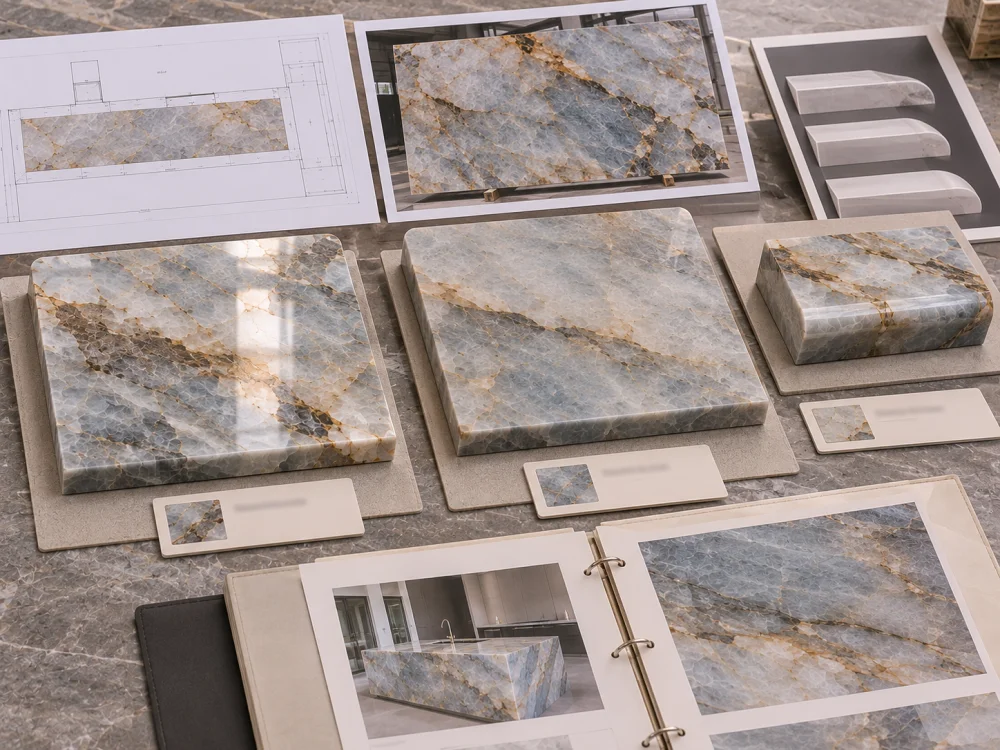
Dokumentieren Sie:
Polished / Honed / Leathered / Project-Specific Finish.
If one material has several active finishes, each physical reference may need its own controlled identity.
Where known and relevant, record whether the sample came from:
If the relationship is unknown, record it as unknown rather than inventing a slab connection.
One sample might exist for:
The purpose determines how much authority the sample should carry.
If a newer sample replaces the old one, record:
Superseded By → New Sample ID.
This is much more useful than simply removing the old piece and losing the reason for the change.
Der Versandkosten für Quarzitproben: Fragen, die vor dem Versand geklärt werden müssen guide uses the same sample-control logic: physical samples should remain connected to material, sample ID, finish, source relationship, purpose, and revision.
One of the most dangerous sample-library errors is allowing a preliminary reference to become a blanket approval over time.
A sample may establish only:
Warm cream Natural Quartzite direction accepted.
This does not approve:
A controlled honed sample may approve the intended surface character for a defined project.
That still does not prove that every slab or mineral zone will reproduce identical visual results.
A worked edge can approve:
It should not silently become the reference for the complete full-slab pattern.
A designer may approve Sample M-12 for Project A.
That does not automatically make M-12 the current reference for Project B two years later.
A useful approval record can say:
Accepted for general background colour and polished-finish direction only. Actual project slabs remain subject to board-specific selection.
That sentence is much more useful than:
“Approved.”
Approval Boundary
Sample Approval should answer: Which physical reference? Which decision? Which project or library scope? Which finish? What remains pending?
When a new sample replaces an old one, the library has two competing goals:
prevent accidental reuse
Und
preserve traceability.
If the active and superseded samples sit beside each other with identical presentation, a future user may select the wrong one.
The physical library should make the status difference obvious.
A coloured sticker can help visual organization.
But colour by itself may be ambiguous.
The controlled record should state the actual status, such as:
ACTIVE
SUPERSEDED
EXPIRED
HISTORICAL — NOT FOR CURRENT SELECTION
The exact wording can follow the organization’s library system.
A superseded sample should point to its current replacement where one exists.
Zum Beispiel:
Old Sample → Superseded → Current Sample.
If the physical library is large enough, historical and obsolete references can be moved away from the primary active-selection area.
This reduces the chance that a visitor or new employee interprets old stone as current inventory.
A superseded sample can remain useful for:
The goal is controlled retention, not automatic disposal.
Natural Quartzite samples do not need one universal calendar expiry.
A useful library instead defines the events that require review.
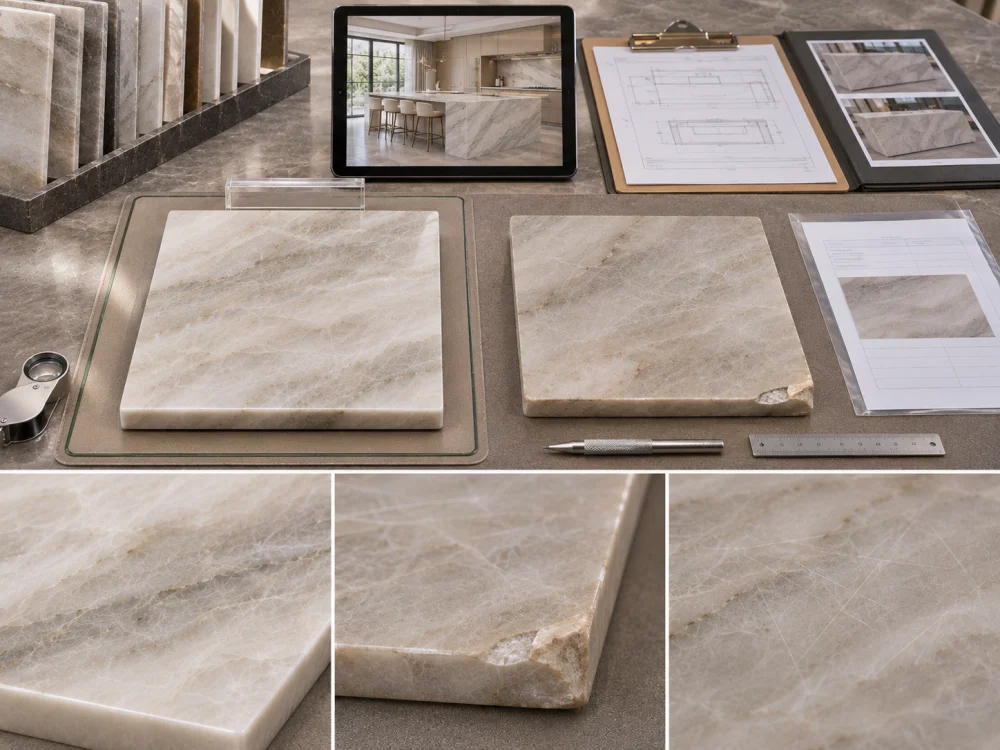
If the sample represented identified boards that are no longer available, update its status.
The sample might become:
Historical source reference — current slabs require new review.
If the supplier or project team intentionally provides a replacement because the current material direction has changed, supersede the old piece.
If a current project moves from polished to honed, do not leave the polished sample labelled as the active finish reference.
A project-specific approval sample can move into project archive status after completion rather than remaining indefinitely in the active general library.
Scratches, heavy handling, contamination, refinishing, or another modification can trigger sample replacement even when the underlying material selection remains current.
If nobody can determine which slab group, project, finish, or supplier record a sample represents, its authority should be reduced.
“We think this is the current piece” is not a strong sample-control system.
A larger library may choose periodic review dates to force status checks.
That is an organizational control decision.
Do not imply that all Natural Quartzite samples become physically invalid after a fixed number of months.
Physical samples are useful.
They cannot reproduce the complete movement of a full Natural Quartzite slab.
It may help review:

For slab-specific projects, the buyer still needs to review:
Der Quarzit-Platten-Showrooms: Was Sie zu einem Auswahltermin mitbringen sollten guide makes this distinction explicit: a physical sample can support colour or finish review, while final slab-specific selection should preserve exact board references and full-slab evidence.
A sample sitting in a library does not prove:
If current slabs are visibly different from the library piece, do not force the boards to conform to the old sample.
Decide whether to:
Sample-library control and slab-inventory control should not operate as unrelated systems.
For example, the material direction may remain acceptable while one set of reserved boards is released back into inventory.
The sample does not necessarily become physically wrong.
But it should no longer be used to imply that those exact boards are secured.
If a reserved slab is replaced by another board, the buyer should review the current physical board rather than relying only on the historical sample.
Der Reservierungsformulare für Quarzitplatten: Plattennummern, Gültigkeitsdauer und Ersatzmöglichkeiten guide explains why material name, board number, reservation status, expiry and substitution approval should remain distinct.
A prior sample approval may support:
material direction
while the new board still requires:
current slab approval.
This distinction is especially important for:
A spreadsheet that says a sample is active is not enough if the physical shelf contains a different piece.
The record and the stone should be reconciled.
Confirm:
The digital record should identify the same physical piece and current status.
For every superseded sample, confirm whether the stated replacement still exists and remains active.
Project-specific pieces that no longer belong in the active general library should be moved to the appropriate archive or disposal workflow.
An attractive piece with no trustworthy identity should not automatically remain in the current approval library.
It may be:
A current sample photograph helps remote teams verify that the physical piece they are discussing is still the same reference recorded in the system.
| Library Field | Aufzeichnung |
| Sample Identity | Stable sample ID + material name |
| Physical Condition | Current / damaged / altered / needs review |
| Beenden | Polished / honed / leathered / other defined finish |
| Beziehungsquelle | Board / slab group / project / supplier / unknown |
| Zweck | Colour / finish / edge / project approval / other |
| Status | Active / superseded / expired / historical / damaged |
| Replacement | Current replacement sample ID where applicable |
| Approval Scope | Exact decision the sample may support |
| Standort | Current physical library / archive position |
An old sample should not become active again merely because somebody finds it useful for a new project.
If a historical or expired piece is being reconsidered, verify its current relevance.
□ Stable sample ID confirmed.

□ Natural Quartzite material name confirmed.
□ Physical sample matches the digital record.
□ Current surface finish confirmed.
□ Sample condition checked clean and dry.
□ Source relationship verified where known.
□ Current purpose defined.
□ Current project / library scope defined.
□ Current slab availability checked separately where relevant.
□ Sample approval kept separate from board-specific slab approval.
□ Previous superseded or expired status reviewed.
□ Current replacement sample checked before reactivation.
□ New status date or review record added.
□ Approval owner identified where project-specific.
□ Physical status marking updated.
□ Physical storage location updated.
□ Current photograph retained where useful.
□ Obsolete reference will not remain visually indistinguishable from active samples.
The best sample library is not the library with the largest number of stone pieces.
It is the library where another person can quickly answer:
What is this?
What does it represent?
Is it current?
What replaced it?
What may it approve?
And do we still need to review the actual slabs?
There is no universal physical expiry period for every Natural Quartzite sample. A library may mark a piece expired when its former reference purpose is no longer valid—for example because associated inventory is unavailable, a defined review period has ended, the project has closed, the source relationship is uncertain, or another current sample has replaced it. The organization’s control system should define the applicable trigger.
Ein veralteter Probenwert wurde bewusst durch einen neueren, identifizierten Referenzwert ersetzt. Ein abgelaufener Probenwert ist für seinen früheren aktiven Verwendungszweck nicht mehr gültig, weil eine bestimmte Zeit, Verfügbarkeit, ein Projekt, eine Quelle oder eine Prüfbedingung beendet wurde. Ein Probenwert kann manchmal beides zugleich sein – beispielsweise kann ein alter Projektverweis ablaufen und gleichzeitig durch einen neuen aktuellen Probenwert ersetzt werden.
[Nicht automatisch. Sie können weiterhin nützliche historische, projektbezogene, Ersatz-, Abschluss- oder Genehmigungsnachweise liefern. Sofern sie aufbewahrt werden, sollten sie eindeutig aus der aktuellen Auswahl entfernt und gegebenenfalls mit dem neueren Referenzdokument verknüpft werden, damit sie nicht mit aktiven Proben verwechselt werden können.].
[Nicht automatisch. Eine kleine Stichprobe kann im Rahmen ihres erfassten Umfangs Entscheidungen zu Farbe, Oberfläche, Kanten oder Materialrichtung unterstützen, doch Naturquarzit bleibt plattenspezifisch. Projekte, die eine exakte Plattenauswahl erfordern, sollten weiterhin aktuelle Vollplattenfotos, Plattennummern, Abmessungen, zugehörige Platten sowie gegebenenfalls das spätere Zuschnittschema prüfen.].
Dokumentieren Sie die Veränderung und prüfen Sie, ob das physische Stück weiterhin den Referenzgegenstand darstellt, den es ursprünglich abbilden sollte. Wenn Kratzer, Verfärbungen, Neulackierungen, Behandlungen oder andere Veränderungen sein Erscheinungsbild wesentlich verändern, nehmen Sie es aus dem aktiven Einsatz oder ersetzen Sie es, anstatt zuzulassen, dass das veränderte Stück weiterhin als Referenz für die ursprüngliche Oberflächenbeschaffenheit dient.
Dieser Artikel legt kein einheitliches Prüfintervall fest. Überprüfungen können durch neue Stichproben, Bestandsänderungen, den Abschluss von Projekten, Änderungen der Fertigungsstände, physische Schäden, Aktualisierungen bei Lieferanten, Unsicherheiten bezüglich der Bezugsquellen oder einen vom Unternehmen festgelegten periodischen Zeitplan für die Lagerbestandskontrolle ausgelöst werden. Entscheidend ist, dass der aktive Status bewusst aufrechterhalten wird und nicht unbegrenzt vorausgesetzt wird.
Senden Sie Josh die Materialangaben oder den bekannten Quarzitnamen, die beabsichtigte Anwendung, die gewünschte Oberflächenbearbeitung, Projektzeichnungen oder maßgebliche Abmessungen (sofern relevant), die Menge, den Lieferort, Verweise auf angrenzende Materialien, falls eine farbliche Abstimmung erforderlich ist, sowie die konkrete Frage, die die Probe beantworten soll. Wenn Sie eine ältere Probe ersetzen, fügen Sie bitte die ID oder ein Foto der alten Probe bei und geben Sie an, ob Sie einen aktuellen Farbstandard, eine Oberflächenmusterprobe, eine Kantensample, aktuelle Plattenoptionen oder projektbezogene Genehmigungsmaterialien benötigen.
Sample-Library Control TakeawayA Quartzite sample library should preserve both current references and useful history without allowing the two to become confused. Give each controlled physical sample a stable identity, record what material, finish, source relationship and decision it represents, and assign a clear current status. When a piece is replaced, expired, damaged or retained only for historical use, change both the physical marking and digital record. Keep the old piece when traceability value justifies retention, but remove it from active selection use. Most importantly, treat a physical sample as evidence for its stated scope—not as permanent proof that future Natural Quartzite slabs, finishes, inventory or project conditions remain unchanged.
For Natural Quartzite sourcing and project sample coordination, HRST STONE can organize current sample references, finish samples, edge samples, sample IDs, related full-slab photographs, board references, project-specific approval records, packing and international sample dispatch within the confirmed scope. Send Josh the material direction, required finish, application, project information, previous sample reference where applicable, requested sample purpose and destination so the current physical reference can be distinguished from older or superseded material.