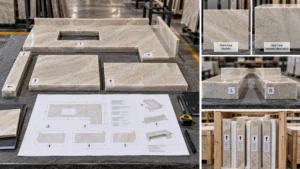
Quarzit-Aufträge auf zwei Verarbeiter aufgeteilt: Wer besitzt die Schnittstelle?
Post navigation
Kurze Zusammenfassung
When a Quartzite order is split between two fabricators, responsibility should not stop at each fabricator’s individual scope. Any location where their work must meet needs a named interface owner, one governing drawing revision, agreed dimensions, compatible edge and finish information, traceable piece IDs, and a defined approval route. The goal is not to make one fabricator responsible for the entire project. It is to prevent a shared seam, return, cutout, alignment line, or adjacent component from becoming an undocumented gap between two otherwise correct fabrication packages.
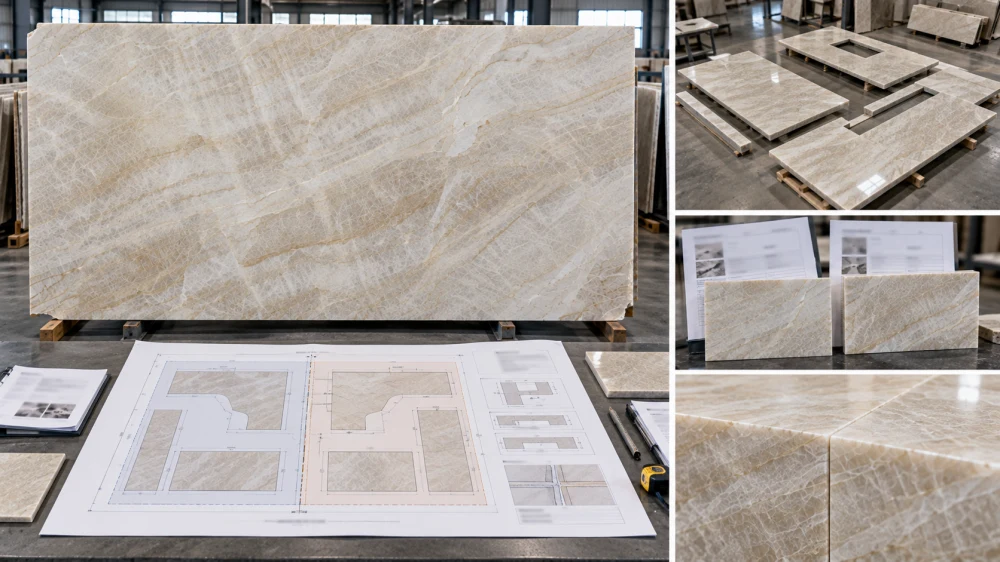
A Natural Quartzite project is divided between two fabricators.
Fabricator A produces the island. Fabricator B produces the perimeter countertops.
Or one factory fabricates the stone before export while another fabricator completes several pieces locally.
Each party may understand its own scope perfectly.
But what happens where those scopes meet?
That shared condition is the interface.
A split-fabrication project becomes risky when both fabricators assume the other party is controlling it—or when each uses a technically valid but different drawing, dimension, seam detail, edge interpretation, finish reference, or revision.
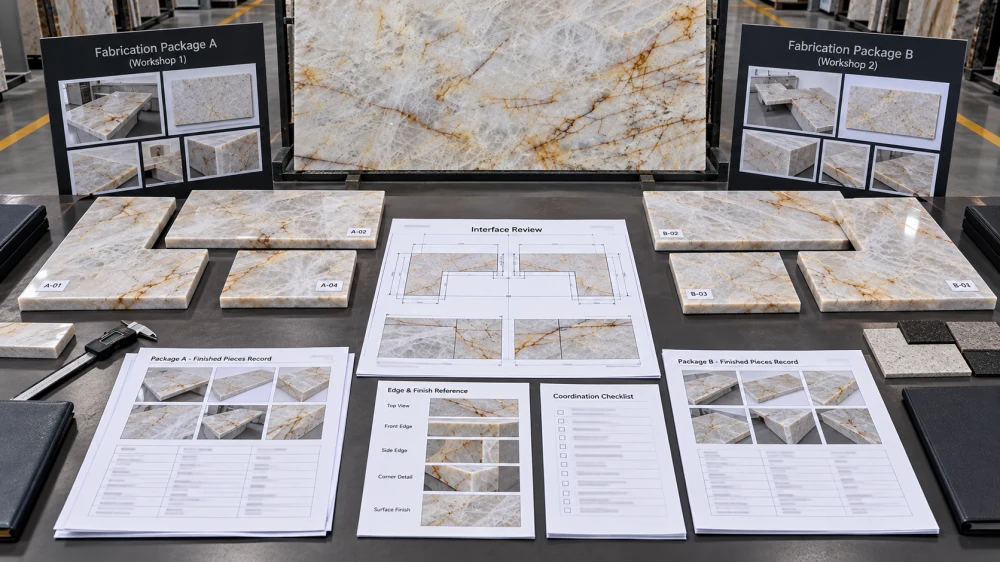
Two Fabrication Scopes Need One Interface Record
Start by separating three concepts:
Fabricator A Scope
Pieces, fabrication operations, QC and deliverables specifically assigned to Fabricator A.
Fabricator B Scope
Pieces, fabrication operations, QC and deliverables specifically assigned to Fabricator B.
Shared Interface
Any condition where the geometry, appearance or installation result of one scope depends on the other.
The interface should not disappear simply because the purchase order has been divided.
a seam between pieces made by different fabricators;
a countertop meeting a separately fabricated waterfall;
a backsplash meeting a countertop;
a return panel meeting a main face;
two adjacent wall-panel packages;
a sink or cooktop condition affecting pieces in both scopes;
a common edge line;
a shared finished height;
continuation of vein or mineral direction;
matching finish or sheen;
adjacent piece thicknesses;
a common support or cabinet condition;
piece sequencing; or
a site dimension used by both fabrication packages.
The project should identify these interfaces before fabrication begins rather than discovering them during installation.
The Interface Owner Is Not Necessarily the Fabricator
The title asks: Who owns the interface?
There is no universal answer such as “Fabricator A always owns it.”
Depending on the project structure, the coordination owner might be the buyer, general contractor, designer, stone contractor, project manager, one designated fabricator, or another authorized party.
Interface Rule
The important control is not the job title of the owner. It is that the project record names one party responsible for coordinating the shared condition and identifies who has authority to approve the final interface information.
This should be established by the actual project agreement and responsibility structure rather than inferred from a generic industry rule.
Build an Interface Control Sheet
Instead of sending both fabricators dozens of unrelated messages, create one interface record for the conditions that connect their scopes.
Same governing revision / coordinated interface detail
One Governing Dimension Must Control Each Shared Condition
One of the easiest ways to create a mismatch is to let both fabricators independently calculate the same interface dimension.
For every shared condition, record:
the governing dimension;
its source;
Zeichnungsüberarbeitung;
measurement date where relevant;
reference datum;
any project-approved allowance; and
the party authorized to resolve a conflict.
If Fabricator A works from an architectural drawing while Fabricator B works from a later site measurement, both can fabricate exactly what they received and still produce pieces that do not meet correctly.
The problem is then not necessarily fabrication accuracy. It is interface control.
Do Not Let Two Drawing Revisions Meet at One Seam
Each fabricator may have its own fabrication package, but the shared interface should point to one current coordinated basis.
If a drawing changes, identify whether the revision affects:
only Fabricator A;
only Fabricator B;
the shared interface; or
both fabrication packages.
Do not assume a revision issued to one fabricator automatically reaches the other.
This is especially important after a change order. A revised drawing can reopen dimensions, seams, cutouts, piece allocation, fabrication details and packing records even when the selected Quartzite itself has not changed.
Keep the Natural Quartzite Material Record Common
Natural Quartzite is slab-specific.
If both fabricators are producing visually related components, they should not rely only on a common trade name.
The shared material record may include:
cristallo-quartzite-cross-fabricator-interface-qc
commercial material name;
approved slab or board numbers;
current full-slab photographs;
bundle or lot reference where relevant;
Oberfläche;
approved visual comments;
orientation requirements;
piece allocation; and
substitution approval status.
For slab-sensitive projects, the material allocation should connect actual boards to finished components rather than allowing each fabricator to interpret the material reference independently.
Use One Piece-ID Language Across Both Fabricators
Fabricator A may prefer one numbering system and Fabricator B another.
Internally, that may be manageable.
At project level, however, every finished component should have an unambiguous reference.
Project Traceability Chain
Source Slab → Cutting Plan → Project Piece ID → Fabricator → QC Record → Crate / Delivery → Installation Location
The site’s Quartzite cutting-plan guide explains why slab numbers and finished-piece IDs should remain linked through fabrication, QC, packing and installation rather than disappearing once the slab is cut.
Control Seams as Shared Geometry
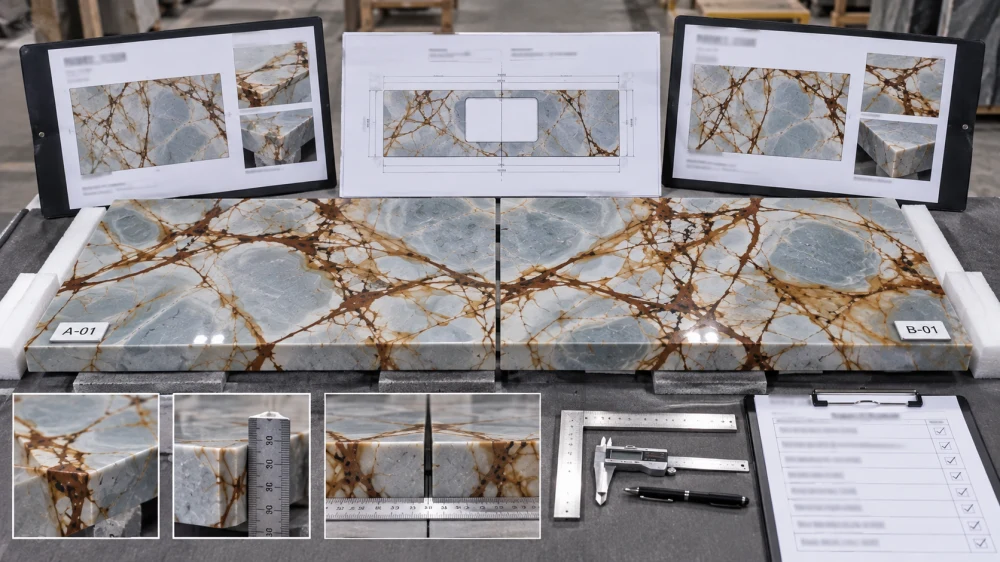
A seam between two fabrication scopes should not be represented as two unrelated finished edges.
Review the complete condition.
Depending on the project, the interface record may need to identify:
Do not promise an invisible seam. Natural stone appearance, fabrication, installation conditions and the approved project detail all affect the final result.
Finish Matching Needs a Common Reference
“Honed” written on both purchase orders does not automatically prove that two independently fabricated packages will present identically.
Where adjacent surfaces are visually sensitive, the project can use a common approved reference such as:
an identified sample;
an agreed surface reference;
current project photographs;
documented finish terminology; or
another project-specific approval basis.
The goal is not to claim perfect visual identity between independently processed natural-stone pieces. It is to make sure both fabrication scopes are working toward the same approved expectation.
Cutouts Can Become Cross-Fabricator Interfaces
A sink, cooktop, faucet, power module or other opening may appear to belong to one fabricator’s piece while still affecting another scope.
Zum Beispiel:
a sink position controls the remaining stone width near a seam;
a cooktop changes the support condition shared by adjacent pieces;
a faucet hole conflicts with a backsplash fabricated elsewhere;
an appliance dimension changes both countertop and return geometry; or
a replacement fixture changes an already coordinated interface.
When owner-supplied fixtures are involved, the project should use the current manufacturer information, approved template or other accepted fabrication basis rather than allowing two fabricators to work from different fixture assumptions.
Use a Cross-Fabricator Interface QC
Ordinary QC asks:
“Did each fabricator make its own pieces correctly?”
Interface QC asks another question:
“Do the two independently fabricated scopes still agree where they must meet?”
Interface QC Review
01 — Confirm both piece IDs
02 — Confirm governing drawing revision
03 — Compare interface dimensions
04 — Review edge / seam preparation
05 — Check thickness and finish basis
06 — Review orientation where visually relevant
07 — Record unresolved differences
08 — Obtain release from the named interface approver
Where both fabrication scopes are in different workshops or countries, this review may depend heavily on controlled drawings, measurements, identified photographs, videos, samples and written records.
What If the Two Fabricators Cannot Physically Dry-Fit the Pieces?
This is common in international projects.
If the pieces cannot be brought together before shipment, the project should increase documentary control rather than pretending a physical trial assembly occurred.
□ Slab / material references aligned where required
□ Piece IDs coordinated
□ Seam and edge conditions reviewed
□ Finish basis reviewed
□ Cutouts affecting the interface reviewed
□ Cross-fabricator QC evidence reviewed
□ Packing / receiving references preserved
□ Open interface issues closed or explicitly held
FAQ
1. Who is responsible when a Quartzite order is split between two fabricators?
There is no universal assignment based only on the fact that two fabricators are involved. The project agreement should define each fabrication scope and identify who coordinates and approves shared interfaces. The important control is to avoid leaving a seam, dimension, edge, finish, cutout, or adjacent component without a named decision route.
2. What is an interface in a split Quartzite fabrication order?
An interface is any condition where one fabricator’s work depends on or must meet another fabricator’s work. Examples include seams, returns, common dimensions, adjacent edges, finish transitions, waterfalls, backsplashes, cutouts, piece sequencing, and shared installation datums.
3. Should both Quartzite fabricators use the same drawings?
They may have separate fabrication packages, but any shared interface should be based on coordinated current information. Record the governing revision for the interface and make sure a change affecting one scope is issued to the other scope when necessary.
4. How should pieces from two fabricators be numbered?
Each finished component should have a stable project-level piece ID that can be linked to the source slab where relevant, fabrication drawing, responsible fabricator, QC record, crate or delivery, and installation location. Internal factory numbering can remain separate if the project reference stays unambiguous.
5. How can two fabricators coordinate a Quartzite seam if they are in different countries?
Use a controlled interface record containing the adjacent piece IDs, governing dimensions, drawing revision, seam location, edge preparation, thickness relationship, finish basis, orientation where relevant, and identified QC evidence. Remote coordination cannot guarantee site fit, but it can expose conflicting information before shipment.
6. What happens if one fabricator receives a revised drawing?
Check whether the revision affects only that fabricator’s scope or also a shared interface. If the interface changes, update the affected record and issue the current information to every party whose fabrication or installation depends on it.
7. Should packing records identify which pieces meet each other?
For complex or international split-fabrication projects, preserving piece IDs, crate allocation, project zones, and adjacent interface references can make receiving and installation coordination clearer, especially when the two scopes arrive separately.
Final Interface RuleTwo fabricators can each fabricate their own Quartzite scope correctly and still produce a failed handoff if nobody controls the relationship between them. Keep the chain explicit: Scope A + Scope B → Shared Interface → Governing Revision → Governing Dimensions → Interface QC → Named Approval → Handover.
For project-based Natural Quartzite supply and fabrication, HRST STONE can coordinate actual slab references, CAD/shop drawings, cutting layouts, project piece IDs, fabrication QC, dry-lay review where appropriate, packing references, and export documentation for the scope assigned to HRST. Where another fabricator is involved, send Josh both scope packages and identify the exact shared interfaces so the information HRST controls can be coordinated against the current project record before fabrication or shipment.
Hi, I am the author of this article. I have been working in the field of Natural Stone for more than 15 years. If you need customized Natural Stone services, please feel free to contact me.