
Introduction: Why Curved Marble Panels Are Popular in Modern Architecture
Curved marble panels are increasingly used in luxury hotels, retail interiors, and sculptural building facades. Curved surfaces create a sense of movement and elegance that flat stone panels cannot achieve. However, natural marble slabs cannot simply be bent into shape. Due to their crystalline structure, marble slabs are brittle and will crack if forced into a curve.
To create curved marble surfaces, manufacturers rely on engineered fabrication processes that reshape or assemble flat slabs into curved geometries. These methods allow designers and architects to achieve complex forms while maintaining structural integrity.
Why Marble Cannot Be Bent
Marble has high compressive strength but relatively low tensile strength. When a slab is bent, tension forms on the outer surface of the curve. Since marble cannot tolerate significant tensile stress, cracks will occur before meaningful bending happens.
Therefore, curved stone panels are produced using fabrication strategies such as the following:
- Material removal through CNC carving
- Segmented assembly of narrow strips
- Back kerf cutting to reduce stiffness
- Composite backing systems such as aluminum honeycomb panels
Four Main Methods to Produce Curved Marble Panels
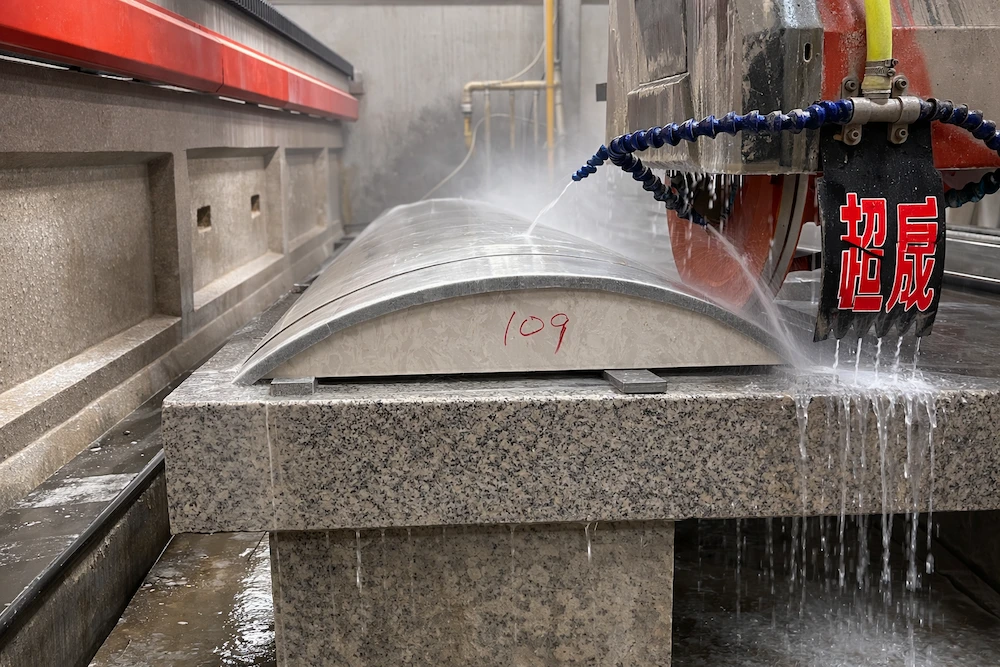
1. CNC Solid Carving
CNC machines remove material from the backside of a thick marble slab to produce a curved surface. This method allows the visible face of the marble to remain continuous and seamless.
Advantages:
- Seamless appearance
- High structural strength
- Premium visual quality
Limitations:
- High material waste
- Higher machining cost
- Typically requires slabs thicker than 20mm
2. Segmented Assembly
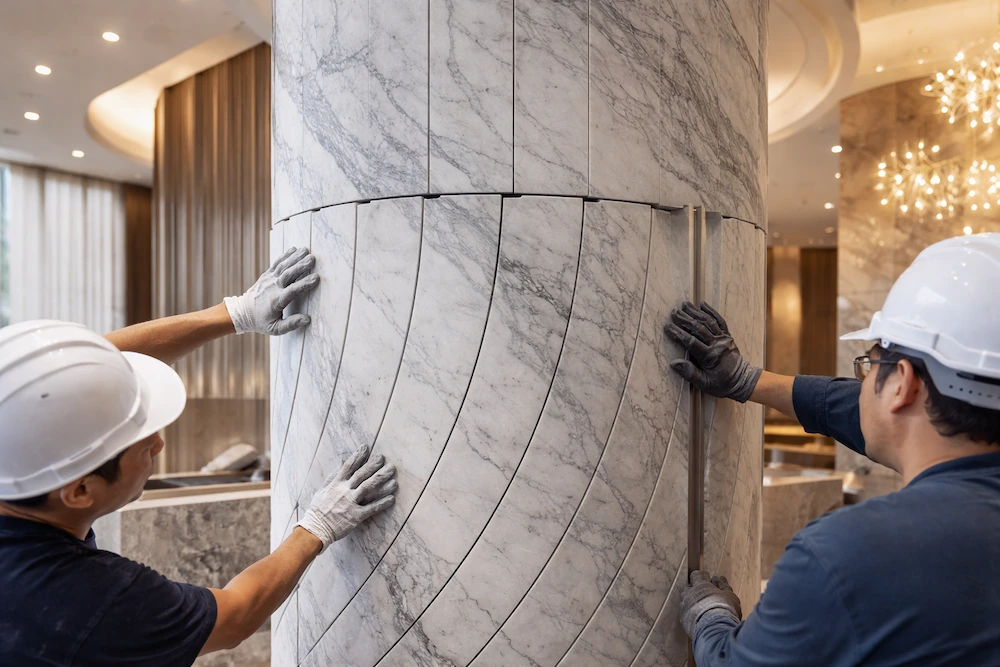
Segmented assembly divides a curved surface into multiple narrow straight pieces. Each piece is cut from flat marble slabs and installed side by side to approximate a smooth curve.
Advantages:
- Cost efficient
- Flexible radius design
- Lower material waste
This is the most widely used technique for curved marble columns and interior feature walls.
3. Back Kerf Cutting
Kerf cutting involves milling V-shaped grooves into the backside of a marble slab. These grooves reduce stiffness, allowing the slab to flex slightly when installed.
Although this method allows tighter curves, it significantly weakens the stone and must be reinforced with fiberglass mesh or backing systems.
4. Honeycomb Composite Panels
In honeycomb composite panels, thin marble sheets (3–5mm) are bonded to aluminum honeycomb panels. The composite structure is lightweight and can be shaped using molds to achieve curved geometries.
This system is commonly used in large-scale architectural facades where weight reduction is critical.

Technical Comparison Table
| Method | Kosten | Strength | Radius Flexibility | Typical Application |
|---|---|---|---|---|
| CNC Carving | High | High | Large Radius | Luxury feature walls |
| Segmented Assembly | Medium | Medium | Flexible | Columns and curved interiors |
| Back Kerf Cutting | Low | Low | Small Radius | Decorative walls |
| Honeycomb Composite | Medium | High | Large Scale | Exterior facades |
Engineering Decision Workflow
- Determine the required curvature radius.
- Select the appropriate slab thickness.
- Evaluate structural and installation requirements.
- Choose the fabrication method.
- Create mock-up samples before production.
Abschluss
Curved marble panels are not created by bending stone but through engineered fabrication processes. CNC carving, segmented assembly, kerf cutting, and honeycomb composite systems each provide solutions for different architectural needs. Selecting the right method depends on radius, thickness, structural requirements, and project budget.
FAQ
1. Can marble slabs be bent without cutting?
No. Marble is a brittle material and will crack if forced to bend.
2. What is the most common method for curved marble panels?
Segmented assembly is the most widely used technique in commercial projects.
3. Is honeycomb composite marble stronger than solid marble?
For large panels, honeycomb composite systems provide better weight-to-strength performance.
4. What is the minimum radius for curved marble panels?
The minimum radius depends on slab thickness and fabrication method.
5. Are kerf-cut marble panels safe for exterior use?
Kerf-cut panels are generally recommended only for interior decorative applications.